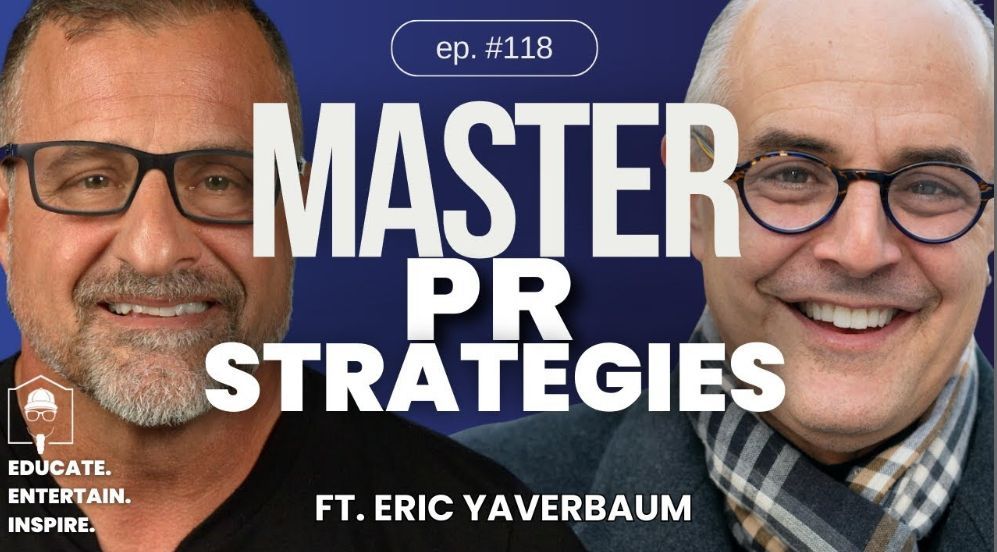
Episode Summary In this episode of On The Homefront, Jeff Dudan sits down with PR legend and seven-time author Eric Yaverbaum , whose 40-year career spans political influence, viral campaigns, and boardroom strategy. From mentoring under Henry Kissinger to creating media firestorms from his Capitol Hill living room, Eric shares stories and insights about the power of public relations, crisis management, social responsibility, and intentional living. It’s part masterclass in influence, part blueprint for legacy—and all heart. Key Takeaways PR isn’t just defensive—it’s a cash-generating weapon when used intentionally from day one. Positive media exposure must tie to business results or it becomes the first thing cut. Viral campaigns don’t require massive teams —Eric created industry-shaking campaigns from his living room. Modern misinformation moves at warp speed ; if you don’t prepare before a crisis, it’s already too late. The most powerful stories are rooted in authenticity and hope , not perfection or polished branding. Intentionality and presence are the ultimate differentiators —in business, in branding, and in life. Featured Quote “Don’t miss a moment. You don’t get them back.” – Eric Yaverbaum TRANSCRIPT Eric Yaverbaum (00:00.206) Let's see what I got. Jeff Dudan (00:01.259) Yeah, but you know, we don't we don't we don't have to do all that but well, hey, it's again really nice to meet you really appreciate you being on incredible career. I've got a few places that I'm really interested to go. Is there anything that you'd like to cover today in particular? Eric Yaverbaum (00:18.478) I'd go wherever you want to go. I'll tell you a lot of good stories. I got a lot of good stories. Jeff Dudan (00:21.579) Okay, okay. Jeff Dudan (00:28.331) listening to him the last couple of days. Hey Jen, do we have that intro that Jack was wanting me to read? Yeah, no problem. Yes, sir. Eric Yaverbaum (00:34.382) Can you give me one minute before we start? Okay, I'll be back in one minute. Jeff Dudan (00:53.963) Don't worry about it. We'll just go it. Just go into it. Jeff Dudan (01:00.587) probably it. You think this is it? I can't remember. Yeah. Yeah. And then you just changed the name. Yeah. Jeff Dudan (01:16.459) Yeah, man. Eric Yaverbaum (01:47.95) Okay, so what I'm told is I have exactly an hour. Jeff Dudan (01:52.779) Okay, all right. I'll try to get you out of five till how about that? Use the bathroom shotgun beer do whatever you're gonna do All right, I'm gonna read a quick intro here and then we'll get going and when All right, we'll just go Welcome everyone to on the home front with Jeff Duden Thanks for tuning in just a quick reminder before we get rolling if you enjoy the podcast take a second drop down to that Eric Yaverbaum (01:57.102) That'd be cool. Eric Yaverbaum (02:01.61) I'm going to go ahead and close the video. Eric Yaverbaum (02:07.47) Great. Jeff Dudan (02:21.771) comment or review section and leave us some feedback. And whether you're listening on Apple Podcasts, YouTube or Spotify, we want to hear from you and please like and subscribe. Today on the home front, we have a very special guest. We are here with Eric Javerbaum. Welcome Eric. Eric Yaverbaum (02:39.022) Thank you so much for having me. I'm a big fan. Jeff Dudan (02:41.803) Eric is, for those of you who don't know, seven times author over a million books sold in his secrets of successful CEOs. Also wrote a book with his daughter most recently, but has had a long career in PR, CNN, all of the major networks, and really has... really excited to hear some stories about some of the great PR wins and losses that you've been a part of over this time. But Eric, to get started, can you share a little bit about who you are and maybe a little bit about where you're from? How Eric Yaverbaum Learned PR from Henry Kissinger Eric Yaverbaum (03:26.03) Well, yeah, I'll tell you a funny story and then I'll tell you about who I am. As we were chatting before, we went on air here. When I was a kid, my first mentor, and I'm a big, big believer in mentors, everybody should, in your careers, get mentors, get people that you can learn from. My very first mentor was Henry Kissinger. And Kissinger told me that when he used to go before the White House press corps, he would walk out, and this is during Watergate, you got, Jeff Dudan (03:29.867) Alright. Jeff Dudan (03:46.667) Okay. Eric Yaverbaum (03:54.894) Press is going after a sitting president. This is in the early 70s. I mean, it's unheard of. The press did not go after a sitting president. Kissinger would go out before the White House press corps and say, does anybody have any questions for the answers I'm already giving? So when you asked, is there anything we want to talk about, the questions don't matter. I'm giving the same answers anyway. It won't make a difference. But I've literally taught that to Fortune 500 CEOs for 40 years now. how to conduct themselves in interviews so that they can get out messages that they want to get out and you know i'm i'm not so proud of the fact that i think that's what modern -day politics is we never seem to get answers to the questions that were actually asking but that is the subtle art of public relations is how do you use a tool of getting media exposure to move a needle? to make you money, to enhance your brand, to help your reputation. And for 40 plus years, and you mentioned some of the shows, I've been on national television for my whole career. I'm written about newspapers and magazines. I practice what I preach. As far as my career goes, when I was a kid, I ran a traditional PR agency for about 20 years. Sold it to Wall Street. thought, my gosh, all my dreams have come true. I have a lot of money. I just sold my company to Wall Street. I would say it was the most miserable year and a half of my life. A big, big life lesson there. Be careful what you wish for. It's not about money. It's not what it's about. You gotta love what you do. You love what you do. You'll never work a day in your life. First 20 years, I worked my backside off to sell my place, or I would say in retrospect, sell my soul. to Wall Street. I stayed there for about 15 months. I walked in the middle of a three -year earn -out. I just couldn't do it. And I worked on the transition team between the Bush and the Obama administration, which was supposed to be brief. And I ended up staying around the first year of Obama's presidency in the White House while I was starting the agency that I run now. The agency that I run now is very, very different than a traditional PR agency. I grew up in Eric Yaverbaum (06:15.79) both inside my industry and outside. My books didn't hurt. You mentioned Leadership Secrets. That book is now actually sold three million copies if you include digital. And I got a reputation inside the C -suite, which, when I was a kid, all I ever wanted to do was be in a boardroom. All I ever wanted to do was let me sit in the room with the CEO who makes the decisions. But I was just, I was a PR guy. We all get our hair gel in New York in the same place. We all talk a really good game. How do you do that? How do you get in the room with the chairman? And that was always my objective to get in the room with the decision maker. And that's what I do now. I do it for startups, which I take great pride in, startups that turn into billion dollar businesses. I do it in philanthropy. I do it in sports. I'm in the room with the decision makers. And... You know, I did that on purpose. That's the thing about, you know, having goals and objectives and an actual plan to do it is I'm in the room with the decision maker because I feel like I can convince decision makers if I am in the same room with them. Intentionality is a superpower. And if you have a goal and you can accomplish that goal on purpose, you'd be amazed at what can happen. So, you know, in my career, I've run agencies now for 40 years. This is the one that I run now is my second. I've had this one for 17 years. And, you know, during the entire course of my career, I am working on my eighth book right now. And, you know, I did a brief stint at the White House. So I've done a few things. Jeff Dudan (07:59.947) You talk about being in the boardroom. PR is oftentimes not in the initial cocktail for entrepreneurs. They're getting their business started. They're thinking about direct response marketing. PR is defensive in a crisis, but are you saying that it needs to be offensive? And from day one. Why Public Relations Should Be Offensive, Not Just Crisis Control Eric Yaverbaum (08:21.55) yeah, don't miss the offensive part. You know, it's ironic because when I started my career, we were involved with a lot of infomercial companies. And these infomercial companies, direct response companies, we were doing their PR. And I would watch the art of direct response. They go on television, they buy, you know, they make ads, they buy time, they literally measure how many widgets do they sell from their ad. what time works better, which is the 60 or 90 second spot work better, is long form, an hour or a half hour, is that better? You can literally measure it. And I always thought to myself, we don't do that in PR. There's no measurement. My clients want me to get impressed. They want to be in newspapers and magazines. They want to be on television and radio shows, but we don't measure. To me, the art of PR is all about, cash registers. And one of the things that I found out when I was a kid was, you know, my first 20 years, I represented all the big, bad brands, you know, we represented Sony, we represented Progressive Insurance, Akiya Home Furnishings, H I mean, I can go on and on. With all of those, and by the way, loved them all, learned from all of them. What I learned was companies, And by the way, this includes startups, because I was involved with a lot of startups at the time too, including like one in particular that got bought by Google. They weren't like insignificant. That agencies like mine got hired and were expected to get press. That's the bare minimum. That's what we're paid to do. In reality, if a company is not fiscally healthy, first thing they cut is PR. So first thing that gets cut. Jeff Dudan (10:13.003) That's right. Eric Yaverbaum (10:15.342) So I became very interested in, and one of the reasons I wanted to be in the chairman's office, one of the reasons I wanted to sit on boards is I became very interested in what's the relationship between positive media exposure and the cash register? And how do I build a bridge from media exposure over the cash register? Because I do know that if I get my clients a lot of press and They monetize that press, they'll keep me forever. And I would say my average client is around for about 15 years, give or take. I mean, I have clients on my raw. I have two clients, they've been with me for 40 years. They don't, I mean, obviously, I mean, I feel like family with them now, but they keep, at least in the beginning, because I know how to make people money from the art of public relations. When I was a kid, What I was known for was crisis, as you mentioned. I got paid really well to handle crises and put out fires. And I put out a lot of fires that you never read about because I did my job. But I don't do that anymore. I'm not interested into putting out fires. I'm entrepreneurial. I always have been. It's what I discovered when I sold my soul to Wall Street is what... Jeff Dudan (11:20.107) Haha. Eric Yaverbaum (11:36.046) I like rubbing two sticks together and making forest fires. And I like using the art that I practice, the discipline of PR, to rub those two sticks together and make businesses billion dollar companies, which I have a long storied history of. And so yes, PR should be, and by the way, PR, of all the things that you're gonna do in marketing is the least expensive. I mean, not if you need to hire agencies like mine, but you can actually do it yourself. And if you can get press exposure that generates interest, that translates over to a cash register, it's magical what it could do. And I've pontificated this very theory for over 40 years. And when I was a kid in the 80s, I would tell this to everybody and everybody would say, you know, big shot, what do you ever do? And nothing. Who do you know? Nobody. I still don't believe you need to know anybody to get on their shows. So my partner and I, in my first agency, when we were small, we were working out of our living room. That's how we started. We said, what can we do to demonstrate? Statement is one thing, demonstration is a whole other thing. What can we do to demonstrate literally our philosophies? How do we use media exposure to generate interest in our little agency that's five people working out of the living room in my... my house, my brownstone on Capitol Hill in DC, how do we generate interest in what we do? How do we use media exposure to do that? So we looked at the landscape of the world, which is ever so interesting, not always in a positive way. And we said, what story can we predict with a reasonable degree of certainty, you're gonna have a long shelf life. And what story could we look at and say, The 1985 Baseball Strike: How Eric Went Viral From His Living Room We kind of know how it's going to be, the coverage is going to play itself out. In 1985, there was a pending Major League Baseball strike. And in the good old days, the way labor disputes got covered in professional sports was rich players, wealthier owners, and the fans. So the story is what the players want, what the owners want, and then they find some guy in the street who is going to complain about, legitimately so. Eric Yaverbaum (14:02.318) why I can't take my family to a baseball game. I can't buy, if I'm going to get a hot dog and a soda and, you know, French fries for my whole family and buy, you know, four tickets, like that's almost out of my price range. And I got to hear about players who are wealthy and owners who are wealthier argue about money. I'm just trying to go to a game a year and get hot dogs from my kids. It's the same. It was, it was always the same. So in 85, Jeff Dudan (14:22.475) Right. Eric Yaverbaum (14:31.662) We formed a National Citizens Action Group to protest the pending Major League Baseball strike. And the premise of the organization was, you know, everybody had, you know, labor unions, everybody has the, do what you want. Everybody's got their right. But we were forming a National Citizens Action Group for the fans, so that the fans would have a voice. And our message was, it's okay, you want to strike? Go ahead. For every game you strike, we're gonna strike. And we asked people to send us a letter that that's it. That's all the fans had to do, just send us a letter. And we got tens of thousands of letters. We used to dump them on Peter Yubarov's doorstep. He was the commissioner at the time, daily. And CNN would come into my living room on Capitol Hill just to see how many bags of mail we got every day. And when the strike started, we called Yubarov's office and they were like, cute kids. Nobody was taking our call. When we started dropping off bags of mail on their doorstep, the people who were honoring, kind of honor our boycott, they started to take us a little bit more seriously. When that strike started in 85, they invited my partner and I into the negotiations. We sat, I'm 24 years old, I'm sitting in Major League Baseball's negotiations to end a labor dispute. Way over my head. All I know is, Jeff Dudan (15:57.643) That is absolutely fantastic. Eric Yaverbaum (16:00.014) I don't want to, after day one of those negotiations, we go out to a river of press who wants to hear what's the fan's opinion, the fans that were in the room. What's your opinion of what was discussed? There's another room, it's the players room. Yes, yes, yes. Jeff Dudan (16:14.507) Okay, you were the proxy for the fans, basically. Okay, you were representing the broader fan base. Got it. Eric Yaverbaum (16:23.854) Yes. So, I mean, the coverage that we got was extraordinary. And, you know, in the good old days, and, you know, some of these names your viewers may or may not know, but, you know, I was on, I mean, I was on everything. Ted Koppel asked me the same question that Larry King asked me. It's the same way that Time Magazine covered what we did. Everybody said, why? Why are you doing this? And my answer was, This is what I do for a living. I get my clients on television, radio, talk shows. I get my clients in newspapers and magazines. I'm just using the same avenues as I would to promote any of my clients to promote this cause that I feel so strongly about. When the strike started, I had three clients. When the strike ended, I had 11 from all the exposure that we generated. That was exposure where I got to do something good. It drove people over to my cash register, which was a service business, and I was on the map. as a 24 year old, I was able to use the art of public relations and press exposure to make my business better. And that's to me is what PR should be all about. Not always defending yourself, not always correcting yourself, not always dealing with the press when you don't wanna be in the spotlight because you said something wrong, which is the way I think most people look at PR. If you're a startup, if you're an entrepreneur, if you're looking to raise money, Jeff Dudan (17:38.059) Right. Eric Yaverbaum (17:52.59) If you're a small business, it's the great equalizer. The kind of press that I got with five people working out of my living room on Capitol Hill in DC rivaled what any Fortune 500 was getting in any given day. Why? Why is that? Why could I get that kind of exposure, which is the same kind of exposure that my clients ended up paying for me to get for them? Because you can't. and you can use that exposure to build your business. Jeff Dudan (18:26.283) Have your fundamentals changed with the rise of social media and the ability to more quickly understand the reach and the impact of the campaigns that you launch? PR’s Evolution: Social Media, Speed, and the New Rules of Crisis Eric Yaverbaum (18:41.134) As my kids would say, hell yeah. Yeah, I mean, you know, when I started in this business, you know, I'm a kid and, you know, Cronkite was just going off the air at the time. And, you know, at the end of CBS Evening News, when he ended the news, he would say, and that's the way it is, and it was. And it was godsend. That's not the case anymore. And, you know, if... Just to give like a crisis example if we had a crisis in you know in the 80s Well, I'll give you one night I did I do from multinational without you know naming names or talking about the crisis But I get a phone call on Friday. boy You're not gonna believe what happened over here in this part of the world today by Monday. It's gonna hit the US Today I have a second and I don't have a weekend to prepare at one second which Jeff Dudan (19:37.003) That's right. Eric Yaverbaum (19:37.358) really means, which I learned from Elizabeth Dole, who said to me, the worst time to prepare is while the tide is rising. If you don't have a crisis plan in place right now, you're all ready. You can lose your entire business in an internet second. Warp speed, that's how fast information travels. And that's how fast misinformation travels. And that entire landscape is different. And here's the thing about that is that everybody who, you know, I call it information dissemination now, it's still, I mean, I'm still called a PR guy. We're still a PR agency. It's surround sound information dissemination. How do you get your news? How do you make your decisions? And, you know, your unique algorithm is telling you what you already want to hear anyway on any social medium. So don't be expecting to hear two sides of the story. You literally, you know, when you come to a fork in the road, as Yogi Bear once famously remarked, when you come to a fork in the road, take it. Digitally, when you come to a fork in the road, you're being pulled in the direction you're already inclined to go anyway. It's that easy to keep going down that road without evaluating facts in the way that you might have, you know, 10 years ago. You don't do that anymore. So, you know, your Facebook algorithm, your Google algorithm, it's pulling you in the direction you're predisposed to going, and we're all doing that, which rears its ugly head in politics, just as one example. I mean, there's no middle anymore. There's no... Intellectual friction used to be a great thing. You get two smart people in a room who don't agree. Intellectual friction gets you a better decision. There's none of that anymore. Everybody goes one of two ways. And I'm just talking about politics. Jeff Dudan (21:31.979) Yeah, the same situation, the same facts, a political issue, and you're gonna get pulled into your echo chamber deeper because they're gonna spin it in the way. Sometimes I like to watch, when I'm traveling, I like to watch the BBC network to see what their view is of the things that are happening in the United States or even Australian news. By the way, Australia is absolutely fascinated with the news cycle in American politics. Navigating Political Echo Chambers and Misinformation Eric Yaverbaum (22:01.006) Yep. Jeff Dudan (22:01.067) because you know we catch a cold and you know we get sick the whole world catches a cold and they know us in some cases more about our politics than our citizens do here but it's it's are you still active in politics or do you work in that arena anymore okay i was gonna say well because there's plenty to do there but it's Eric Yaverbaum (22:17.518) I couldn't run far enough away from politics. If I tried, I mean, I was a, after I left the White House, I was a political pundit for almost a decade. I was the only person, at least that I know of, I've yet to hear anybody say, no, you weren't, there was this other person. I was, I did three hours a week for Fox and I did two hours a week for MSNBC. I did both, I mean, talk about two polarizing networks. I did them both. Jeff Dudan (22:46.123) Right. Eric Yaverbaum (22:47.502) in the same week, every week, for almost a decade, spun through two presidential election cycles. Me personally was not beloved at Fox, semi -worshipped at MSNBC, only because, again, telling people what they want to hear. What I found interesting for myself about both networks was, It was always a debate with me. It didn't matter which network I was on. Again, I'm dating myself a little bit because that's not the case anymore. So I could go onto a network where I wasn't popular with the viewers, which was very clear if I walked out the front door. But I had the opportunity to have those debates on air. And one of the things I found fascinating about, and this is all about information, I debated the health care bill ad nauseam for, I don't know, a year and a half. And I was debating it on national television for months and months and months and months. And I said to myself, I never actually even read that bill. I wonder, everybody that I'm debating with, because we're all going about the virtues of it or how terrible it is, but none of us read it because nobody ever reads bills. So I decided to read it. And I used to take this big, it was 1 ,100 pages. I used to take it on air with me on both networks. And it was all marked up almost like a textbook was. I'm thinking of my little sticky notes sticking out the side so I could flip to a page and say, well, this isn't what it says on page 921. That's what we do here. We debate misinformation. And we were doing that then too. I mean, I started an organization back in that period of time called ReadTheBill .org, where I tried to get Congress people and senators to read the bill, commit to reading the actual bill that they were voting on. And, you know, again, hundreds of thousands of, and people, because we're all voting based on these, you know, what our perception is of that. Hundreds of thousands of voters signed the pledge. Zero Congress people or senators did, because they don't read the bill. Jeff Dudan (25:05.035) Well, they don't have time. You can't possibly read 1 ,100 pages and... Eric Yaverbaum (25:09.038) Well, you can't read it when you're getting it at two o 'clock in the morning, the morning before a vote. And that's the way that we're set up. Something's wrong with that. Jeff Dudan (25:12.811) Yeah, right. 100%. 100%. You know, I've heard people say there's no such thing as bad PR. Obviously, when you look at some of the massive mistakes that people have made that maybe have cost them billion dollars lately around shoes and things like that. But oftentimes you see people get in the news over something negative and then a year later, they've got their own talk show. You know, how... Eric Yaverbaum (25:40.494) Yeah, well, you know, I mean, if getting your own talk show is your goal, I mean, personally, you know. Jeff Dudan (25:44.811) Well, true. Yeah, that's that's punishment in and of itself. But, you know, it's it's you know, at some point, you know, once you have reach and people know who you are. And I mean, we're just creatures of habit. I mean, we're interested to see what's going on with Britney Spears right now. I mean, there's you know, Britney Spears has been one PR matter after another for the last 15 or 20 years. But yet, you know, people continue to follow and, you know, like what she's doing and all that kind of stuff. What kind of opportunities are there for companies to take some chances to, you know, push the envelope a little bit, but yet not put, you know, who they are and their customer base at risk? Eric Yaverbaum (26:35.63) Well, that's really, that's up to each individual company and each individual person. I mean, I would say I'm kind of out there on my opinions. My opinion is they are what I think. I'd rather just say what I think than say what I'm supposed to say. I mean, I can, I can be politically correct all day long, but that's not me. it, it, my agency, we are who we are. Jeff Dudan (26:49.831) Right? Yeah. Jeff Dudan (26:57.803) That's no fun. Eric Yaverbaum (27:04.142) I'm really proud of that particular factoid. And with emphasis on factoid, I don't ask anybody to be anything but what they are. I would much rather know who you are in real life than who you pretend to be in front of the camera, you know, all the time. And I think corporate America gets in trouble a lot for that because they, you know, they're trying to sell stuff. So they're going to lose half their customers. Jeff Dudan (27:16.043) Mm. Authentic Branding: Say What You Mean and Mean What You Say Eric Yaverbaum (27:31.982) on any given day based on what they say, what are your values? What do you actually stand for? And the people who don't want to buy your product because of that, to me, I say, fine, that's okay. Let people buy your products for who you are transparently and genuinely. I just think that's so much better. You're gonna get yourself in trouble. I can say right or I can say left in this interview. By the way, no matter what I say, ever, somebody's going to disagree. And in my case, sometimes a lot of people. And for people, my entire career, I've been dealing with that. I mean, if I say the wrong thing on national television, my social media gets flooded with really awful things. In the old days, I would watch what people would say about me. It didn't, but didn't make it to air. I'd see the stuff coming in, what the viewers were saying, but it didn't make the air. And, you know, and I can feel it some days. And, you know, I live in New York City. I go out at night. I can feel it. Somebody sees me on television one day. They got a definite opinion one way or the other. I can't be anything but myself. That's just who I'm going to be. And, you know, I look. I told you 10 minutes ago, I couldn't get far enough from politics if I tried. After spending most of my career involved in politics, in some way, shape or form, it's just, it's toxic. I don't want to be involved. Personally, I'd rather do stuff that makes the world a better place. Right now, at this particular stage of my career where I've never had so much fun in my life, I'm talking about life and I'm talking about my... professionally the first 50 years are the hardest after that man if you learn some stuff if you let life teach you it's a great you'll learn great stuff every day and it's not always because you know counting money is easy losing it's painful What do you learn from the challenging situations? I believe there's silver linings and every one of them you tell me what was the worst day your life? Eric Yaverbaum (29:51.534) I will tell you why it was the best. That's the day that changed you. Everything's a matter of perception in your entire life. Yours, and anybody who's listening to this, your all damn life, is in between your ears. It's how you think. Whatever you are thinking is literally how you are living. That's your life. So if I say my life's great, and believe it in my own head, guess what? Life Lessons from Getting Knocked Down (Literally and Metaphorically) Jeff Dudan (30:07.115) Yeah. Eric Yaverbaum (30:19.63) Things are great. Everything's a matter of perception. And I am in that business for a living. And people always say, I was just talking about on a show earlier today, Eric, I'll be an optimist. I learned how to be optimistic when I was a kid. I literally taught myself how to be optimistic. Learned optimism, the first book that I read that started to frame a different way of looking at things. Jeff Dudan (30:24.459) It - Eric Yaverbaum (30:46.126) And is the glass half full or is the glass half empty? Which one are you? Who cares? Just fill up the glass again. That's actually an option. Nobody throws that into the equation. It's actually possible. It doesn't make a difference if the glass is half empty or half full. You literally have the opportunity and the option any given day. Fill it up again. Start all over. Get up. It's like as a kid. Jeff Dudan (30:55.339) You Jeff Dudan (31:11.627) Yeah. Eric Yaverbaum (31:16.493) I'm a big believer in team sports. I played basketball, it's a point card. I wasn't the best player on the court. I directed the offense. I've been directing the offense my entire career. I was also a boxer, a really lousy one. I got knocked down a lot. I didn't do a lot of knocking down. But one of the things I always did when I got knocked down, I got back up. Everybody would say, yeah, stay down. It's like, eh, I don't think so. I'm gonna keep trying. But all metaphors for life, for your career. personally, professionally, all of, we all get the same 86 ,400 seconds a day. You got them, I got them. Same ones. Equal. What do you want to do with them? I'm going to just take them. That's what I'm going to do. I'm going to get every one of them. That's all because I can. I got that choice. So do you. So does everybody listening. What do you want to do with them? Because, you know, we're all going to the same place in the end anyway. All of us. Same again. And the thing about it is, you know what you want to do today? You want to have lunch or you want to have dinner. You want to like sleep in a bed tonight. You want to have, depending on what climate you're in, you want to have an air, you know, air conditioning or heat. We all want the same stuff. I'm hungry at dinnertime. I want to eat. You hungry at dinnertime? You want to eat. There's not that, I mean, you know, money pollutes to me. Jeff Dudan (32:44.075) It does. Eric Yaverbaum (32:44.142) I mean, it's definitely, I've had a great career. I'm not gonna apologize for being successful, after I never have. And I made this all on my own. I did this all on purpose. And yes, I can pay my bills, so I don't have to worry about that part. But the stuff that's priceless, go ahead and fall in love. Or if you want, if you're really wealthy, just buy that, because you can't. get sick and you'll realize what matters. The day that you get sick, everything changes in your life. All you want is good health. The day you lose somebody, all you want is them back. Everything that matters is not for sale. Jeff Dudan (33:32.107) Yeah, I a little trick that I've recently adopted when I find myself not wanting to do something or you know something that I just you know not interested in doing or is upsetting me. I just changed the meaning of it. I was in New York this weekend. My daughter lives on in the Upper East Side and she's teaching. She used to go to school at NYU and she's teaching yoga and I did yoga once before and I. almost had a stroke. Like it was tough for me. I'm not a yoga guy, but you know, she wanted, she wanted us to go. There was nobody else signed up for her class and you know, and I'm just, I just said, you know what? I want to do this because she wants to show me how she does this particular aspect of her life. And, and dude, I wouldn't have the best class with the best attitude. And it was so simple to do. Eric Yaverbaum (34:05.069) Yeah. Jeff Dudan (34:23.243) We just get out of our own way and again, change the view, sit in awareness for a minute. What's the universe trying to teach you? And if you, you know, take it, be open to that, because at the end of the day, like you said, man, it all comes to a screeching abrupt halt for every single one of us one day. And then you're going to look back and say, man, I wasted a lot of time being petty. Eric Yaverbaum (34:44.942) Yeah, you, that's why I said the first 50 years are the hardest. I learned all this in the first 50 years. I've been having the greatest life ever since. You know, the trappings have changed. Things are different. I learned what was priceless and what, you know, what wasn't priceless. But, you know, I also, you know, everybody, you know how many obstacles you're going to face in your life? You know how many obstacles you're going to have just today? Jeff Dudan (34:48.907) Yeah. Yeah, right. Eric Yaverbaum (35:14.382) Obstacles are actually the path. They're not obstacles. We all have them. Nobody's life is, you know, like Facebook makes it out to be. I am not happy 24 -7. But what I am 24 -7, every wake, I'm getting this moment. You know what I'm doing right now? I'm talking to you. Nothing else. I'm talking to you. It's interesting to me. We have an interesting conversation. It's engaging. I hope something that one of us said is contagious. I hope... some smile of a reaction makes somebody else smile. I hope somebody else says, gosh, that's an interesting, or learns one thing. I hope that would be really cool. I mean, what a way to live that is. I mean, I'm an exercise, on the cover of my next book, they have a fitness fanatic. You know, I exercise every single solitary day. I don't, I exercise because it makes me feel good. And I hope that other, Jeff Dudan (36:03.979) Okay. Why Hope is the Most Underrated Brand in the World Eric Yaverbaum (36:12.014) I don't, you know, I'm not obsessed with the way that I look. I am obsessed with the way that I feel. You know what endorphins, by the way, they're free too. All you gotta do is exercise. You want them? Can't buy them either. Go ahead, get some endorphins tomorrow morning. You can't buy them. You will not believe how it changes your perspective of a day. That's from just exercising, a commitment. to exercise that I hold myself accountable for and I use social media for that. And this is a big difference about social media. I use social, one particular platform, Instagram. On Instagram, I use Instagram to keep myself accountable. I'm not getting used by it. That's the big difference between so many people and social media. We're the product on social media, and we're free by the way. We should be using social media, we should not be being used by it. And everybody's life isn't a vacation, everybody's life isn't that meal that you're looking at a snapshot of. Everybody's life is not happy all the time. It sure looks that way on social media. And I worry a lot about the youth and kids who are growing up digitally, born digitally. How do they look at the world? Go outside and climb a tree. Watch a sunset just once or twice or every day if you want, you should. And be in the moment, live presently. I mean, I pontificate about all this stuff every single place that I go. And it has nothing to do with what I do for a living. I'm very happy. I was with a client the other day and I said, you know what? What we should be doing is promoting hope. That's what we should be doing. And... the client says, well, why? I said, Hope doesn't have an agency. I want to adopt Hope as my client. They don't have to pay me. I'd love to spread a little bit of that. And any brand who does that, people with positive attitudes, it's magnetic. Eric Yaverbaum (38:33.774) I don't attract an audience by being doom and gloom. I attract an audience because I'm a hopeful guy. And I really, there was Fred Rogers when he gave congressional testimony in 69. They were trying to raise money for PBS. PBS was like, they were literally shooting in the basement with a camera and they had a show and they had no money. And Fred, Mr. Rogers goes before Congress and he's trying to raise money. and nobody knows who he is. And he basically said that in times of trouble, look for the helpers. If you see the helpers, you'll know there's hope. And that particular congressional testimony ended up raising all of the money that launched PBS. I mean, Congress was just awed by what this guy had to say. It's true. And you know, we just, you know, We all recently went through a pandemic. Forget about all the other things that we go through every single solitary day. We went through a pandemic. All we need, we saw helpers. If we saw helpers, we were hopeful. If we were hopeful, we got through the pandemic. And the irony of it all is, was everything that you ever worried about, you know, all of it, anything you worried about, it already happened. So now what are you gonna worry about? Stop worrying so much. Live life. Enjoy the moment. Jeff Dudan (40:03.499) You wrote a book with your daughter and some of the other appearances that you've made. It seems like family was a priority and important to you. Absolutely, what? Eric Yaverbaum (40:12.558) Priceless again. I mean, there's not, I mean, for any parent who might be watching, there's nothing you'll ever do. I mean, it doesn't go to the, go to the rock and go to the moon. You can do, there's nothing you will do that's greater than raising children, nothing. Jeff Dudan (40:34.603) Yeah, yeah, 100%. Are there PR campaigns that you've admired over the years that maybe you wish you were a part of or somebody did a really great job on something that you could point out? Eric Yaverbaum (40:48.91) I think that PR campaigns that changed the course of history fascinate me. It's the greatest honor of my career. I mean, like the Kissinger story that I started with, I have so many stories. I feel a little Forrest Gump -esque. I'm always present for these historical directional shifts. I am so... To me, I don't care. I don't know what anybody else thinks besides my mom who thinks the same, but it's so cool to me that I've been inside of history when it's making a left turn or a right turn that I get to be participatory in. It's so cool to me that there's, I mean, forget about the books that I've written and will continue to write. I feel like I have a lot that I could teach people. The books that include me. that talk about me, that reference me. It's so cool, not that I'm in the books, it's just that my role and involvement in influencing perception and the way that people thought about things. And you know, look, when I was younger and you know, no disrespect to Domino's pizzas, and one example, they were my first national county, I sold pizza. Selling pizza didn't change the world. Walk a Mile in My Shoes, which was a campaign that I did for caregivers, got legislation, increased funding for stem cell research, passed, pissed off George Bush at the time, which I thought, wow, that's so cool. Bush is pissed at me. How cool. Meanwhile, I ended up on the transition team years later. That, to be involved in that, it doesn't matter what I get paid. That's priceless to be able to do things like that. to be able to influence the direction of a large group of people to change history just a little bit in a different direction. When I was a kid, and I didn't happenstance upon Kissinger, my uncle was very involved with Nixon, was friends with everybody in the administration. That's how I met Kissinger. When PR Changes History: Campaigns That Mattered Eric Yaverbaum (43:09.102) He smuggled weapons to Israel for the Six Day War. There's a book called The Pledge. They wrote all about him because he got caught. He got caught. He had to go before Congress. Congress ended up letting him off. But I thought, my uncle Abe, he was involved in a historical, like, how cool, how can I do that? Because I don't have the money to smuggle weapons anywhere. All I have is the gift of getting people to listen to me. People will listen when I talk. It's appealing to people to listen to a perspective. Like when we opened, we helped to open, I don't know whether you had the opportunity to go there while you were in Manhattan, but my agency was involved in something called Summit, which is in one Vanderbilt. One Vanderbilt opened. It's the building connected to Grand Central. It is the most expensive per square foot commercial real estate in Manhattan. And on the 92nd, 93rd, and 94th floor, they have an extraordinary immersive, I don't know how to describe it other than a central park in the sky. You'll never see Manhattan like you'll see it. A very famous artist named Kenzo, Kenzo Digital designed the entire space. When you talk about being present, you can't help yourself when you're inside of that space. When we were opening that, I looked at it as an inflection point for New York City that was hurting. I mean, if you lived here during the pandemic, you know, there were some strange times and nobody could wait for the, I mean, the fact there's traffic again, that there's crowds in restaurants again, that we can all go out to play, that we're not all stuck inside of our, you know, homes, you know, for, I don't know, depending on how long you were cautious for years, the world reopened. How great is that? I'm so happy to see traffic again. One Vanderbilt to me was an inflection point, a tipping point for what was going to, where was New York going? New York was hurting. New York's been hurting before. It's a resilient zip code. That's what I love so much about it. And a few other things like the Yankees and the Knicks. And the pizza. Jeff Dudan (45:26.795) And the pizza. Eric Yaverbaum (45:30.19) That's right, and the pizza. But to me, it was an inflection point in a pandemic. It was an inflection point where, I mean, it actually opened the second year of the pandemic. The building's filled to capacity. The most expensive per square foot real estate doesn't make sense. Why is that? That building was the most helpful project going on in Manhattan, opened during a pandemic. To me, was an inflection point for the next direction for New York City. And that's what they said about it. And New York City is coming back. like we always do. What an honor to have been associated with that project. Jeff Dudan (46:02.827) Yeah. Jeff Dudan (46:08.491) As you look out in the world today, are there some issues or trends that you are interested in bringing your special skills and making an impact on that would perhaps be part of your legacy? The Future of Media: AI, Creativity, and Legacy Thinking Eric Yaverbaum (46:22.286) Yeah, I'm, you know, it's, you know, I always say Google me, you'll read a lot of great stuff. I don't know anyone who's gonna do that, again, besides my mom. But it's, I wanna be wherever, you know, tomorrow is. I am an idiot, still to this day. I was an idiot when I was a kid in the room. I'm an idiot, you know, all these years later in the room. Because I'm always before the fact. I'm always before it happens. I mean, it's not any great mystery that artificial intelligence is going to be changing the world. Nobody's going to be shocked to hear that statement. The thing about artificial intelligence is, again, just like social media, which I was all, I had social media magazines before social media was. Nobody, I had a Facebook magazine, I had a LinkedIn magazine, I had a Google magazine, and a Twitter magazine. Nobody had them. Nobody thought what I thought about. I knew social media was going to change the way that we all socialized and communicated. And I flipped those magazines and under two, we had 14 million subscribers, just like that, two years. Business in two years, in and out, which is something that I've been doing my entire career. When I said we're being used by social media and we should be using it, I say the same thing about artificial intelligence and that's where we're at right now. Whether you love artificial intelligence, whether you hate artificial intelligence, whether you fear artificial intelligence, whether you embrace artificial intelligence, use it. Use it to do something good because you can. And you know, the fact that technology is developing is not a surprise. It's not new for any of us. There's nobody alive today that won't say, yes, technology is evolving. The rate at which it's evolving. It's warp speed now. The intelligence is feeding upon itself. It's getting faster and faster and faster and faster. How do you use that? Embrace it and figure out a way to use it. And you know, I'm fascinated with artificial intelligence and all of the uses that we don't even know about yet and we'll know about tomorrow. Now, no one's going to say I'm an idiot for saying that. But I definitely want to... Eric Yaverbaum (48:45.774) I want to play there. That's where I want to be right now. Jeff Dudan (48:48.843) AI really shortens the time for people to do coding and all kind of the technical process management, the stuff that people went to school for for a long time to learn how to do. And now it really plays back into the hands of the smart creatives because it's more about the question and it's more about being able to connect the dots across different technologies and different groups and different thoughts and ideas. So people that have the creative thinking and they learn to adopt these tools are really going to be able to accelerate what they do. It's how Google built their, if you read how Google works, I mean, they just hired smart creatives at every position because they really were, they wanted people to be able to see around corners, to ask questions that hadn't been answered before, hadn't been asked before. And I mean, I, the, you know, for me having to go to a programmer now, you know, it would take me three or four or five days to get something done. And now we can whip it up in an hour and get something to look at. It's, it's like a juice, man. It's like steroids for creatives. Eric Yaverbaum (49:51.309) Well, yeah, as it should be. It's fun. It's exciting. It's exhilarating. It's not to be feared. I mean, I'm a writer. I write every day. Is AI going to replace me? Is AI going to be writing my books in the future? Is AI going to be writing my articles? Because most writers, like more writers than not, that's what they're worried about. I'm the opposite. I'm like, you got to be kidding me. Like, I can do my research in five minutes. Jeff Dudan (49:54.795) Yeah. Jeff Dudan (49:59.531) Yeah. Jeff Dudan (50:06.731) now. Jeff Dudan (50:19.403) Yeah. Eric Yaverbaum (50:19.598) I don't need three people to do it and wait three weeks for it. I can do it in five minutes. It's not right in my books, but it can do research for me. Cool. I mean, everything about it, it's just, it's the wild, wild west. I wish I was around during the wild, wild west. I don't know why anybody wouldn't. That's what we're with AI. It's just like we were with social media 20 years ago. That stuff is fun. You gotta embrace it though. Jeff Dudan (50:23.019) That's right. Jeff Dudan (50:48.491) Yeah, the only problem was you only lived to 35, but you know it was Eric Yaverbaum (50:52.462) That's true, that's true. That's why I exercise every day. I'm all about the long game. I want to stick around for as long as I possibly can. Living is too much fun. Breathing is underrated. Jeff Dudan (50:59.907) Yeah. Awesome. Well, Eric, we're up against the clock here. This has been amazing. Really appreciate you coming on. It's been an honor to have you on and share with us today. Last question. If you had one sentence to make an impact in somebody's life, what would that be? Eric Yaverbaum (51:21.486) Don't miss a moment. You don't get them back. Jeff Dudan (51:23.339) yeah. Awesome. Beautifully said, Eric Javerbaum has been here with Jeff Duden, and we have been on the home front. Eric, thanks for being on. Eric Yaverbaum (51:35.63) Thank you so much for having me. It's been an honor. Thank you. You too. Jeff Dudan (51:38.027) All right, take care, sir. Yep, yep. Let's just let that upload for a second.
This is a subtitle for your new post
Brief Summary In this episode of On The Homefront, Jeff Dudan sits down with Ilana Golan , a trailblazing former Israeli Air Force commander, Silicon Valley entrepreneur, and the visionary behind Leap Academy . Together, they unpack Ilana’s extraordinary journey—from selling pens as a child and instructing F-16 pilots, to being betrayed by a co-founder and building one of America’s fastest-growing career transformation companies. Ilana shares lessons in resilience, reinvention, and how personal branding and clarity are the keys to future-proofing your career in today’s ever-changing landscape. Key Takeaways Reinvention Starts with Clarity : Most people feel stuck not because they lack ability, but because they lack direction. Ilana’s method starts with gaining clarity on values, strengths, and desires. Your Career is an Experiment : Ilana reframes career progression as a series of small experiments, not permanent decisions. This mindset reduces fear and accelerates growth. Leap Academy Was Born from a Crisis : After being kicked out of her startup by a co-founder, Ilana hit rock bottom—then promised to create a roadmap to help others navigate similar transitions. Personal Branding is Non-Negotiable : Whether you're an entrepreneur or climbing the corporate ladder, building a digital presence is essential to becoming visible, credible, and referable. The Hidden Job Market Is Real : Most executive roles are filled through networks, not job boards. Building your brand and relationships makes you top-of-mind when opportunities arise. Portfolio Careers Are the Future : Diversified income streams—consulting, board seats, advisory roles—are key to stability and freedom in the modern career landscape. Featured Quote “It’s not about what we make—it’s about what we make possible.” – Ilana Golan TRANSCRIPT From IDF Commander to Career Coach: Meet Ilana Golan Jeff Dudan (00:03.712) Welcome everybody. This is Jeff Duden and you are on the home front and I have a very special guest today. I can't tell you how old of friends we are. It's at least three hours. We have today with us Ileana Golan. Ileana broke barriers as a commander in the IDF in the Air Force. Ilana Golan (00:15.8) you Jeff Dudan (00:27.742) training F -16 fighter pilot. She's an engineer. She's an entrepreneur. She's a Silicon Valley investor, and I do believe an insider. And today is the CEO of Leap Academy, which is one of the fastest growing award winning businesses for helping people transition their careers. Ileana, how did I do? Ilana Golan (00:45.779) wow, you did fantastic. Thank you, Jeff. Jeff Dudan (00:48.32) Well, I mean, you wrote the story. I just had to read it. It is so great to have you on. I'm so excited to have you on. And we're very similar in the work that we do, which is really helping people transition from whatever their current state is, is it their current state or is it their current constraints and giving them tools and tactics and opportunities to build a better life for those people they care about. I would love to start because you have such a rich history. Ilana Golan (00:51.507) Ha Selling Pens at Age 5: Ilana’s First Taste of Entrepreneurship Jeff Dudan (01:16.93) Can you tell us a little bit about how you grew up? Ilana Golan (01:20.158) I love that, Jeff. And yes, we share so much of the same things. We just want to see people become the best version of themselves, which is so incredible. But I will take you back in time. And as a kid, guess, I think I was always I was actually a shy kid. So if I'm being really honest, I was very shy. I had huge bunny teeth, you know, like I was just like. Jeff Dudan (01:25.142) Yes. Ilana Golan (01:47.886) I was very, you know, it took me time to get out of my shell a little bit. But I did have a little bit of that entrepreneurial thing in me, I think from a very early age, at age probably about four or five. My parents weren't at home, which I still don't know why at age four or five they weren't at home. But I decided to take a bunch of their stuff and put a big box in front of the house and sell them. Jeff Dudan (02:15.298) you had a moving sail, but you weren't moving. Ilana Golan (02:17.71) Hey, we were not moving. So my parents came back. They were like, what just happened to all our pens, all our stuff? Where did it go? And I looked at them and showed them how much money I made. And it was obviously very little, but I was very proud. So there was a little bit of that, Jeff. Jeff Dudan (02:35.468) Well, you had a very low cost basis in your inventory. Ilana Golan (02:38.478) Exactly. Yeah. And there wasn't really a lot to sell because I mean, we came from, you know, I mean, we were never poor by any standards, but we grew up basic, you know, there was like one toy, one thing that you do, you go to school. So it was very basic, but I had everything I needed. Jeff Dudan (02:59.66) That's outstanding. And then you went to university in Israel. Ilana Golan (03:04.172) Yes. So before the university, I went to the military. So we do have a compulsory military in Israel. I stumbled upon one of the best roles a person can get. I think there was some luck in there for sure. And I became an F -16 flight instructor or flight instructor. And we were basically teaching because women actually had a pretty glass ceiling there in terms of not being able to be real combat pilots and commanders in my squad. We essentially had this barrier. So the only possibility for me to eventually go into is to train pilots. And that was an incredible experience, incredible school. Being able to learn how to talk to people that have twice your age, or dozens of times your experience. is a very humbling but very, you know, educating experience. Jeff Dudan (04:05.526) fundamentally the training that you must have had, and this was prior to university, must have set you up for disciplines and regiments and guidelines and approaches and ways of thinking. How did your time in the military lead you to become an engineering student? Becoming an F-16 Flight Instructor in a Male-Dominated Role Ilana Golan (04:26.212) it's such a great question. mean, first of all, it teaches you to touch things that are bigger than anything that you've done before, right? And I think that's a very humbling experience. You're literally in the military, you're thrown in the water and you hope that you're actually gonna swim. And like you said, it comes with very basic training. You're kind of slammed into it. And at that point you need to suddenly, you know, I suddenly realized that my mission in life is to train these pilots to defend my country and come home safe. And I'm doing this all through technology. So even though I, till I think age 18, I actually fell in love with being in medical school and being a doctor, that was kind of my dream. In the military, it all flipped and I fell in love with technology and what we can actually make possible with technology. And that's what kind of took me into engineering. Jeff Dudan (05:24.77) I heard a statistic that engineers are represent 40 % of the world's billionaires. I have a I have a so you're you're probably one of them. But, you know, I have a getting on the way and I have my youngest is an engineering student material science and he just loves solving problems. He loves creating processes, putting his hands on things almost. Ilana Golan (05:36.398) Getting there. Jeff Dudan (05:52.438) You know, he's built businesses when he was in high school. He had a pressure washing business called Two Bros and a Hose. And they would make a lot of money on a weekend pressure washing. But as soon as he stopped buying equipment and figuring out how the truck work and the pumps worked and all of that, he lost interest in it. Because for him, was about creating the process and the technology and the ability to do it. so you're an engineering student. Ilana Golan (06:03.586) Well. Ilana Golan (06:10.19) Hmm. Jeff Dudan (06:21.876) And did you have any inkling how entrepreneurial you were at that time? Ilana Golan (06:28.324) absolutely not. And I think entrepreneurship wasn't even a thing, at least not when I grew up. It wasn't, the word didn't exist for sure. And, you know, I don't think it was really a thing. I think we were just trying to tap into what this computer thing is. I'm dating myself here a little bit. But first of all, I think you're right. Like engineering school teaches you to take a big problem and break it down to smaller chunks that you can actually like start chewing on. And I think that's a really interesting thing because that's what you need to do in entrepreneurship or anything, even in corporate, right? You take this big vision and now the question is, and again, you can decide to get overwhelmed, which we sometimes do too, or you can actually chunk it down and say, okay, there's a bite -sized piece to this and I can start doing this. The interesting thing is because of my military, I got, again, kind of lucky because I did become the first to ever become a commander in that squad. So I did kind of break that barrier and that created a little bit of a wave in Israel. So people kind of knew me and that, you know, that helped a little bit. So when I started studying engineering, actually in the very first semester, Intel came and snatched me. So I always laugh that they probably stole me so that somebody else will not steal me, but I don't care why, but I barely knew any coding and I was already an Intel. So there was a little advantage there. But I think again, there was this pattern of taking a big vision, a big thing, and how to even get started because at the end of the day, you're talking to a machine and you need to give bite sizes to the machine. And if you can't give a bite size to the machine, it will not understand. So I think it really started this entrepreneur. It wasn't an entrepreneur, I can't even say that, but it started and I understood that my... love coding. but where I get really, really good is that combination of actually being client -facing or human -facing with that understanding of business. And that became kind of that zone of genius. And I think then my question became, where can I find more of that? Where can I do more of that? Not just the coding piece, but also understanding the whole vision of what's possible. From Engineering Student to Intel: Climbing the Tech Ladder Jeff Dudan (08:48.14) So as you were a commander, that the, and you got some recognition for that. Did you, was that the first time that you maybe were up in front of people or maybe getting awards or, you know, just really being recognized as somebody that, you know, can break down barriers, has done something that other people haven't done before. Like what kind of impact was that on your confidence as you went forward? Because you're, Your journey just is just full of bold, confident type steps, just one after another. Did you really gain that first sense of, hey, I can take on a challenge and win it from your time there? Ilana Golan (09:32.94) I think so. So I think I touched leadership probably as kind of head of school somewhere around senior year. So that was my first leadership touch. But when I got into the military, think this is where suddenly I realized, first of all, I realized that I was very determined to prove to everyone that we can do this. So even though they put women and they're guarding them so they won't go beyond enemy lines. And there were all these reasoning, but we can get really, really good at this. And that was a very determined to at least try to prove it. And so I think that when you, you know, suddenly they opened the door and I became the first commander, I think it just created this, you know what, you can actually dream big and sometimes it will actually make it happen. And I think there was something really beautiful about it. And I'm sure. It's motivated me in a whole different level in the future. I don't, I'm an only child. I see. Jeff Dudan (10:34.466) Do you have brothers or sisters? You don't? Okay. Well, there you go. Now, did Intel bring you to the United States? Ilana Golan (10:43.572) No, so that's also another funny story. I love traveling and that's been in my blood. And I traveled after the military before I got into Intel, I traveled alone, which I think was also something that usually women don't do alone. It was basically all over Thailand, India, Nepal. And I think even just traveling alone teaches you so much about unpredictable challenges and, you know, like dealing with things on your own. Suddenly you're sick. What happens? Like there's like things that you need to deal with that are not easy. So I had to deal with all these things. I think it also really boiled me, know, and prepared me for what's coming. And I think it teaches you independence. So in Intel, after about five years there, I realized that I actually want to travel the world. That's when I met my 2B husband and we decided to go hiking and biking around the world for about nine months. And actually the last area was where we're landing in the US. I originally was born in Utah. So even though I moved to Israel really early on, but I was born in Utah. So I was lucky enough to actually be able to find a job here pretty quick. was an Israeli startup and that would started my startup journey, I guess. Jeff Dudan (12:16.288) I'd like to talk a little bit about that startup because I think and I've been involved in one where it was a it was a Swedish company and they were rolling out a product in the United States and it was amazing to me to see how tone deaf they were about the US market thinking that their product as it was in Sweden was going to just be adopted in the US and it needed so much refinement and it needed the complete rebuild and it just It didn't contemplate market conditions. Does any of that resonate with your startup? Startup Wake-Up Call: When Market Fit Misses the Mark Ilana Golan (12:51.854) was laughing out loud because there was like tick the box, tick the box, tick the box. Yes. So first of all, yes, it was actually funny because on behalf of Intel, I actually acquired a Swedish company and we morphed it and became an Intel product. But when I came to the US, I think it shocked me. Again, I'll say two things. The first startup that I was in was already a kind of more established. And so I think I, and I was, think too much down the layers to really notice. The second startup was basically I was founding the company here in the U .S. And it was interesting because I met them in Israel. It sounded like. This is a moneymaker. All you need to do is come and collect the cash. So I came and the cash was not coming because it was completely not what we needed for this market. It's something that looked really good 5 ,000 miles away, but completely not relevant for this market. And it was a complete revamp. And I'll say another thing, Jeff, I think it's also very hard. to explain what we're seeing on this side of the world where they have this massive certainty that what they built is the best thing since sliced bread. But they're sitting 5 ,000 miles away dreaming about all this cash that is coming in and you're looking and they're like, I'm meeting Cisco, I'm leaning HB, I'm leaning on, they're not gonna buy this. So either we morph this damn thing or we have a problem. And that was like a really interesting realization about market fit, about Jeff Dudan (14:04.438) Right. Ilana Golan (14:24.418) how to communicate. I I learned so much from that Jeff. Jeff Dudan (14:29.186) Can you share at all what the product was or if not the product itself, what segment it was in? Ilana Golan (14:34.806) Yeah, yeah. So it was basically big automation. And the idea was basically, if you think of, I don't know, like a T -Mobile, right? It needs to make a phone call from New Jersey all the way to California, right? Like, how do you automate a million phone calls and make sure that they come on time? Or, you know, like something along these lines, like, if there's like a... a Superball, how do you make sure the ad will actually come to everybody at the same time because you don't want people to see the ads in different moments and to see the Superball in different moments. So how do you validate all these big systems? It was a fascinating product, but initially it was kind of more of a lab, it was kind of more very tight verification things that just didn't... didn't pan out, like it wasn't what people needed here. And I think there's also just different, you know, people here have certain staffing and, you know, they rather bring somebody in -house to code and not lean on a third party, the IP is not there. So there were all these assumptions of the behavior of the client, which we needed to completely change. Jeff Dudan (15:48.396) Yeah, we sure do fall in love with our own products, don't we? Ilana Golan (15:51.4) but that's a beautiful part about founders, right? Like we have to fall in love, but we also need to listen, which is an interesting balance. Jeff Dudan (15:55.767) Yeah. Jeff Dudan (15:59.042) Yeah, yeah, it starts as a love story and then it turns into, like any relationship, needs communication both ways. Ilana Golan (16:09.376) Yeah, and I think that's also taught me to communicate because I think, you know, if you come from, know better and it becomes a head -to -head conversation, it's really, really hard. When you come and basically sit on their side of the table, but and say, look, this is what I'm seeing. Here's the things you want, you we can, and you bring the proof, you explain. For them, it's an emotional thing, right? You're actually bashing their baby. Jeff Dudan (16:35.072) Right. Ilana Golan (16:35.83) You know, once you understand some of these little things about communication, I think you know how to move people's minds a lot better, which is also a big trait that I feel like I needed to learn. But it was golden. It was really golden. Yeah. Jeff Dudan (16:52.684) You had another stop or two and at some point you were focusing on investing in tech startups. Ilana Golan (16:59.872) Yeah, not yet, but if you want a little bit drama in the show, I can tell a little bit of drama. Because before, quite before that, so here's the thing, was in this company that I was in, I was already kind of climbing up the ladder, already vice president, so really kind of, I ticked a lot of boxes. Jeff Dudan (17:07.424) Yeah, I'd love to hear it. Betrayed by a Co-Founder: The Lowest Point of Ilana’s Career Ilana Golan (17:23.906) But I had no life. Like I was flying all the time. Every single week I'm in a different place. All red eyes, always, you know, saving cash. The biggest thing was how many red eyes can I do without taking a shower once? I mean, it was really disgusting. But at the end of the day, you know, at some point I was like, you know what, maybe this is not driving me anymore. Like I've been there for five years. Like I feel there's more to me. What can I do to get better? And at that point, a friend of mine, actually somebody I knew for like 20 years came to me and said, hey, Lana, let's start a company together. And I got so excited, Jeff. Like, it was just like, my God, this is going to be a dream. So we worked on this company day and night. was, you know, and at that point we also raised some capital and even that went really fast. So I have to admit because our founder story made sense that we pushed this really far. there was like kind of the Silicon Valley dream, right? $800 ,000, they were evaluating our little baby at 5 million almost. And I remember looking at this document and I'm like, my God, like, how did I get this lucky? And so at that point, I parted ways from my vice president role. You I wanted to make sure everybody understands that I'm not running away because I founded this site. So I wanted to make sure, you know, everybody's set. And I moved to this new baby, but within exactly 24 hours, my co -founder decided to take the money, throw me out of the business and I was left with nothing. So no job, no salary, no company, no investment. And I think the worst part, Jeff, is that the ego was down the drain. It was totally crashed. And it was suddenly I realized that I gave for the last 20 years, everything to the company that I was with, but I never built myself. I was inevitably, I got complete nobody outside. And I think that was a huge, really hard realization. And for somebody really driven, I think we always know what's next. Like we always know like everything is scripted in my life. Like I always knew kind of what's coming. And suddenly there was this... Ilana Golan (19:32.738) big void. Like I wasn't even sure if I'm looking for a job or looking for to start a business or I'm looking at co -founder, I'm looking for events. honestly, Jeff, at that point I was like, where am I even heading? And that was my... Yeah, pretty much. I mean, I'm to start a similar company and I'm going to show him or whatever. Like, you know, because at that point you're just like, I was at the bottom of my barrel, Jeff. I was so... Jeff Dudan (19:45.132) Did you say revenge? Right. So doing is doing. Yeah. Ilana Golan (20:00.846) It was a really hard moment. And I think the hardest thing is that I told everybody. So I felt like my ego was down the drain. what do I tell to people now? Like that I'm a nobody and I don't know where I'm going. And like it just threw me off. I knew I could always go back to that company that I was vice president, but there was a reason why I left in the first place. So the question is, what do do now? And that was a really, really hard, I mean, we can talk about it, but that was a spiraling for about a good time. Eventually, I did start a tech startup. It was acquired and that's how I became an investor. But it was not without a lot of drama. Jeff Dudan (20:39.49) Yeah, I'm interested if you go back to that point in time, a 20 year career, very successful, highly sought after, probably got calls from recruiters every single day to come and do this or to do that. You decide on an opportunity, you take that leap. It doesn't work out. And at that point, it was probably a good opportunity to do some soul searching about your beliefs and your values and your fundamentals. Is there anything that you could share that you very intentionally changed about the way that you thought? Ilana Golan (21:16.302) It's a great question because I think some of these questions took me a long time to even come with the question because I think sometimes you're so down yourself that it's you're not even coming up with the right questions in your head. So for me, if I'm being really honest, Jeff, my main question is how the hell did I become such a failure? It's amazing how fast we forget 20 years of success and we go right into How did this become my life? Like how, and it's, it impacted my sleep, it impacted how I wake up, it impacted my relationship with my husband, it impacted, I was snappy at my kids. I'm never snappy at my kids. I mean, I was just, you know, and it was amazing, Jeff, what's hardest about it as a mom, like I was finally having, I had all the time in the world to spend with them. It was the first time in forever that I wasn't flying every other week. And I wasn't present. I was grouchy. I was annoying. Like I was a fraction of who I could be. to a long story short, think first of all, I realized how hard this was. And at that point, I probably Googled every little like, how do you find your passion? Why do you find your next career direction? Like I Googled everything possible, checked every TED Talk. But it was either very motivational, like, who, who, you can do it. And I'm like, I know I can do it. I'm like so motivated, but I just don't know what and how. Or it was done by people that didn't really inspire me without hurting anybody, you know, listening. But really it just wasn't, you know, if I already looked at kind of my career trajectory, I knew there was a lot more, but I need to be inspired by somebody that has done some big things. And at that point, I promised myself that if I ever figure this out, Jeff, I gonna... tell the world how because that was a really hard moment. So I don't know if I had really good questions. The questions came later. So I think once I realized that slowly I got myself back on, you know, and started leaping again and again, suddenly the questions came back and I said, how were, how was I never intentional strategic about my career? Why did I never, you know, really go into the driver's seat? Ilana Golan (23:31.444) Why did I never build my personal brand? Because that's so fundamental. All these questions suddenly came back, but it was only once I recovered. was really, really hard to... When you're inside the jar, it's hard to read your own label. And I could not read anything. Jeff Dudan (23:47.808) Hmm. So many great businesses are created by personal experience and oftentimes personal crisis, a problem that somebody has that you can't believe that it hasn't been solved before. How did that experience lead you ultimately to create Leap Academy? Creating Leap Academy: Helping Professionals Leap into Their Potential Ilana Golan (24:06.334) I mean, that was exactly where I promised myself. know, I mean, I and the truth is, Jeff, initially, I thought maybe I just going to create this little thing, you know, we're just going to make it like on the side. Twenty thousand dollars the first year. You know, I just going to maybe there's just not enough people that going to run into this problem. But I was really curious if I was the only. crazy person that ran into this or is this really common? Because I felt like this should be really common in today's world. And I was wondering about it. the first year we made not 20K, but a quarter of a million and we skyrocketed from there. And now you're right, we're one of the fastest growing companies in America and I'm... And again, for me, it's not the numbers, it's the numbers of lives that we can save. It's the level of coaches that I can bring on. It's the level of support and branding and community that we can create for each other to open each other's doors and to create this hidden market. And that's what I'm proud of. But it all came from that point of, know, from that low moment in my life when I really lost everything. And I think You know, to somebody listening, if they're running into this similar situation, I'll just say to you, like, seriously, like, sometimes this is exactly the muscle you need to go through right now in order to create the best version of yourself. So if you are going through a really tough moment, if you are lost, this could be very well the muscle that you need to build in order to create a different tomorrow. But I will also say, You know, I one of the lessons that I got from there is to stop going through this alone, Jeff. So I went and grinded through this. And right now, I probably have like six coaches on different things. We talked about one of them, you know what saying? Like, I have somebody helping me with a podcast. I have people helping me with LinkedIn and Instagram. I have people helping me with the business. have people, you know, it's like I am done going through this alone, Jeff. It's always takes you, you know, You always gonna Ilana Golan (26:14.38) have a ceiling, you know, like I am now such a big believer in finding the people that have walked the walk and take them there. Like you, Jeff, if I need a franchise, I am calling Mr. Jeff. Like, seriously, like, why would you even try to figure this out all on your own? Like you always gonna, it's never gonna work out. Jeff Dudan (26:36.822) The collaboration is a catalyst. It's a catalyst to an outcome. It's a catalyst to a win -win situation. you could say, well, this is a vendor situation or whatever. ultimately, finding the right who's, and Dan Sullivan with Strategic Coach, I don't know if you've been in Coach, but nothing new without a who. And it's finding the right people because it's too It's too expensive in terms of time to figure everything out from the beginning. Ilana Golan (27:14.542) I'll take it even further, Jeff. I will say the biggest cost in your life is the money you're not making, period. It's not just the time, it's the money that you're not making. What if I started Leap Academy five years ago or 10 years ago? We would be a billion dollar company now. So there is also a cost to not taking action and that cost is really, really, really high. So I would just say that. Jeff Dudan (27:20.268) Hmm. Jeff Dudan (27:40.355) What is the impact that you aspire to make with Leap Academy? Disrupting Professional Education for Driven Leaders Ilana Golan (27:45.514) Oof. So I will answer it in two phases. I mean, in the general sense, I just want to take driven people that know that there's more to them. They might be feeling stuck. They might be feeling that there's more to their life, but they just don't know what. And first of all, we want to figure out what that is. And then we really want to help them get there. Right. And to get there, we might also lean on partners to get there faster, right? But at that point, maybe it is up the corporate ladder. Maybe it is to find a new job. Maybe it is to start a new business. But no matter what, you need the clarity, you need a better story, you need to broaden your network, you need to build a reputation. Like there's all these engineered processes that if you just follow, it's actually not that hard, but you just need to follow the sequence. And if you have that together with, you know, the network and the mindset coaching and the branding coaching and all of that, it really helps. But I'll say, you know, beyond that, Jeff, I truly believe and the way I look at this, I think the education system did not catch up to what's needed in the future of work. And whatever you're learning at age 20, 22, even an MBA is just irrelevant. It's more theoretical versus what actually takes you, meets you where you are and takes you higher. So we are the big vision is Leap Academy will disrupt professional education. We want to completely change what education, professional education looks like. And if I'm being really honest, I think eventually this should be taught in colleges in high school. Like I don't think that needs to be only taught to the elite. Like I think every single person needs to know how to find their next career. What's right for them, how to lean on their zone of genius, what's transferable. It's just basic learning. At some point, I want every single person to know it. That's the big vision. Jeff Dudan (29:40.972) Similar to a university, people have to enroll. Well, first of all, they have to apply. And you don't take everybody. And then if they are accepted to Leap Academy, what types of things do they need to commit to? Ilana Golan (29:55.806) it's a great question. mean, so we are, you we do want to make sure that every single person can actually get massive results. And that's the reason why we might decline someone. It's not because we don't wear mean or anything like this. Like we do want very specific standards that people are really committed to their success. They really want to push more. They really want to create more of their life. They understand that there's no magic wand. There's no get rich quick. But they truly are hungry to create a better tomorrow, whether it's impact or financial or influence or reputation, legacy, thought leadership, freedom, whatever it is for them. But they really are driven to create a better tomorrow for themselves. And that is really, really important, Jeff. So once they come in, we kind of decide like what kind of program is right for them. There's some basic one that we believe almost everybody should go through. We have Millionaire's Club, have Presidential Club for kind of top C suites, etc. So we do have a big variety of rules, of programs. But at the end of the day, the one thing that is a pattern for everybody is they're all driven, they all want something incredible for themselves. And they all want to create some mark on the universe or on their self or on their families and to become the best version that they can be. Yeah. Jeff Dudan (31:16.354) Do you call them leapers? Okay. I wasn't sure. was hoping that, I was hoping it wasn't leper. But so if I'm a leaper and I come in, is it incumbent upon me to tell you where I want to go? Or is it your assessments that helps craft a future path for these people? Ilana Golan (31:18.272) We do call them leapers and they call themselves leapers and it's really fun because I know Ilana Golan (31:36.342) No. Ilana Golan (31:43.918) No, we do it together for sure, Jeff. So I think about, I would say 75 or 80 % of the people that join and we're talking about, you know, almost a thousand a year have no clue what they want to do next. And that's their biggest thing. And without that clarity, everything is a waste of time. They can pay a lot of money to a resume writer, but guess what? That resume writer will not be able Jeff Dudan (31:59.076) Mm Ilana Golan (32:08.28) to create a good resume if they don't know where they're going, right? So with us, we just create this holistic experience that they understand where they're going, they understand what their story, what kind of things they're gonna need to emphasize, then we take care of all the branding, we take care of the network, you know, like all of this needs to be aligned because only then you create incredible results for yourself. you know, so for me, it's really about, you know, understanding your must -haves, understanding your zone of genius, really understanding going to make you shine where and again it's about not just getting the paycheck but the life that you want with that paycheck and how you create all of it incredible so yeah it's a combination. Jeff Dudan (32:49.762) Yeah. So it's like coaching plus plus plus plus. So it's coaching plus enablement coaching plus. Okay. And like, all right, well, if, this is true, that you believe that you want to excel four levels into your, you know, fortune 100 company, here are the things that you, that these people typically have. It might not have dawned on you to have a personal brand. It might not have dawned on you to have this training or these connections or to be parts of these networks. Ilana Golan (33:15.574) Exactly. Jeff Dudan (33:19.586) And it might be too that you're helping them because if they do these things, they can and they don't have the opportunity to leap in their own organization, they can leap to another organization and be recruited there because now they're more recruitable, they're more employable for the higher role. So it might be that they have to leave the current company and move to another one. Or sometimes, which I read on the website is sometimes people leap into a business for themselves. Ilana Golan (33:36.491) Exactly. From Director to CEO: A Real-Life Leap Story Ilana Golan (33:48.662) Right. Yeah. So you said it really beautifully. So I'll give you an example because I think it's easier to speak with examples. So we had a leaper or somebody that came, director, lost their job. And again, in their mind, I'm just looking for another director role, right? So that is kind of where their headspace is. Now, again, for some people, it's the right thing to just go as fast as possible, find the lowest hanging fruit. I mean, in his case, it was very clear that he wants to try to maximize the potential and he can breathe a little bit. He can take a little bit of time. I mean, not forever, but he can take a little bit of time to get this right. with him, it was very clear that if he could just build something and add a little bit of things, he can actually build some really amazing executive presence. So with him, actually, we went very strategic. to how the best to build that executive presence, a lot of it to some mentorship and startup accelerators, some advisories, some board seats. Like it can be a lot of different things that people don't necessarily think about it as a personal branding, but for him specifically, it was the right approach. And he actually landed a chief business officer. So from director that was laid off to a chief business officer in a startup, and now he was promoted to be the CEO. So. That is the kind of leaps that are possible, but only if you really get them right. And again, not that we commit that every director will become a CEO, but you know what I, but there's like ways to do this. It's like playing chess, but most people never realize it. And nobody teaches you the rules of this chess game, but it's incredible once you actually master it. The other two things that I will say is when you get this right, first of all, It's not only that you're going to be happier, but you're also going to be more appreciated. You're going to be paid more. You're going to create more of the life that you want. It creates incredible safety net because if God forbid something happens to this work, now your brand stand on its own. You're not as like me attached to this title or the one job that you had. But the other thing that we're seeing is a trend that we're seeing the last few years is to create a portfolio career. Ilana Golan (36:03.436) So no matter if you're in a corporation or you have your business, if you can actually strategize a portfolio of income streams that will actually ripple effects, it create this ripple, it can actually create like a really interesting snowball for your reputation, for your wealth, for your impact. And that's been a really, really interesting thing that we work a lot with clients. So again, the idea is just to get this incredible life for them. And it's exciting to see it. Jeff Dudan (36:34.74) Risk is something that if people are gonna take on risk, they might need just a little bit more certainty in another area of their life. So they might say, I'm concerned about taking this leap because it's gonna leave me with questionable income for six months. Maybe I'm finding a position that's got lots of options, but it's a startup and they're not gonna be able to pay me as well. I have a certain lifestyle. By the way, bankers have told me this over and over again. People's lifestyle is the last thing that they will change before they go bankrupt. Like they will give up so many things that are appreciable, creative assets, you know, just to maintain their country club membership and the four cars that they have sitting in the drive, and they can only drive one at a time. like people have a heart, like lifestyles are very dangerous because man, they never go backwards. The intent is, you know, Because we all seek progress and negative progress is one of the greatest dissatisfactors in life. And if you have to downsize and you're willing, you know, very few people actually have the courage to downsize that. So creating another income stream through a board seat, creating some long even some equity inside of that or some long term gain, creating some diversification probably would help people, you know, incorporate maybe a riskier decision, even starting a business, buying a franchise, whatever it is into that. Ilana Golan (37:52.13) Right. Jeff Dudan (38:03.106) That's one observation. And then the other thing that I wanted to ask you is, are companies actively coming in and recruiting your leapers? do you have... I mean, it's like, okay, I mean, it would only make sense because you're having so much success and you have so many people that are enrolled in the program that immediately for me, it tells me that this person is willing to invest in themselves. They're up to something and going somewhere. And because they haven't been kicked out of the program, they're actually following through on right. And the next question is going to be, what do have to do to get kicked out? so but I imagine that if you know, it's like it's like a training camp. People are going in there and they're going to work hard. And as they're working on themselves, that's that's if I'm an employer that really needs top notch people, tech, whatever it is, I'm to come to you and say, who do you have? Ilana Golan (38:39.359) Right. Ilana Golan (39:02.178) yeah, for sure. So I'll say a few things, Jeff. And I think first of all, you're spot on. I do believe leaping will become a habit. So if we're looking at the pace of change right now, people will change every year or two. Now, it could be that they're in the same company, but they'll still change responsibility, the tech that they're working with, the tool that they're working with, the functions. They're still going to have to adapt new things all the time. It's never been the case. Jeff Dudan (39:10.849) Mm -hmm. Ilana Golan (39:30.412) So we're to see people and now is this whole like plateau of opportunities to make income these days. There's just so much out there. So I do believe that we're going to see and we already seeing the trend, but I think we're going to see people leaping every year too. So it is coming at a pace that is really mind blowing. And I think it just becomes a skill that every single person will need to learn again and again and apply again and again. So you're absolutely right. If somebody is not driven, by definition, they will fall off. I don't believe that there is any more stuck in the world. I think if you think that you're stuck, we're actually losing relevance at a pace we've never seen before with this pace of change. So if you're putting it all together, the people by definition need to be really, really, really driven. They want to, they need to not only level the playing field and catch up with where, you know, the pace of change is, now they need to rise above the noise. And that's not simple. So I do need people that are driven. I need people. I always love that there's no traffic jam in the extra mile. I need the people that will be in the extra mile that will rise above the noise, that will roll up the sleeves. And when they are, it's incredible. Yes, I want to hire all of them. but we are seeing an incredible ecosystem. First of all, with companies that are coming in and looking for, but also our leapers are everywhere. So we just had somebody that landed a VP in PayPal. The first thing he said is like, have, you know, I need to hire two senior directors to my team. You know, I mean, it's an incredible hidden market. So where is he going to look? First of all, he's going to look at, you know, his friends and, you know, our network. And only if he doesn't, now we can start looking outside. But that is the, you know, one of the first places they're going to look for. So it's an incredible thing. Yeah. Jeff Dudan (41:21.538) One of the first steps is, from what I understand, focusing on their vision and being crystal clear about their life. So first thing is clarity, right? Like, okay, if you as an example, 20 years in your career, you're moving forward through a compensation structure, you're continuing to, you know, your roles and your accountability continues to go up. Ilana Golan (41:34.114) Yeah. Yeah. Jeff Dudan (41:51.304) as your skills and your your capabilities improve and all of that. But it doesn't sound like you had a clear vision for how it was going to end. Is that fair? Ilana Golan (42:02.398) I don't know how to explain the clear vision is, you know, if somebody would even paint a vision of what my life looks like, I would never believe it, Jeff. It's that bad. You know, like the gap between where I was and where my life is right now is not even something that I can say in words. It's incredible. Jeff Dudan (42:15.137) Right. Ilana Golan (42:26.434) So no, that was not my vision. so you're absolutely right. think, you know, the clarity is the first piece. I mean, it's really taking into account your must -haves. First of all, what's really important for you? I mean, sometimes it's finance. Like you just need to make the cash, right? That's like the most important element. And sometimes it's because you need the money. Sometimes it's give you confidence. I needed to make more than my husband. It really doesn't matter what the reasoning is. But sometimes it's cash, right? Sometimes it's growth, like you want to learn something new, you want to flourish, you want to change a function, you want to change an industry, you want reputation, maybe even fame. And that's okay. That's growth. Sometimes it's impact. I want to feel like I move the needle. Sometimes it's balance for health, for kids, for whatever it is. And the interesting thing is no job will really give you all four. If you think you have a job that gives you all four, don't ever leave, right? But no job will give you a four. But if you look at your life, you'll see that you're roaming between two of them every year or two or every few years. Again, it used to be a little longer for each one and now it's shorter. And if you're to look a little bit, you'll see that it's morphing. And even if in the same role, maybe you started with, know, I want financial stability, but I'm learning like crazy. So it sits on this growth area and now you're getting used to it. So it starts moving to the balance and maybe a little more impact, you know, so it's kind of changes. even within the same role. So the very first thing is to understand what do I even want? What's important for me right now? And it's going to change every year or two. So you don't even need to look so far out, right? The other thing is the zone of genius. Like where do you really shine? And that's a really important piece of it. Gay Hendrix has an incredible book about it. the bottom line is, and we use a lot of techniques, but also some questions and things to really understand. But the most important thing, then you put it all together. And I think the big thing that changed in my life is when I realized that I can look at a career as an experiment because it's such a short change. I can start looking at it as an experiment, not as a career decision. And that lifts a big weight off your shoulders. And I actually brought this from actually startups, right? Because after my exit, I did... Ilana Golan (44:43.554) find myself kind of mentoring in Google, Startup Accelerators, and Singularity University, and speaking in Carnegie Mellon, and a bunch of others. And it's really interesting because for some reason for startups, you know that you're going to have to experiment to find the market fit, but we somehow don't morph it into the world of careers. But it makes so much sense, especially now. So now we're helping our clients and these leapers to do some small experiments to kind of feel Is this really where I want to go? And if you do, great, we go all in. And it's a great way to just make it as a habit and to do it again and again in life. Because I think right now, if I want to join a board, I can join it. If I want to start a podcast, I post on a podcast. It suddenly becomes this thing. Great, what do I need to do? Start a podcast, get clarity what I want to do, story how I do it. How do I bond my network out of build reputation? Boom, next. It just becomes this thing that you do again and again. Jeff Dudan (45:41.94) After you had your exit and then you started being invited to speak a lot more, was that when you really started building and focusing on your personal brand? Ilana Golan (45:46.061) Leap. Ilana Golan (45:51.746) Yeah, that was the, so, well, I'll take you back in time when I initially thought I might raise capital for that startup. It was a tech startup that I started and it wasn't a massive success, but it was good enough to take me a little forward. But when I started that, I started at some point, I was debating if I wanna raise capital. And when I was actually looking and talking to investors, it was, actually really interesting because I could see specific investors that already raised capital in the first one when I was kicked out, but now it frightened them. And so I was meeting them again and again and again. And after about three, four times, because again, they want to meet me, but they're not really putting the cash, right? And at some point I just said, look, tell me flat out what's missing for you. And at some point they just said, look, right before you came in, we actually really like you. We like the company. We like your vision. Right before you came in, we Googled your name. We looked you up on LinkedIn. You have about 400 connections on LinkedIn. There's nothing in Google. Like we don't even know if these stories exist. Jeff Dudan (47:07.724) wow. OK. So basically, just the sanity check. I'm going to put you in the Google and see what pops up. Ilana Golan (47:09.388) And at that point... Yeah. There was nothing, Jeff. I was basically working a thousand percent for somebody else's success. Like I did not put even five percent of on my own, on reputation, on anything. My Facebook was my two and a half friends and my LinkedIn was a few other friends. That's all. Jeff Dudan (47:17.726) Wow. Jeff Dudan (47:37.388) Got it, got it. So. Jeff Dudan (47:44.832) Let's talk about, and it's all right, our camera just overheated a little bit. we're going to be recording. We got a secondary camera set up, and then we'll edit this little piece out. And then we got you, and then we got a second camera set up here, and we'll cut it in from this angle. So with the Ilana Golan (47:48.564) Okay, that's what I thought. Okay. Ilana Golan (47:57.506) No, it's Ilana Golan (48:04.854) Okay, no worries. Let me know if you want to stop for a second and reset it or something. Jeff Dudan (48:08.296) No, no, I was on a great I was on a great path here. And this is a great this is incredible. So really, really great. I'm just now I got to figure out where I was heading with that. Ilana Golan (48:11.585) Okay, sorry. Ilana Golan (48:17.966) So I, you know, like just no reputation whatsoever. I was a complete nobody. Yeah. Jeff Dudan (48:21.75) Yeah. Yes. This is a question. You ready? Okay. All right. And by the way, that's the camera that overheated that you just bought. So you got to be, when you plug it into the computer, the bandwidth is so high that if you go too long, we have a little fan sometimes we put on it. Okay. So here's the question. If I'm looking to leap. Ilana Golan (48:33.579) shit. Ilana Golan (48:39.48) you Ilana Golan (48:43.565) No, no. Jeff Dudan (48:50.494) inside of an organization or to an employment position in another organization, why is it important for me to build a personal brand? Why Everyone Needs a Personal Brand—Even in Corporate Ilana Golan (49:01.454) such a great question, Jeff. I'll say a few things. So first of all, almost everything today is happening, especially mid to late stage career. It's all happening in what I call the hidden market. The chance of actually somebody mid to late stage career landing something from a job board is so minuscule. It's not even worth the effort. So what happens, the hidden market is basically who thinks about you when you're not in the room, right? So essentially, we all have a brand and that's where people sometimes are mistaken. We all have a brand and the brand is what people think about you when you're not in the room. You might not be building it. So that means that they probably not thinking about you in the right context, but you all have a brand. the problem there is that, you know, in the other hand, you is the easiest way to control the narrative, which is so, so strong. So if you do want to be seen as a leader, as an executive, as somebody that really knows AI, big data, whatever it is that you want to be known for, it's the best way to control the narrative. But if you don't use it, then you're absolutely out of losing it. So, you know, the thing is that employers today, first of all, they're going to first ask, hey, who do you know that can come in as whatever, director, VP, senior manager, whatever it is. So they first going to go to the network, to people they know, to their employees. And that's where they're going to try to find someone. So first of all, people need to think about you in the right context. That's where repetition is. You have to be top of mind. So even if you posted one time six months ago, you're not top of mind for anybody. Everybody's moving 6 ,000 miles an hour today. So if you're not top of mind, they will not remember. So if you look at all of these things, you actually make it super hard for people to bring opportunities your way. Now, I'll take it even further. If you do have that reputation, this is where it becomes gold because now you come from more of a position of power to every conversation. You're more confident. They can see that confidence. Now you can negotiate your worth. You can negotiate better titles, better terms. They're going to appreciate you more when you come in. They're going to, you know, like recognize you better. it's everybody wins, but it's so fundamental. Ilana Golan (51:24.27) I mean, whether we like it or not, 2007, we all became a media company. If we're not using it, we lost. And again, I didn't lose it for a decade, but now it's time. Jeff Dudan (51:34.018) Well, it's so true because, and it's really just this simple concept of social proof. And in our process, we manage everything up to including making sure we have the same wait staff at our dinners that we have where we host candidates to come in and that they know us and we know them and the people that are driving the transportation to and from the airport are people that we use all the time and they'll engage with them and say this, and it's just making sure that that, that, you know, from every point possible that, you know, we're, we are people that are, that are known, that are liked, that are trusted. You know, and you do that through your social media, you do it through things like this. You do it through, you know, other people that are already in the academy or in our system, you know, providing testimonials or engagement or whatever it is. But it's basically, you know, people are testing to see Is it, you know, am I okay to engage with this person? And if, if, know, where the internet is today, if you don't show up anywhere for anything, then that's probably a huge red flag. Because like, where did you even, where did you even come from? You know, but, but if you, but it's true, though, you know, I've Googled people that I was going to be meeting with. And it's like, man, I can't find anything on this person. Like, what are, what have they been doing? Ilana Golan (52:47.202) Right? Absolutely. Jeff Dudan (53:00.49) or not doing not a not a not an article, not a post, not a, you know, you know, announcement about a position or anything like that. So, you know, very relevant. And I think I think great, a great realization for people that, you know, it's a blind spot. People are like, you know, I'm just I'm building, I'm building my reputation through my work. And but, you know, it doesn't you're making it you're putting too much work on the people that you want to influence. I mean, and even if you have a big online presence, right, you can't assume that the people that you want to influence are going to land on the piece of content that they need to see. it's really, now part of it is if you have so much stuff out there, you don't know what they're going to land on. So you really have to make sure that you're finding a way to put the right stuff on the right people at the right time so that they can. Ilana Golan (53:30.592) soy. Jeff Dudan (53:56.768) be informed why they should engage with you. Ilana Golan (54:01.166) that is so, so, so true, Jeff. Like I can't tell you how many times we, you know, I've seen people that I wanted to introduce them or to help them. you know, I mean, this is, I can't introduce you. You just either wrote me a hundred paragraphs of something that is irrelevant or, you know, or you, you didn't put the links. didn't put that. I mean, this is, I can't be the person doing the work. You need to make it the work. You do the work for us if you want the introduction. And the other thing is, yes, make it easy on people. Like I can't stress it enough because the big thing is also, you known for what you want to be known for? Right. And that's also when you reinvent yourself, you will find yourself known for the wrong things. Because again, at some point I was known for the cloud data center business person that invests. And now I want to be known for a leap Academy. Right. So there's also a shift. But if you do this right, Jeff Dudan (54:40.054) Yeah. Ilana Golan (54:57.292) And you're very strategic, very intentional with every move you make. It will actually happen a lot faster than anybody realizes. But I think just most people don't realize how and just don't take the action. Jeff Dudan (55:09.93) I think it's well known that every business owner, every small business owner needs to be a media personality in the face of their business, but it's a little counterintuitive that people that are leaping within corporate America need to consider that as well. Ilana Golan (55:25.088) Right. And I think in today's world, it's inevitable. You have to. It's not a nice to have anymore. It's a must have. Jeff Dudan (55:25.942) Yeah. Jeff Dudan (55:32.638) Absolutely. You have career transition coaches. I took a spin through the website and is Kelly Doyle working with you? I think. Ilana Golan (55:43.439) yeah, Heather Doyle. Yes. Jeff Dudan (55:47.07) Heather, OK. You know what? Then that's not the person that I knew because I there was actually a very, very successful coach here in Charlotte. So career transition coaches, what is their role in your organization and are they the front lines with your clients? Ilana Golan (55:50.935) Okay. Ilana Golan (56:03.874) Well, if you ask about Heather, I will say though one thing, first of all, she was, don't know if you know, IPEC, that's like the main coaching school for all the coaches. And she was actually the chief operating officer for all of IPEC. And she came to work for me because she believes so much in what we're doing. So first of all, she's incredible. But I will say, first of all, it was really important for me to bring only people who have walked the walk. And because one of the biggest issues that I've had before is that, again, the people that I was looking at didn't inspire me. So we have people that ran a 600 -person department themselves and decided to be a coach. We have somebody that was a top results coach for Tony Robbins. have, you know, like, so it was really, really important for me that every single person have walked the walk in a very substantial way. And again, their big role is, you know, to look if there's some, there's usually some weight that is holding people back. They might not realize it and they might think, I'm missing the strategies, I'm missing the strategies. So that's what happened to me, Jeff. When I wanted to start LEAP, the fear was numbing. I'm not going to lie. And even though I did some pretty daring things in my life, suddenly being known for this was scary because what if it doesn't work? And what if I make a mistake? And what if people don't like it? And what if I fail? And I always laugh that at some point I set and binge -watched Grayson after me for hours and watched Netflix because the fear was numbing. And I kept thinking, I don't have the strategies, I don't have the strategy, but the truth is, Jeff, the strategy was really simple. I just need to write one post. Hi, friends, this is what I decided to do now. So the strategy was really simple, but the fear was numbing. And what we realized is that really, really good Mindset coaches, performance coaches can really help you find the things that are holding you back and push you forward. And on top of this, we have branding coaches and executive coaches and entrepreneurship coaches, etc. So we do have a really broad spectrum. So it's just incredible. Jeff Dudan (58:13.868) Yeah, great talent on the website. I went through the bios and you've got just the right person, just the right who for just the right what. And it's very, very comprehensive offering there. so if I, what's the application process? Cause I'll be signing up for to be a leaper. don't, I don't know where I'm going to leap to, but I just, I want to go somewhere with you guys. So what, what is the application process? Ilana Golan (58:21.677) Yeah. Ilana Golan (58:31.775) Ha ha ha ha ha ha ha Ilana Golan (58:37.55) you So there is a website and basically you just look at a short 30 minute training if you want. If not, we just book a call with you. But usually people want to just check to see if they, you know, they match with it. So they go to a free training and if that resonates, they book, you know, short career strategy call with us. We understand that the team will understand exactly where they are now, exactly where they want to go. And if we can help, we strategize exactly how and we explain how this works. And if we can't help, we send them to one of our loving partners. But in your case, Jeff, I think we're going to do some really fun partnership here. So I am very much looking forward to it. Jeff Dudan (59:25.782) Yeah, I'm excited. I can see at least one strong collaboration that we can do. Actually two that I'd like to speak with you about. Ilana, what questions, is there anything that I should have asked you that I haven't? And is there anything that typically comes up with candidates on a call that you think they should know? Ilana Golan (59:50.166) No, I will just say to everybody, every single person that is listening, if you're contemplating whether you're the best version of yourself, if you're debating, if there's more to you, if you think that if you stay exactly where you are within a decade or two, you're going to have massive regret. The only thing that I will say is, first of all, it takes one phone call to even just assess this, right? Like, let's understand. It's a free conversation. will give you clarity no matter what. But to me, you know, at the end of the day, it's just amazing what's possible. And one of my favorite slogans is, it's not about what we make, it's about what we make possible. And I'm just so excited about what we're making possible, but also every single human can make possible in the world for themselves and just live an incredible life because that's what it's about. Jeff Dudan (01:00:45.162) Okay, where can people reach out and get in touch with you or Leap Academy? Ilana Golan (01:00:51.668) Ilana at LeapAcademy .com. Yeah, mean, just send an email. My team will take care of you and just looking forward to changing more lives. Jeff Dudan (01:00:55.083) Okay. Jeff Dudan (01:01:03.296) Yep, and I'm sure that if you go to the Google that you and Leap Academy will pop up because I did that. Last question. If you had one sentence to make an impact in somebody's life, what would that be? Ilana Golan (01:01:21.952) I think one of them is what I just shared, but I will say everything is possible. And there is a new possible right now that if you just going to open your eyes and you're to know how, you can absolutely change the second part of your life. And any single person that is driven should be in that driver's seat, should be intentional, should be strategic. And the sky's the limit today. Jeff Dudan (01:01:47.01) Perfectly said, we'll end on that. Thank you so much for being on today. Ilana Golan (01:01:51.445) Jeff, you are amazing. Thank you for a beautiful show as always. Jeff Dudan (01:01:55.714) It's been so much fun. It's been an honor and a pleasure and I'm so excited for all the people that you're helping. All right, well, this is Jeff Duden and we have been with Ilana Golan and we have been on the home front. Thank you for listening. Jeff Dudan (01:02:13.802) Okay.
Brief Summary In this powerhouse episode of Unemployable, Jeff Dudan sits down with Tommy Mello—founder of A1 Garage Door Service and Home Service Freedom—to unpack his journey from painting garage doors to building a $600M service empire. Tommy shares real, raw stories of grit, leadership, systems, mentorship, and the mindset shifts that unlocked exponential growth. It’s a masterclass in scaling, branding, recruiting, and dreaming bigger than big. This episode is for entrepreneurs who are tired of thinking small and ready to build legacy. Key Takeaways Dream 10X bigger than you think you can —then reverse-engineer the plan to get there. Hire experts and listen to them : Mentors like Al Levi and Dan Antonelli changed everything. Systemize first, then scale : Playbooks, scorecards, and SOPs enabled explosive growth. Pay for performance, celebrate wins : Culture and accountability go hand-in-hand. Invest in personal growth to lead better : Mindset, health, and self-belief compound business results. Give back and stay humble : Tommy shares openly, invites people in, and leads with legacy. Featured Quote “The magic you're looking for is in the work you're avoiding.” — Tommy Mello TRANSCRIPT Who is Tommy Mello? From Painting Garage Doors to Building a Service Empire Tommy Mello (00:00.174) Should be good. Jeff Dudan (00:01.294) Okay, all right, sounds good to me. And we do like the hero's journey, you know? Okay, cool. So we, you know, the podcast is obviously for entrepreneurs. We do the hero's journey. So anything that you're comfortable to share about. Tommy Mello (00:05.302) I got an hour and a half actually, hour and a half. Jeff Dudan (00:18.974) you know, early days, your early business, your early partnerships, stuff like that would be great just to kind of set the tone. And then, man, we'll, so I'll just ask you at the beginning kind of who is Tommy Mello, and you can take that wherever you want to, but, and then we'll just go wherever we go with it. I never seem to have a problem figuring out what to talk about, but I got some, definitely got some things that I'd like to dig into while we're on it. So, sound good? All right, man. Three. Tommy Mello (00:42.37) Cool. I'm looking forward to it. Yeah, let's do it. Jeff Dudan (00:47.57) two one. Welcome everybody. We are on the home front with Jeff Duden and today we have the super entrepreneur and business builder Tommy Mello. Welcome Tommy. Tommy Mello (00:58.162) Hey, pleasure to be here. Thank you. Jeff Dudan (01:00.518) Yeah, excited. I've known you for a few years. I was on your podcast maybe three or four years ago, then got a chance to break some bread with you a few weeks out in Phoenix on your home court. And just, again, just amazed at what's happened for you over the last three, four, five years and excited to share that with all of the people on the home front today. If you don't mind, I'd like to just hear a little bit about You know, how you grew up, anything you care to share. Who is Tommy Mello? Tommy Mello (01:34.374) Yeah, I know it's a great question and I like this question. I'm from Detroit. I was born and raised until I was 16. Mom and dad got a divorce when I was seven years old. Father went through a lot of stuff but was still there for me. My mom worked three jobs, really lower to middle income, figured out a way to make it work. She and I were born on the same day, March 4th. She's 1954. I'm 83 kind of 41. But I learned to work at a very early age. You know, I was mowing lawn shoveling snow started washing dishes when I was 12. I learned if you wanted something you got to work for it. And so I moved to Phoenix when I was 16 finished up high school started a landscaping business. I was busing tables. I mean, what I figured out really quickly was when I wasn't working, I wasn't making money. And I've always heard wealth is actually when you actually make money when you sleep so Started to figure that out early on and I knew I wanted to be my own boss. So Started a landscape company did water conservation analysis That went really good. I was able to kind of have this kind of a Blue ocean strategy that I could save people a lot of money in water and it was a big deal at the time here in Phoenix, so able to convert a lot of deals. I was bringing in about 30 grand a month, which early 20s, that was a lot of money on top of bartending. I was flipping pole flexes. I was flipping cars, I was flipping houses. I was, you name it. And one of my roommates said, do you know how to paint? And I said, I know how to paint, but what are we talking about? He goes, can you paint garage doors? I'm managing a company. And I go, garage door company? Yeah. I can paint Rogers how much he's like 100 bucks a door, but you got to you got to buy the paint. So I went to Home Depot and I found this thing it's called Glidden Speed Co. and it cost 12 bucks a gallon at the time. This is 2005. And he said you could probably paint two or three doors a day. So I hired this old man. I remember the guy was in his it wasn't that old but you know in his late 60s. And he taught me how to fan it on and spray we use his sprayer I paid him a few hundred bucks a door he taught me on three doors. Tommy Mello (04:00.138) And I walk into Home Depot, I buy a... What the heck is it called? It was a Max 5 painter. It was about a $500 machine at the time. And I got to the point where I could paint 10 doors on Saturday, 10 doors on Sunday. I go meet these technicians and they hand me the samples. I called every company I could find in the yellow book. And I became their painter of choice. And I said, guys... Why don't I just do the color match of the house? It'll actually help you. You could upsell it, charge the customer 400 bucks, give me 100 of it. And so they all did it. And I'd meet these technicians and this is when Phoenix was blowing up. And they're like, yeah, I'm making 100 grand a year. And I'm like, man, maybe this is something I need to look into. So my other roommate and I started a business, didn't know what we were doing, made every mistake in the book. I mean, I got in the Yellow Book pages. That's why we named it A1 Garage Door Service. Jeff Dudan (04:40.563) Right. Jeff Dudan (04:55.488) Yeah. Tommy Mello (04:58.39) 2010 I got my mama stepdad to move out help me with the business broke up with a partner Still best friends with him. Just things weren't going I felt like I was working more than he was he was smoking a lot of weed at the time and 2014 I found a really good right hand I found my integrator 2017 I got on the service time to start a podcast 2018. I met out levy the seven power contractor who was been my best consultant. He helped me set up manual standard operating procedures and org chart, come up with a really operational excellence and really started grinding these last few years and we took some chips out the table last year. Ended up getting just under 600 million and I rolled half of that back into the business. So the goal is in two years should be a billionaire. But I'll tell you this, I'm humble. I'm still super hungry. Very modest. I never I don't drive a Lamborghini. I don't flaunt the money. I never try to be conceited about what I have because in a lot of ways I was lucky. The multiples were through the roof. I had an amazing team. I wouldn't have been able to do it with all the great people, but that's who I am today. Jeff Dudan (06:11.986) You know, a lot of people say that, Tommy, and what an incredible story. You know, a lot of people say that about the people, but my experience with you is that you live it. You just mentioned Al Levy, and if you go into your book Elevate, you give props after the key chapters to people in your company that I assume either own those areas of the business or they contributed to helping you create excellence in that business, recruiting, marketing systems, culture, leadership. And you know, that's rare, right? Because usually, you know, a lot of people like to take credit for all of it. And you know, you clearly pay homage to the people that help get you there. So you had a partnership and you know, you had the courage to end it. You know, a lot of people stay in toxic relationships, both in personal and in business situations. What was it that made you end that relationship with certainty? Why were you so clear about it? Tommy Mello (07:18.506) Well, one day he went out of town and I handled all the phone calls. Usually he was on phones and I'd go do the work. And we tripled our booking rate when he was gone for a week. I mean, I fought for every job. I did not miss a call. You know, they say CSR is the best of the best, book 90%. I booked every frickin' call. Like, my life depended on it. Like, someone was gonna die if I didn't book it. And that's how I started the business. I was hungry. And I mean, I went to war. Jeff Dudan (07:36.808) Right. Jeff Dudan (07:42.858) Yeah. Tommy Mello (07:48.158) I mean, I'd make sure I got a five-star review. Before reviews were even a thing, I was getting videos with an old-fashioned camp, you know, that you put the memory stick in before we had phones like this. I was just super like... I had other companies training me. I'd pay them to train me on stuff I didn't know how to do that we'd say no to, so I learned how to do it. And it was like he was my best friend, my roommate, and my business partner. Jeff Dudan (07:57.31) Right. Tommy Mello (08:15.722) It was almost like a marriage except we were not doing anything. It was just good friends. And you know, it was really it was probably one of the hardest points in my life to kind of there's been a few times in my life that I had to really find the inner part of me because I'm not good at this stuff, man. I'm very like I don't fire people. I'm very loyal. But this time I just knew I had to make a change. And so my mom I called her up and I said I'm going to need help. because I don't really have anybody I could trust. That I needed inventory, payroll help. I'm marketing sales and motivation. I'm not good at payroll. I don't like inventory. I had to do that stuff for a while and I hated it. I hated it. So my mom and stepdad moved out and they helped me build a business. I paid my stepdad 65 grand a year. Paid my mom 15 bucks an hour. And my mom made great money. She was a realtor. She figured out ways to make money, but they did it because they loved me. Jeff Dudan (08:48.832) Yeah. Tommy Mello (09:14.682) And you know, they're millionaires now they're retired, but it was tough, man. I'll tell you, I had a really, I remember the day I went up to him and it said, listen, we've got some debt on the business. I want to continue to be your best friend. I'm going to either give you the business, you take the debt or I'll take it. And he thought about it and he says, I want to move to Montana with, to be with family. So, uh, yeah, that's how that went. Jeff Dudan (09:34.536) Right. Jeff Dudan (09:39.167) Yeah. Yeah, I had the same situation. So I started with four partners. I ended up buying 100% of the business in 2004. But it was that third buyout, or the second buyout, the guy before the last one, was my roommate from college. We started the painting business together. We cut our teeth in the hurricane business together. And then we found these other two guys to start this business with. But it was to that point. It was like, we couldn't get to a number. And finally, and I thought I was bringing the value to the business similar to you. I think I was leading the business, our office was growing, we were really doing all the thought leadership and all of that and I just basically said, look, I mean the goal, you know, my thinking was they didn't, I didn't think they would think they could do it without me but I knew I could do it without them. So I basically, I said, look, you're either gonna take, you're gonna, I'm gonna write a number and you're gonna pay it or I'm gonna pay you but that's the number. And. you know, thank goodness he took it. Cause I ended up buying the last guy out and then, you know, growing the business. So, at some point you're on your own now, you're moving forward and then, you know, you're a sales and marketing guy and you're probably outselling. your ability to produce and then all of a sudden, you know, the business is growing and, or you correct me if I'm wrong, but then you have this hundred million dollar brainstorm where you basically say, you know, and I'm not gonna put words in your mouth, but oftentimes I see people at these inflection points and they're like, they're so tired of the stress, they're so tired of like what's not working right, that they basically just take all of their self-limiting beliefs and they say, screw that. Jeff Dudan (11:29.07) I'm not, you know, we're just going to go for it. We're going to, we're going to create a vision that's so big that everybody's dream can fit inside of it and then I'm going to make it happen and I'm going to take these people with me because you said it, man, like you spend your entire life going through life, trying to find those few people that you can actually trust and When you find those people and you can get alignment with them inside of your business and you can get clarity inside of it and it's your vision and it's big enough, that's when big gains can happen. And you've 100X, a thousand X to your business in a very short period of time. And that only happens when you have people that believe in you and that trust your leadership. So you tell us about that $100 million brainstorm, like what led to it? and what it looked like when it happened. The $100M Whiteboard: Tommy’s Big Vision and Reverse Engineering Success Tommy Mello (12:21.418) Yeah, one other comment that when I did sell, I sent Gabe, my old partner, it's nothing much I sent him 250. I gifted him 250 grand. I didn't need to do it. But I just, I wanted to make sure when he saw our success that we were nothing when he went away, by the way, we had a little bit of debt. We owed the yellow book. The business was not doing much. So, um, so, you know, I realized when I leave, he walked in, we were doing 17 million, I think. And he said, man, you're a firefighter. You're one of the best firefighters I've ever met. He goes, you know everything about this business. He goes, but you're the only one that knows it. He goes, you got every answer to every question and you are capable of doing anything. But he goes, you don't empower your people. He goes, you're the problem solver. He goes, Tommy, if I work with you, you're not going to have any problems. You're going to get bored. and you're going to grow and you're going to grow so fast that you're going to have more problems and we're going to get it organized again and then you're going to grow again and you're going to empower get the right people on the bus as Jim Collins would say and the systems actually pick the people so people say the people are the most important thing but the systems are who pick the people so one day i'm in my office and i whiteboard i take this big whiteboard and i wrote 100 million on the top right corner and i pulled out my calculator i said let's just say does um no i wrote i'm trying to think that i start with 100 million i think i wrote 100 million and i said if i could get each guy to do 500 grand a year and this is five years ago or maybe even a little more i said we would need 2 000 technicians so i wrote 2 000 technicians next to 100 million and i said where are we at today we were at like 60 and i said okay so what are we going to need We're going to need full-time recruiters. And I put down a list of the... So I wrote a line all the way down of where we were today. And I know this is hard to see, but I wrote a line backwards all the way to the beginning, the left corner. And I said, here's where we're starting from. What needs to happen in year one? What does it look like in year two? What does it look like in year three, year four? Let's get there in five years. So I wrote down everything and I called up, three of my managers walked in and they looked at the number at the top right and they kind of laughed. They're like... Tommy Mello (14:48.118) What have you been smoking? $100 million in the garage door industry? And I explained it to them and they walked out of there going, we're gonna do $100 million. They bought into my dream. They figured, I'm a math guy. I write down equations and formulas. I live with a calculator. I usually carry a TI-83 with me. And so we just, we had a very concrete plan and we just executed. And you know, like I said, most of home service is all about capacity planning. You need enough technicians and enough leads. And I'm really good at getting leads. And I shifted during COVID my thinking. I thought, how do I get new customers? How do I get new clients? How do I get new customers? How do I get new clients? And then I said, how do I get better people, my internal clients? How do I get A plus players that'll do a million dollars a year in revenue that'll get five star reviews and recruit for me and pick up shifts and not steal and stay organized. And when the shift changed and it took place, everything changed for me. And I started loving my people way more. And I started smiling more and I started enjoying Mondays more. Cause I worked around people that were hand-picked. They were fun, they tell a great story. They look you in the eye when they talk. And that's how we're building the companies. We're so focused on the people. And it's the systems that help get the people. So many people say, I can't even get a good guy to just fill out an application. I'm like, yeah, you think you're gonna find everybody on Indeed and ZipRecruiter? Yeah, that's the unemployment. Jeff Dudan (16:12.934) Now, they're working for somebody. Tommy Mello (16:15.03) That's the unemployment line coming to you there. Jeff Dudan (16:16.946) Yeah, that's right. Yeah. From Leads to Leaders: How Shifting Focus to People Changed Everything Tommy Mello (16:19.123) So that's kind of when it all changed. Jeff Dudan (16:21.79) Yeah, 3% of people are unemployed right now, and those are the people answering your ads. Like, you gotta tap people on the shoulder, you gotta get their attention. Some's gotta snap their head around, and they need to see something that they can get into that serves a need or feeds a desire that they've got. But, you know, generally people wanna be part of something. Like, as long as people know where they stand, they're usually okay. It's when they come in and it's different than what they expected. That's when people get upset. So as long as you can give people a realistic and clear picture as to what's going to happen and then you can deliver on that. You can get some people, you can get loyalty. And that's fantastic. Tommy Mello (17:08.886) Well, what I will tell you about that is you ever see somebody like you watch a movie and the detectives in New York and somebody is retiring and they have the cake and they go out beer and they party they go do karaoke. I said, why don't we do this when they decided to work here. And so throw a celebration that they are willing to gamble their entire family and take a big chance to come work for you. Jeff Dudan (17:22.834) Sure. Tommy Mello (17:36.874) This is their life. You spend more time working than you do with family than you do sleeping than anything. So we got a red carpet. We do a champagne toast. We I read a handwritten letter to the family. We we celebrate them coming. We don't just say here, you're going to follow this guy for the next two weeks. Here's your manual. Go have fun. We actually want to get involved, get to know them, meet their families. You know, I'm not I'm not I'll never be 100 percent happy. I'm always going to be working on getting one percent better. But I'll tell you I do get excited to meet these new people and get to know them a little bit. And I don't, you know, now there's going to be, after the next three months, there's going to be almost a thousand people here. I wish I had a relationship like I used to have, but, and that's why we hire managers to do the same thing that looked and genuinely care about people and want to see them win. I mean, we just got back from Pinnacle Trip in Mexico. We took 61 people with us. Such a great time. And my meeting this morning, I said, listen. Guys, we work 260 days a year. Let's say we average three jobs. Multiply that by your average ticket. You need to have $1,670 to make Pinnacle next year. At three jobs, you could run four and we could pull that number down, or you could run two, you could move that number up. Or you could pick up a shift on a six day. There's no reason none of you could do this. All you got to do is ask. I got ride-alongs. We got Rilla Voice. We've got come back to Phoenix and train. We've got extra training. We've got the market acceleration technician training. Every one of you deserve this. When you look in the mirror and you don't say you want it bad enough, when you say I'm not worth it, I don't deserve it. You shouldn't work for A1. Go work for my competitors. But if you work here, you deserve it. You are welcomed. You're allowed to make money. And some people say, well, I don't sell things people don't need. I go, that's bullshit. I sell things people don't need all the time. I sell things people want. Nobody needs a Mustang. Nobody needs a Rolex. Nobody needs a water filtration system. They wanted it. So we offer things people might want, like the MyQ on the phone so you could open and close your garage. No one needs to open and close their garage from their phone, but they want it. And so I remove excuses. That's what I'm really good at. And I say, what are your dreams? What are your goals? And then I say, that's not big enough dream. I don't want you to own a house. I want you to buy a house every year. Jeff Dudan (19:50.526) Right. Tommy Mello (20:03.326) I don't want you to go to Disney World. I want you to go first class and cut all the lines. I want you to take a month off each year and enjoy your family. So let's remind you of what your dreams are and let's take those down to KPIs and let me give you a reason. I'm not gonna put you on a performance improvement plan, man, because you told me what you wanted. You looked me dead in the eye and you said you wanted this more than life. So let's freak it. Let me help you get to what you want and what you deserve. Jeff Dudan (20:27.018) Yeah, yeah, fantastic. That's awesome. Who was Al Levy? How can people find an Al Levy to walk into their life? Was he a business coach, a business consultant, a friend? How did you find him? The Power of Mentorship: Al Levi, Manuals, and the 7-Power Contractor System Tommy Mello (20:41.646) So Al was a huge consultant. He was number four on my podcast, the home service expert. And I don't know why he found a liking to me. And I was confused at the time, just a hard worker. Maybe I don't know what it was. And he said, Hey, Tommy, I guess he was probably 64. He just turned 70 or 64 at the time. And he said, Jeff Dudan (20:55.346) Maybe it's the energy. Could be the energy. Tommy Mello (21:08.958) Why don't we go out to lunch? I live in Scottsdale So we go to lunch. I hand him my book the home service Millionaire he looks at her and he says this is garbage. We need to rewrite it And uh, he says would you mind if I came and did a shop tour? So he comes into my shop And he goes, can you show me your manuals and I give him this old dusty book of nothing And he goes why are all these calendars on the wall? Haven't you guys ever heard of google calendar? or Outlook and he tripped over a cord and then he said, I could have stole your whole warehouse with your own forklift. There was nobody in there. And then he said, would you consider working with me? I said, I'd love to work with you. And over the course of the next two years, I gave him 350 grand. By the way, I didn't have the money at the time. I was good at making money just to know how to keep it. So he got me the right financial help too, his friend Alan Roar and Gal, her sister. So they came in and helped me and Alan and I sat in a room with two of my best guys. Adam and Brian and we built the manuals one by one And he did ride-alongs with my guys and said every one of your guys do springs differently I'm gonna show you how to get them to all do it the same way He goes you got 25 different trucks because we need to make one truck And one van And he goes you're gonna spend a lot of time building this tommy and i'd walk in there with a new idea every day And he said stop No ideas till we build the fundamentals turn off your damn cell phone Put it in that bucket. We had a bucket we put our cell phones into. And we just worked. We figured out, can you have facial hair or not? What's our tattoo policy? What happens if your truck breaks down? The manuals were 75 pages each. It gave you how to play the game and the KPIs are how to win. And he was super influential. He said, he's trained hundreds and hundreds and hundreds of companies. He retired after me. He said, you're my best student. He goes, you're gonna take this to a whole new level that no one else is gonna be able to keep up with. And if you go to 7pow He does the manuals for people. It's like seven, eight, $10,000. The way I built the business, he gives it all away. He automated the sequence, but Al, without Al, he just turned 70, I would not be where I'm at. He is not only a mentor, but he's like a second dad to me. And I love my dad more than anything, but Al's took me under his wing, protected me. One day he walks in and he took a picture and it was of my van and it was black and white. Branding That Converts: How Dan Antonelli Helped Elevate A1’s Identity Tommy Mello (23:34.898) And he goes, Tommy, tell me what you do from this picture. Like if you would just look at it. And I'm like, ah, it's not very good. Is it? And I had a lot of pride in my raps. He goes, there's this guy, Dan Antonelli it's called kick charge. He did ghetto. He goes, you should probably talk to him. And so I talked to Dan and Dan was like, yeah, that'll be like 25 grand. And at the time I thought that was a lot of money. We were at 40 million at that point. Tommy Mello (24:04.982) Dan ripped me apart and I said, all right, I'm just gonna do a leap of faith. I'm gonna trust you. And we built the character of me on the van. And I had no idea. Like I saw it, I said, Dan, I want it to be like an old school feeling. Like kind of like the Wells Fargo. Like I want it to just the trustworthy feeling that when you pull up, I want it to be vibrant, bright. And I want it to look like no other competitors. And he built the perfect brand. And I didn't have Angie's List on the side. I didn't put everything, springs, rollers, cables, bearings. He just said, no, we're going to put your brand on it. It's going to not be affected by anything else. You don't even need a phone number on it. He goes, it's, people will know who you are. And when I got the brand done, trusting Al Levy and Dan Antonelli, my prices went through the roof. I started charging more because people expected a premium company to show up. I started recruiting way better. Because now my website looked like my billboard, looked like my Val Pak. Everything was my signature strip on my email now had, I had all the color codes right. And my stickers, everything. And you know, then we got the whole building done by Dan Antonelli and the training center. And these are the little things that I coach people on that like I went through the hard knocks. If I knew this stuff when 2007, when I started, I'd be like $10 billion right now. It's like you get... the structure set up, you get the right branding done. Donald Miller wrote the story brand and like your brand has to tell a story. And so Al was just, I mean, he's helped me over and over and over. And I know when I call him, he'll have the answer. He doesn't listen much, he'll just tell me. And I talk a lot, but I'm very silent with him. I just, he does the talking. Jeff Dudan (25:33.599) Right. Jeff Dudan (25:53.866) So you learned, fortunately, at a relatively young age, and you're still a young man for where you are, of course. And you learned the value of listening to experts and getting in the right room and putting the right people around you. You wouldn't be where you are without Al today, or you might get there, but it might have taken longer. What other areas have you found where you've been able to put yourself to get in these rooms and around the kind of people that have made a difference for you? Tommy Mello (26:24.706) That's what I'm the best at. I mean, if I had to have one skill, I was taught everybody this morning, my dad and my grandpa would go three hours in the wrong direction before they asked for help. They were men of men. They didn't need help. They weren't going to ask for help. They could take apart anything and put it back together and fix it. And when I watched them, I decided I'm not going to be like that. I'm going to be the first one. If I feel like I'm at all in the wrong direction, I'm asking for help. So the first thing I did is I looked. I studied so much, I've read thousands of books. I've got over 1,200 on Audible. And I said, who's the most successful industry in home service? And the way I figured that out is who has the most private jets, and it's HVAC. So I found the biggest HVAC companies around the country, right, air conditioning, plumbing, electrical, usually they do the three. And I humbly asked them, I said, I'm a big fan of yours, I read your book, I'd like to come in. Jeff Dudan (27:10.991) Okay. Tommy Mello (27:23.114) I'll fly out there. I want to be a fly on the wall. I'll buy you guys lunch. But I was very humble about it. I didn't say I know everything. I'm going to be a billionaire. You know, a lot of people now are like, oh, I just said, hey, I'm just a guy doing garage chores. I'm in Phoenix. I love who you are. I look up to you. I'd love for you. And I don't want to take a lot of your time. We just kind of want to be a fly on the wall. If I could talk to some people, that'd be great. And Ken Goodrich, Ken Haynes, Leland Smith, Keegan Hodges. These guys don't let me into their home. And they answered every question. They'd let me meet every single person on their team. I could spend time with the CMO, the CFO. And I extracted all this knowledge and I'd fill up a spiral notebook. The difference is with me versus a lot of people is I put it into effect the day I got home. As I actually implemented it because knowledge without implementation is nothing. So. I went and I just said, this is what we're going to do. We're going to apply this stuff. And people thought I was crazy because they're like, great, what shop did you go to now? What book did you read now? And I've kind of had to tame the pace of how much I do stuff. But that's all I did is ask very humbly. And my favorite three letters in the dictionary are ASK in that order. Just got to ask. Jeff Dudan (28:38.698) Have you taken advantage of some of these networks, YPL, Vistage, Genius, these types of things? Networks That Pay Off: Genius, Nextar, Home Service Freedom, and Paying It Forward Tommy Mello (28:45.718) I'm in the Genius Network. I just joined that because Joe Polish is probably one of the best connectors in the planet. I'm in his 100K group. I'm not in YPO. I was in Young Entrepreneurial Council for a long time. That helped me get into Forbes. Now I'm a regular contributor for Ink Magazine. I write an article every week for them. And that builds domain authority, by the way. I've got the highest. website ranking out of any home service company. I can't find anybody even close to me other than 1-800-GOT-JUNK and River Pools, which is Marcus Sheridan that is really good at SEO. So yeah, I think there's a lot of value to be added into those groups. I've traveled to Nextar. They let me come into their home. They let me see everything. I stayed at Julian's house, who's now the CEO. And I started my own thing called Home Service Freedom. We've got a couple hundred members. It'll be a couple thousand here in the next two years because the formula works. Everything that I'm talking about works. Everybody that I've coached in the garage industry has tripled within their first year. Performance pay, branding correctly, recruiting the right people. And my buddy Jody started a company called Rapid Hire. And I hired him and he taught me how to recruit. And we use social media to recruit. Rapid hire is something I think everybody should look at because without them and they're the they're the salt of the earth. I Will say this I? Don't have any enemies There are so many people in this industry home service and home improvement that hate each other. I talked to everybody I don't ever I've when I shake your hand. I come through with it I don't have to look over my shoulder ever and I'm friends with everybody and they all they'll all give me help and I help everybody. If someone wants to come in and learn, I just invite them in. And I have no, people are like, why don't you hold anything back? And I'm like, because I got nothing to lose. I'm already, by the time three months comes, this is gonna be a different company. I'm here to help. And if I can help people grow and change their families and change their communities and change the way we do things in the home service industry, the blue collar industry, I'm giving back that people have given to me. Tommy Mello (31:01.666) for the last decade. This is the least I can do to pay it forward. And that's why all these other guys helped me because they got help. They all had a mentor that helped them. Some of them, several mentors. And that's what we do when we're successful. We pay it forward. Jeff Dudan (31:13.554) You know, people will give you $10 for every dollar you can take from them. I believe that. I've been in business with people and you know, they're transactional people and they're take, and they just burn relationships as they go around. And, you know, ultimately they, you know, I guess they never run out of people, but they never get big. I mean, people wrapped up inside of themselves make very small packages. And We do the same thing. So we run these Meet the Team days and where we bring in candidates and we'll have 15 to 25 candidates in twice a month. And nice size events and all of that, but more often than not, I'll have two or three emerging brands in the back of the room. People I've met at the conference, somebody that saw me speak, somebody that just reached out. And I'll say, hey, if you're an emerging brand and you're trying to grow your franchise, the best thing that you can do is come here. come to our meet the team day, see how we do it. Because at the end of the day, if they don't do it well, and they cast dispersions on our industry because they're not doing it the right way, then that reflects poorly on everybody. We get regulated, all that kind of stuff. So we're interested in expanding the reach and relevance of the sector. And that means people doing it responsibly and people doing it well. And I've got, I mean, I've been involved with 30 or 40 different brands. in some capacity or another consulting, advising, investing or whatever it is. But man, there's probably been a hundred brands that have been through here over the last 15 years. And you never know. Like, and by the way, something always comes back. Some of these people actually have one guy that's a president of two of our brands that built a brand with his family, 113 locations in the state sales space, sold it, went to work there two years. And then he came back and he said, hey, I'm done with this contract. I want to. I want to come to work with you. So you never know what's going to come back, but like paying it forward, it's, you know, and if nothing ever comes back, look, maybe that was our contribution to the universe. Because, you know, the... Tommy Mello (33:16.782) I never give in the thought of, you know, I'm not the godfather. One day I'm going to call you. You know, I never have that expectation. You know, Dan Martell was sitting next to me in this very room. And he said something to me. He said, and it really stands out as, and it's not quite on the thing we were talking about, but he said, you know, Tommy, I charged for my time. He actually is one of my coaches. And he wrote the book, buy back, buy back your time. Jeff Dudan (33:23.128) Yeah, exactly. Tommy Mello (33:45.738) And he said, it's amazing to me how many people I've talked to over the last five years. He built SAS Academy, very successful guy. And he said, it's amazing how many people you give them your price and they, they try to haggle with you. And you know, he goes, I'm really, I'm not cheap. And he told me his price. I wired him the money the same day. And it was lots of hundreds of thousands for one hour a month for one year. And He said, I buy how I want to be bought from. He goes, I attract the top clients ever because I pay full price. I don't haggle. I just, and one day I called him up and I said, you know what really bothers me is I've got plumbers that would do stuff for me at a great price. And I've got people that take care of my houses and my investments and they don't call me. And he goes, what are we talking here? I'm like, well, just yesterday I could have saved 10 grand. He goes, who cares? 10 grand is a rounding error. He goes, that's nothing. He goes, I understand how you were 10 years ago. That's a big deal. He goes, think of percentages instead of dollars at the size you are now. Number one. Number two is he goes, just remember and I start now I buy whole like I've learned this in the last year. I buy differently. Like Bree wants a nice purse. I mean, we just went looked at one the other day. It's 36 grand that I didn't do but you know, I'm like Jeff Dudan (35:14.717) Everybody has their limits. Tommy Mello (35:15.058) I buy how I want to be bought from. And it's amazing what the world does to you. It's amazing how, like, some people go to a seminar and they're afraid to spend $1,000. And yet, you know, then they go, how do you attract customers that spend 30, 40 grand? I'm like, because I put it out there. I attract it, I put it out. Whether it's karma or it's divine intervention, it's Jesus. I just, I have this ability because I attract people. and clients that want to do business with us, they call three companies. I had a guy call me two days ago, Justin Tatum. He goes, the other company was 6,000. We were 16,000. And I said, well, so what happened? He goes, they went with us. That's not, that's a $10,000 gap. But we built value. We told them how the process is gonna work. We showed them the difference. We have different materials. We have trademark parts. And a lot of people, that's the kind of people I attract. Those are my clientele. And I think that's an interesting story because so many people, they won't spend money on manuals. They won't hire the right consultant. They want everything for a deal. They'll end up getting a fractional piece of crap somebody and it'll never happen for them because they're looking to cut corners everywhere and get a deal. Then they wonder why all their clients want deals from them. Jeff Dudan (36:32.426) That's right. Yeah, if you know your, yeah, 100%. Yeah. Tools, Tech, and CRMs: Building an Unbeatable Home Service Tech Stack Tommy Mello (36:34.222) It's crazy how that works. Jeff Dudan (36:39.678) I want to talk a little bit about tools and you know, underneath everything that we've talked about today is a tool. You've got pay for performance, you've got recruiting tools, you've got systems, you've got all of these things. Like when did you start to really create your own toolkit? Because like when you go to these different groups or you go to these different people, man, it's like they've created this system, they've created this process. More often than not, Really, really simple, easy to understand, easy to implement, easy to execute. It's just a matter of people actually following through with it and getting the right toolkit. Um, you know, I'm interested to know your thoughts on, uh, you know, the tools that you build and how you share those with people and how you use those, you know, to create, uh, to create the outcomes that you're looking for. Tommy Mello (37:33.386) Yeah, well, when I got on the service day, and I'll tell you, it's a pretty cool story. After my exploration with HVAC, I was on my fifth CRM. My first one was called Paper. My second one was called Excel. And then I got on several other CRMs. And I was looking to go to Salesforce to build my own custom. I was going to build a Frankenstein and API webhooks and build this. Monstrosity and it was gonna be very expensive and I looked at this demo and this thing's called service Titan And I'm like man. I need this So I call it to the sales rep and he's like, okay great. You're big enough. I could onboard you and So I'm onboarding and then he goes what's your email? I say teamello at a one garage comm And he goes a one garage. That's a weird name for an a track plumbing company. I go no I do garage tours He goes all dude. We don't We can't help you. And then I was like, I was Obsessed with getting on this software. So I called the next sales rep I tried to get my way in I tried to try to even fool being an hvac company to get onto it And no, no Finally, i'm like i'm gonna do a hell mary. I linked in to aura madessi and the founder And I sent this email that this linked in to him and he calls me back and he goes Hey, man, I got your message Jeff Dudan (38:43.779) Right. Yeah. Tommy Mello (39:01.534) He goes, I'm sorry, you got to understand we're really focused. We're trying to take over HVAC plumbing electrical. We're really trying to stay in our own lane here. And I said, Ara, you can go out there and get 100 more HVAC companies. They're not going to be as big as my garage door company. I will get hundreds and hundreds, if not thousands of garage door companies on your software. Don't bet on 100 people, just bet on one, bet on me. And he goes, dude, you're crazy. He goes, I'm telling you, I'll tell you what I'm going to do. It took him a couple of days. He said, I'm sending out 10 product specialists. I only sent out one to companies. You're getting 10. We're going to if anybody's going to make a work, it's going to be useful. Let's give it a shot. And that was when they went into and then I got them their first painter, their first roof, their first company, their first. And, you know, I never I never was big into attribution with him about getting credit because he sends out money all the time. And the company's grown to three thousand people. And its valuation is. Well over 12 billion now. And people always ask, do you own service site? And I'm like, hell no, I wish I did. I don't have any equity in it, none. But that was the first time I realized the technology was so important. And now we use Rilla Voice. Now we use Sherp for automations and it's solving so many problems. Now we use Power BI. So I've got AI, I've got the business intelligence tools and I've got the automations. And here's the deal. And I'm very friendly with all my competition. I've got garage door freedom. I'm friends with all these other home service companies This is i'm saying this in the nicest way, but I don't think anybody has a chance I don't think You know Ray croc said when your enemies are drowning stick a hose in their mouth and I don't try to do that but I believe that I believe we could be a monopoly I believe there's probably going to be some type of rule that they're going to have to break us up here the next five years because We're playing at a whole new level. I always got an open ear. People are always calling me with a new technology, a new system, and I'm open to it. And we implement quicker. And we just, we make it simple. Like you said, keep it simple, Simon. And I'm having a lot of fun, man. Every day, I'm just more energy, more pumped up. I mean, I feel like this is my first day at work. I don't feel like I'm going, I like Mondays. I'm not going to work. Because everything I hate doing, I've hired people that love doing those things. And I get to be me. Tommy Mello (41:29.438) I get to go into my office and do everything I love. I mean, shoot, it's Thursday today. I'm sitting here on a podcast. I love this stuff. Jeff Dudan (41:37.482) Yeah. When did you start doing events? Why Tommy Built a 25,000 Sq Ft Retreat in Idaho for Team and Legacy Tommy Mello (41:44.435) Um, my own events probably four years ago we wanted something in the garage door space and uh, so we called it vertical track and all of a sudden it was made for the garage industry and all of a sudden i'm like hey who are you he's like oh i'm a plumber then i met an hr guy then i'm s pest control then i met a painter and i'm like this is for garage doors are like we know well we like your podcast we like your content we just we bought a ticket and i wasn't like vetting them then i was like you can come if you want and it just grew into something bigger Jeff Dudan (42:10.134) Sure. Tommy Mello (42:11.966) And then now we have home service freedom. But I started going to a lot of events, and then people started saying, hey, would you mind speaking? I remember the first event I spoke at. It was Send Out Cards, Cody Bateman. And it was in Salt Lake City. And he goes, would you speak? I got like a thousand people. And I'm like, yeah, I'll speak. And he met me and he's like, dude, you'd kill it on stage. He goes, I've just, he goes, I've never seen you speak. And in my head, I'm going, I've never spoke. and a thousand people way to like lose my virginity of the speaking world. So he they told me they're like it's 45 minutes whatever you do don't effing go over and whatever you do don't go under. And so I'm in the hotel room and I'm practicing. Yeah. And I'm like I'm practicing and I'm like and I got notes written all over my arm and I'm sweating. I mean I'm wearing this light blue shirt. Jeff Dudan (42:55.446) You gotta land it right on the dot. Jeff Dudan (43:00.747) Thank you. Tommy Mello (43:07.314) And I walk out and it was like a heat lamp and I'm like, all right. And I just started and I told stories. That's all I did is tell stories on stage and I ended perfectly. And Cody comes up, puts his arm around me and he's like, dude, you could come back every year. You just blew everybody out of the water. And I mean, now I just get up there because it's like a muscle, you grow it. And now it's like, I don't care if there's 10,000 people. I'm gonna bring the heat. As long as it's my subject matter. Jeff Dudan (43:17.354) Yeah. Tommy Mello (43:37.15) And I love it. I was on stage on Tuesday and a couple people, Josh from Parker and Sons, Josh Kelly, he walks up to me, he's like, I've seen you speak so many times. He's like, that was the best you've ever done by far. He's like, but here's the difference. You made us laugh. You made us cry. You were so passionate. You were all over. You would make everybody feel like they were the only one in the room. And you had fun. Jeff Dudan (43:37.354) That's right. Tommy Mello (44:06.738) And he goes, that takes talent. And he goes, great job. And it was the best compliment I've ever received on talking and a speech. And it was like, I never do a keynote, the same thing. I really try to taper it to the audience I'm talking to. But I really have learned to enjoy it. Jeff Dudan (44:24.534) The stories, as long as you stay inside of the stories, man, it always seems to go well. It just, you know, like talk to what you know, give them your strengths, share your experience. I was just doing an interview for Liberty University right before we got in here. And she asked me this question. I was like, Oh, these would be some good questions to ask Tommy, but you know, they were a little academic and whatever. But her question was, you know, tell me about your, you know, tell me about the challenges or you know, some of the, you know, kind of this broad softball. you know, type thing. And, uh, you know, I thought about it for a good bit. And I said, you know, my, my thing is, is never ask for advice, never give advice, just share experiences. And you know, if somebody's telling you something that they've never done, man, the chance of them being wrong. is high or if I'm giving you like my opinion on something that I've never done, man, you probably shouldn't listen to it. So, you know, stories like I've got, you know, I got 35 years with the stories and home services, man. It's we've screwed everything up. We've gotten shot at. I mean, it's like, you know, going through disasters for 30 years and all of that. I mean, so but, you know, sharing experiences with people, it's like even just thinking about it, man. It makes me light up. And, you know, I've You know, done more speaking lately and, uh, you know, it's, uh, it's something that I've really, you know, doing, like you said, doing this podcast, getting to go out and speak, man, it's, it's my favorite stuff to do. And I also think it brings a lot of value to people. Tommy Mello (45:55.754) It's great. My dad always used to say because he's like, man, if I went back to high school, he goes, I did good in high school. I asked every girl out and he goes, if a girl said no, I was persistent. And he always said, if I knew now, if I knew then what I know now, and I used to hate him, I was like, tell me what you know. I can still use it. And I now I'm like, metaphorically, I've got all these bruises and scars. I remember when that happened. I remember when that happened. I remember, oh, don't do that. Performance pay, spend more time on the process of making sure Jeff Dudan (46:14.119) That's right. Tommy Mello (46:25.634) There's three reasons why a system fails. No, no system, the wrong system, or the system's not being followed. And most of the time it's the third one, the system's not being followed. The performance pay, me and Adam used to sit down, pick up a six pack of beer and come up with a new performance pay. And man, we'd have to change it every three months. We didn't plan on this. We didn't know this. So now I'm really good at it. And, uh, it's like, you can't take away experience. You know, these guys come out of an Ivy league school. They think they know how to run a company. They do not have the skill set of the experience that we have. And I speak to blue collar people. I can't sit in a boardroom and talk graphs and hypotheticals. I'm good at what I do. I know my place. I know what I'm good at, and that's where I stay. And I know there's people that are brilliant, that are smarter than me. They're better at a lot of things, but I've got a lot of experience. I've been through it. I lived in an apartment for four years. We owned the complex, but it was 900 square feet. People are like, why do you live in such a small place when you own seven other houses? I'm gonna go on to be close to my technicians. And they all stayed there. And we lived in this tiny apartment. I drove a 2012 salvage Titan, salvage title Titan, a Nissan Titan. And they said, why do you drive this? I said, till every single technician installed as a new truck, I'm not gonna own a new truck. And that's the deal. It's like I had delayed gratification. I was disciplined and I stayed consistent. And, you know, and I listen. My grandma said she I was her favorite grandson. My grandpa said I was his favorite grandson Because I listened to their stories and I sat there even it was the same story for the 12th time I'd still laugh. I still listened to it. I had ultra respect for my elders And we'd walk my grandpa and I would walk around and I hear eight stories were the same But I'd always hear a new one and I just learned to listen instead of just here and I think that I'm more excited about what I'm gonna learn here in the next few years than what I'm gonna teach. And when you teach, you learn your stuff better, you become more of an expert at it. Jeff Dudan (48:22.918) Yeah, yeah, I was watching this Netflix documentary on Arnold Schwarzenegger over the weekend, and it was pretty cool because it had three seasons of life for him. It had his bodybuilding career, you know, and by the way, like, who had the camera when he was 14 years old in Austria, because there was a hell of a lot of footage of this guy. He loved the camera, like he loved the camera, like way back then, because there was tons of pictures and videos. So then it went all the way up through, you know, then being Mr. Olympian all those times and just a great career. And then, oh, by the way, he was trying to break into acting, but he was doing real estate. So he was a big real estate investor. He ended up with multifamily office buildings, all that kind of stuff. He had an office and he was doing all that. So like he, he had his bodybuilding money. He had his real estate now. Then he went in and then he crushed and him and Stallone are going back and forth for like who's the best leading man in action films. And he had just this huge box, you know, over billions and billions of dollars at the box office. And then politics. So he's had three lives within a life, three lives that any one person would kill to have. You have an amazing life right now. I think I know what's next for you. You're 41 years old. It's pretty clear in what you've said here and also what you've said when we've talked offline that you've got, this is just the beginning for A1 and the other things that you're affiliated with. Do you have aspirations after that to do anything else or have you thought that far about it? Tommy Mello (49:55.602) Well, one of the things I've been working on with Dan Martell is he says you're 75 years old. I want you to think Back to year 41 now What did you do with your life? He said what did you do and I want you to be super descriptive family religion community business So we started working on this And he says if you're buying a plane, I want to know what color it is I want to know that what the seats look like. I want you where did you visit in italy? Who are you with? I want to see what your daily life looks like throughout every year. When do kids happen if that's in your DNA for the future? So I've been working on this. And the one thing I really admire Elon Musk, because he's trying to change, whether it's satellites and bringing third world countries internet or going to space and going to Mars or even Tesla running non-fuel. just the things he's doing is just amazing. And you know, there's Tommy Mello (51:03.094) 2 billion stars in our galaxy and 4 trillion galaxies in the known universe. And that just blows my mind. And that stuff is something that just fascinates me. I don't think I'm gonna go, I'm not gonna like be in NASA or probably be, you know, join SpaceX, but that kind of stuff is politics. I'll probably be a big, I'll get behind big. I just see that is just, it's a dirty game. and people change and they got to kind of conform and I'm not I don't conform well and politics I'd probably be great in but I probably got too many stuff in the closet that would get exploited. So politics is probably out I'll get behind some big people but I just love the idea of space and that you know that's a lot of the stuff I've been thinking about and just we're building a nice house and I know expanding our house and people are like why did you do that? Jeff Dudan (51:45.348) Yeah. Tommy Mello (52:01.797) I'm like Tommy Mello (52:08.682) And I really mean that from the bottom of my heart. I had my dad's 70th birthday. Every one of his brothers and sisters, a family of 12 kids were there. We have so much fun. And before at the apartments, it was like, I wasn't able to do that. And now it's like, how do you build experiences? Because those are what I'm gonna remember. I won't remember the day I worked the 12 hour day and burning the midnight oil. I'll remember all these experiences. And that's what I'm doing in Idaho. And every one of the people that... Jeff Dudan (52:27.754) Yeah. Tommy Mello (52:36.95) that I work with my coworkers, they're allowed to come. People say, don't let anybody see your house. They built the house. So they're allowed to bring their families. They can go swimming, they can spend the night. They're gonna be allowed to come to the Idaho. It's not like, oh, no one could see how much money you've made. They know how much money, they know what we do. We have an open book policy. They know if we hit our goal each month, they know how much we made. We don't hide anything. They know everything. Every single person knows that. I mean, every person that I work with, all my coworkers know where we're at. Jeff Dudan (53:09.274) What's going on in Idaho? What's it look like? Did you buy a ranch? Tommy Mello (53:11.554) So Sandpoint, Idaho. So I'm building, it's a big house on the lake. It's called Ponderay Lake. It's in Sandpoint. And me and Bray went everywhere. We went to Flathead Lake. We went to Lake Minnetonka. I know every lake in Michigan, cause I'm from there. I went to a couple of lakes in Milwaukee. I went to a lake in Texas. And then we go to visit a buddy. His name's Travis Ringy. We went to Sandpoint, Idaho and I fell in love with this lake. He's got a speedboat. And he goes, Hey, by the way, that's the mountain you go skiing on. It's a beautiful mountain that just got bought by winter park. And he goes, you got every snow sport you could think of here. You've got every summer sport you could think of the towns amazing. And so I go to this, he goes, that's called springy point. And he goes, I think the guy that owns bottle bond, the big bar, the most successful bar, I go, yeah, I used to work for less. I go, let's stop by there. So Les walks out and he goes, oh my God, Tommy. And we're talking and he goes, you know, that property next door, five acres is one of the most beautiful properties. And I ended up buying that five acres and we're putting this house and it's like, it's pretty sweet, man. It's I'll send you some renderings, but it's like a dream house and it's just a place that I just want to get away. I could go fishing. There's Gaza. which is a Jack Nicklaus course. It's a country club most expensive in North America. And I'm joining that. I'm not big into snowboarding or skiing. I know how to snowboard. I'm not very good, but gonna get into this stuff and just, I go all in. If I'm having fun, I'm having 100%. If I'm working, I'm 100%. I got this cool poem that's outside of my office that kind of says I mix work with pleasure as well. And I don't know. I don't know exactly how it's going to go. But I mean, right now I moved my builder up to Idaho. I bought another house to move him into. And with the footings are in, the framers are starting in two weeks. And it's, you know, it's twenty five thousand square feet. It'll hold about sixteen couples. And it's. It's a dream. You go hunting up there. The people are nice. I'll have a golden tee bowling alley, golf simulator, all the good stuff. So it's I'm really looking forward to it and building memories there. Jeff Dudan (55:31.942) Are you going to what's about 18 months to build something like that? Tommy Mello (55:37.186) So the expected date was 2026. I started on it late last year. So it was like almost a three year build, but he thinks he's got it down. He thinks it'll be done by the end of next year, but it's two houses with a sky bridge. This summer. Jeff Dudan (55:54.778) Oh, that's going to be sweet, man. Congratulations. That's a dream. Well. Tommy Mello (55:57.27) Thank you. I really, I'm looking forward to it. You know, I always invest in things that go up in value, you know That's one of the things about me if I buy a car I know it'll go up in value like I got the DeLorean and 81 DeLorean there There's only five thousand left and it's done like back to the future. I bought these rocks. They were $60,000 What is the rock called? What? amethyst and My cousin sources the rocks and he's like you could sell each of these for a hundred grand And so like, and these are like the whole peaceful, Vortech type stuff. So like, you know, I definitely, I'm splurging a little bit, but by the time I get done with the house, it'll have so much equity. The house in Paradise Valley, so much equity that I'm adding to it. So very calculated with this stuff, but enjoy it. You only live once. You can't take it away from it. You can take it to the humanity that will last for the time of life. Jeff Dudan (57:00.234) Yeah, man. You know, building, there's, you know, in my book, Discernment, I talk about this balance sheet and, you know, the relationship between creation and consumption. And, you know, I'm happiest when I'm creating. And it doesn't matter what it is, man. It could be a poem. It could be a business. It could be building a house. It could be buying something or putting something together. And then, look, part of it's consumption, right? You got to enjoy the fruits of your labor. You got to, you got to, you know, there has to be some manifestation of. all the hard work that you put into that makes it worth it. But at the end of the day, you know, I bought the I got a big house here on the lake and all of that. But it's just it's just another house until I put people in it. And until I have people over, until we're doing something with it, then it's honestly you know what it is for me. It's I'm on the end of a couch. There's a refrigerator, there's a bathroom, there's, you know, like, I mean, it's just like, that's all it is for me until, until we're doing something with it. So anytime that you can make a good economic investment and also make an investment in enriching your life and relationships, man, it's, it is awesome. Fantastic. Tommy Mello (58:09.89) That's all I thought is I'm like, man, there's a lot of people that come into Phoenix. And I've met a lot of people and I'm like, why don't you just stay with me? I mean, next time you're in town, you stay over. And that's the coolest thing ever is whether it's a podcast. Tommy Mello (58:33.098) You can hang out. I've got the golden tea, three golden teas, big buck hunter, cruising the world. And I'm putting a lot of putting a train to the house because like, man. Jeff Dudan (58:53.368) It does. Tommy Mello (59:11.123) Oh, I probably kicked the wire. Jeff Dudan (59:13.472) Oh, you're back. Tommy Mello (59:15.148) Oh. So. Jeff Dudan (59:16.422) You think we lost that? Jeff Dudan (59:23.698) Well, I don't know what you just said in the last 30 seconds, but man, if you could say it again, I'd love it. We'll cut it. We'll edit it. Tommy Mello (59:30.278) Yeah, so what was I talking about? What? Sorry. We good? Jeff Dudan (59:34.93) I don't know, but it looked good. Tommy Mello (59:41.726) Yeah, okay. Yeah. So, so, in my, so in my game room, when people come over, I got three golden teas, big buck hunter. I've got two card tables. I play a lot of Euker. I play cribbage. You name a game. I can play any game. Sometimes we play golf, literally the card game. We played left, right center the other day, big money game at the house. And we've got crews in the world and putting a shooting range. I got the bowling alley going in. I got the lazy river. And I know this sounds pretentious. People are listening to me right now going, oh, poor Tommy. Jesus. This is not what I'm trying to do because I've ate Campbell's soup for weeks. I lived in a small apartment. I've started from nothing. I know what nothing was given. I just want people to know no one paid for my college. I ended up getting a master's degree, which means nothing in the field I'm in today. But I always say I started from the bottom. Now I'm here. as a funny joke when I go on stage because if you've seen what we've been through, it's true hard work and a lot of discipline and it's late gratification. And the coolest thing in the world is I'm willing to share it all. I'm not this guy that's like, look at me. I don't drive a Ferrari around and it's trying to get a bunch of people. Most of those guys are living in a small apartment and they're leasing a Ferrari anyway. I think it's good to stay humble. Jeff Dudan (01:01:08.298) People that speak abundantly and then by virtue of that or think abundantly and then by virtue of that have success, appreciate experiences. And more often, you know, and I try to explain that to my wife. She's like, because sometimes if I go out, you know, and with somebody like you or other people in my circle that are like that, they'll be like, stay at the house. Right? And my wife thinks it's weird. They're like, why do people go somewhere and then stay at their house? I'm like, well, that's just cause what we do. I don't know why it is what we do, but it seems as you know, the higher up that I've got in these business circles and these groups, you know, it's almost like, hey, just, you know, stay at the house and you don't want to waste any time. Why put somebody in a hotel? You've got all these extra bedrooms anyway. You just stay in the house so you can take it because time is short, right? So if somebody goes through the energy to come out to town and visit with you and you're talking about something that's good for everybody, then you want to have as much time together as possible. So, I mean, I bet, I bet you are going to have a conga line of cool people visiting you in Idaho, hanging out there. There's going to be incredible stories made, uh, memories, stories, and, and probably, uh, great businesses and great ideas that are spawned out of it. Tommy Mello (01:02:05.857) love that. Tommy Mello (01:02:22.002) I'm just going to have to get a little disclosure statement because I'm going to have all the snowmobiles and all the dangerous stuff and the guns. And like, I'm a little nervous about that because me and Bree just got me this $80,000 side by side. It's amazing. And the first day out, we flipped it, which is the right thing to do with a K&M. And Jeff Dudan (01:02:29.258) Oh yeah, yeah people will die but... Jeff Dudan (01:02:43.957) Yeah. Jeff Dudan (01:02:47.873) Yeah, you got to do it. Why you got to get it? Get a break it in. Tommy Mello (01:02:51.398) I broke it in pretty good. And I'm like, you know, me and her were fine. We were, we were seatbelted in and everything, but I'm always worried about like, man, this, these things are dangerous. They're high performance. They go very, very fast. These things go a hundred miles an hour. Snowmobiles are dangerous, man. You gotta like, I've never respected high powered machinery more than I do now. Jeff Dudan (01:03:07.615) Oh yeah. Tommy Mello (01:03:14.698) You know, the story is when I first got onto that lake, Travis took us out on the speedboat. We're going 110 miles an hour and he's standing up and he's slowing down for logs in the lake. And this guy comes whizzing by us and he goes, that's my buddy. And his buddy, we get to this island, he throws us a beer. And Travis, we see him whizz off and Travis calls me up. Few weeks later, he says, yeah, I sold the boat. And he didn't really see anything else. The next summer. I go out there, we're looking at this, the new property. And he goes, by the way, that guy, he flipped that day, six people died. And I was like, well, why didn't you tell me? But he's like, I didn't want to tell you that he was a friend. And it was, that's why I sold the boat. And you got to be very, you got to respect that stuff. You never know. That's one other thing that we said this morning is, you know, call the people you love, because tomorrow's not promised. You never know. You just, you never know when your day is. Jeff Dudan (01:04:11.85) Yeah, yeah, 100%. Tommy, this has been great. Excited to have you on. Is there anything else about Elevate that, you know, what is the one thing? that if somebody's sitting there and they're a million dollar operator, they've had their business for 10 years, they keep hitting that glass ceiling. They got, they got self-limiting beliefs. They don't, they don't believe it's for them. And they just, you know, they've gone up to a million and a half, and then it seems like everything falls apart. And then they shake back down to 900,000, because you've seen it over and over again, and you know, they just, they put themselves back into the size of business and the size of team that they're comfortable with. Like if you could, if you could whisper in their ear right now and tell them one thing. that could you know shake them free what would it be? Breaking the $1M Ceiling: Advice for Business Owners Stuck at Plateau Tommy Mello (01:05:02.794) It'd be dream bigger. You know, I'm not, there's no doubt in my mind this is gonna be a $15 billion business within six years. Have a plan to get there. Another thing I would tell you, I've been hanging out with Andy Elliot a lot, is you're a billboard. If you look in the mirror, you're not happy. You know, some people, they get very depressed because they focus on what they don't have. They focus on things they can't control. They focus on things that are in the past. You look in the mirror and you're not happy, then get up and frickin' work out. Then eat right next time instead of drinking that 12-pack. Start to look better, start to feel better, start to get the sleep you need, and believe that you're worth more. And make a bigger plan. Whatever your goal is, 3X that. It's not good enough. If you're at a million now, don't beat five million. Go for 20 million. Dream bigger. You're worth it. Look in the mirror and believe you're worth something. When you walk in a room, if you don't think you're the baddest-ass dude that ever walked in that room, then you got a problem. Jeff Dudan (01:05:37.376) Yeah. Tommy Mello (01:06:00.194) Fix it. You can fix it. If you don't think you're worth it, you're not. If you think you are, you are. You got to decide right now if you are or not. And I believe I'm worth every penny. I believe I'm going straight to the top and no one's going to stop me. You're going to either have to kill me because I'm going to fight trying. And here's the deal. I'm not stopping. There's no end in sight. So I hope everybody feels the same way because if you don't think you're anything, you don't think and another thing is be where your feet are when you're at home, be at home. Turn your cell phone off. When you're at work, be at work. Don't be thinking about what's going on at home. Go all in on everything you do, and you'll start winning. Jeff Dudan (01:06:35.91) Awesome, awesome. Tommy, if people wanted to get in touch with you or people wanted to consume more of your content, where would you direct them today? Tommy Mello (01:06:47.778) So Tommy mellow.com there's no W in my name so Tommy mellow.com you can find me on official Tommy mellow everything Instagram tick tock Twitter Jeff Dudan (01:06:55.654) Yeah, nothing mellow about you, sir. Tommy Mello (01:06:59.494) Now, and I got a newsletter and I just happened to open it. I don't normally advertise this, but you get three free months. It's a pretty cool newsletter. There's no ads in it. I write it myself. It's well put together. It's tommymello.com forward slash news. And if anybody wants to come out here, I host a lot of people. I don't charge anything. You want to see our shop, you want to understand performance pay, see our training center, see what we do here. It's tommymello.com forward slash forward slash shop and Come do a shop tour coming out. I'm an open book. I love to host people I think it's it helps my team out. We stay very organized I get to put them under the spotlight and show off what they built and it means a lots of them and it helps us keep things tidy and clean because you never know who's coming in next and Love to have anybody out and I put a lot of content out there If you want to see more, sometimes I'm goofy, sometimes I'm serious, I have a lot of fun. Some people like me, some people don't. I don't really care what the haters say because I've never seen a hater doing better than me. Ha ha ha. Jeff Dudan (01:08:06.998) I love it. Love it. All right. Last question. Similar to the to the previous one. But like if you had one sentence to speak into somebody's life, what would that be? Are we just going to go with the dream bigger? One Sentence That Changes Everything: The Work You Avoid is the Work You Need Tommy Mello (01:08:25.134) The magic you're looking for is in the work you're avoiding. Jeff Dudan (01:08:31.294) Wow. Tommy Mello (01:08:33.75) That's what I would tell somebody. I would tell them, definitely dream bigger, stay focused, wear blinders, racehorses wear blinders for a reason. You know, as an entrepreneur, we're 1% of the population, the best of us, we're hunters, other people are farmers. And what I would tell you is, we've got a lot of ideas, but we don't implement a lot. Stay focused, stay focused. One of my buddies, I wrote this down in my book, The Home Service Millionaire. I said, I like to have my eggs in a lot of baskets. He goes, Tommy, what if you put all your eggs into one basket? Imagine how quick it would fill up. Then you could put eggs in different baskets. And I think wearing blinders, staying focused, focus on the one thing. Gary Keller wrote a great book. Have it in your shower. Have it when you're getting ready. Have it in your car. Have it on the back of your phone. Focus on those goals. Put it all in on the one thing and watch what happens. Don't get distractions. Don't get your ADD. Don't listen to your buddy that bought a bar or flipped a house or whatever. Stay invested in the one thing paying you off. So many people divest. They say, now I started making money. I'm going to go move into this big house. I'm going to buy a third car. I'm going to buy a vacation home. Focus on the one thing. Stay disciplined. Have a little bit of delayed gratification and watch it compound. Jeff Dudan (01:09:51.102) awesome. This has been Tommy Mello on the home front with Jeff Duden. Tommy, thanks for being on so much. This has been incredible. Tommy Mello (01:09:58.626) Jeff, you're the man. I'm gonna come out and visit soon. Anytime you're in Phoenix, come stay with me. Jeff Dudan (01:10:04.126) You got it. Likewise, invitation right back at you. All right, and everybody out there, thank you for listening.
Brief Summary In this dynamic and fun episode of On The Homefront, Jeff Dudan sits down with social media phenom Sophie Jamison—better known as Sophie Lightning. From posting Nerf content in her college bedroom to being crowned the world’s first Chief TikTok Officer by Hasbro, Sophie shares the behind-the-scenes journey that landed her on the Forbes 30 Under 30 list. She breaks down how brands can actually win on TikTok, the science behind virality, and how to create content that converts without selling your soul. If you’re serious about TikTok, this episode is a masterclass in Gen Z media strategy. Key Takeaways TikTok's algorithm prioritizes relevance over followers , making it the most powerful discovery engine for brands right now. Content should be creative, authentic, and enjoyable for the creator —otherwise burnout (and low engagement) will follow. Trends are useful, but only if they fit the brand . Don't force your product into every viral moment. First 3 seconds matter most —your hook should clearly frame what the viewer will get from the video. AI is changing the game —from analyzing retention to generating smarter copy, creators who don’t embrace AI will fall behind. Micro-influencers deserve to be paid fairly , not just compensated in product or commission. Featured Quote “Stay true to who you are—and never do it quietly.” TRANSCRIPT From TikTok to Forbes: How Sophie Jamison Became Nerf's Chief TikTok Officer Jeff Dudan (00:03.438) Welcome everybody to the home front. is Jeff Duden and we are here today with Sophie Jamison. Sophie Jamison is a TikTok sensation from way back now. She started in 2019 posting two videos a day. By the end of 2020, she had gained 2 million followers and then Nerf hired her as their first ever chief TikTok officer. She had success in that role. She was also the chief TikTok officer at a kitchenware brand made by Gather. And today she has her own creative agency. We're excited to learn what she's doing there. Welcome to the home front, Sophie Jamison. Sophie Jamison (00:41.418) Thank you for having me. I'm so excited to be here. Jeff Dudan (00:44.076) Yeah, it's been great. And I've really enjoyed going through all of your content and listening to your interviews and very excited today about what we can learn because people like me struggle to understand what we're doing wrong on TikTok and why we're not instantly viral. mean, me watching a football game and eating Cheetos seems to be interesting, but apparently not to the masses. anyway, Sophie, would you share a little bit, maybe some highlights of your journey? Sophie Jamison (01:13.462) Yeah, absolutely. I'd love to. I mean, you covered it super well too in the intro. So I started posting on TikTok back in 2019 because of the COVID pandemic. So came home from college. That was my only aspiration at the time was getting to this dream school and then got sent home to be online anyway. Picked up the camera, know, picked up the iPhone camera and was like, instead of consuming content, I'd love to just try to make it. If you scroll back, those videos were horrible. probably even less interesting than just watching a football game and eating some snacks. But it was that two videos a day, sometimes three, sometimes four, and just really testing and seeing what would work and perfecting the craft as much as possible. It was a lot of YouTube tutorials, a lot of learning, and a lot of deleting those videos once I finally kind of figured it out. Jeff Dudan (02:00.359) Any unboxing videos? Sophie Jamison (02:04.194) back in the day, yep. Nerf blasters, of course. So all the content was about Nerf blasters. I had them lying around. It was something I loved. I love the preparation right there. That's the end series. Jeff Dudan (02:06.446) What did you unbox? Jeff Dudan (02:17.474) Yeah, I walked out of my office for this podcast and I got smacked in the side of head with this today. Is it? How does it work? Sophie Jamison (02:24.726) I think that's the brand new award. Pretty new blaster, yeah, end series. Yep, you pull it back, pull the trigger. One dart at a time. Jeff Dudan (02:35.527) jeez. That's it's got a lot of pop. Sophie Jamison (02:39.19) They've come a long way. Jeff Dudan (02:41.422) Got a lot going. yeah. Dual. All right. Sorry, Anyway, off we go. So you're doing all that. You're doing all the kinds of videos that I watched my 20, now 20 year old watch over the years, unboxing videos, product videos, just all of that kind of stuff. So you're all into it. And by the way, you were playing soccer at the time, no? Sophie Jamison (02:43.498) And that, I mean, that's on the weaker category too of things. Sophie Jamison (03:08.81) Yeah, so I had just gotten a blood diagnosis of von Willebrand, so it's a blood clotting disorder, so I couldn't play contact sports anymore. And I'm not even gonna lie, I was a very good goalkeeper, so that was a challenging time for me. that's another reason why I picked up the Nerf blasters, can't paintball or airsoft, but those are just quite not powerful enough to leave a bruise, so they were the perfect solution. Jeff Dudan (03:32.514) Got it. Awesome, awesome. And Nerf did a, they ran an ad for somebody, for a chief TikTok officer, which was probably the first of its type. And it came across your screen and how did you react to that? Sophie Jamison (03:48.382) It was, it was the world's first, yep. Sophie Jamison (03:54.774) I'll never forget that I got a I got an email from my PR rep at nerf and was like we're doing this and then it was like what I imagine it's like getting drafted to the NFL or something just Constant ringing on the phone if people calling me and being like nerf just put this out you have to apply you have to do this my Optometrist called me my like old eighth grade school teacher like people I didn't even know had my number were sending me this and saying you need to apply I was like I've already applied like we're good I got it covered. Don't worry. then yeah, applied by making TikTok, which was cool. And then had a formal interview and I'll never forget this either. They called me a couple hours later and they're like, can we FaceTime you? We just have to ask you a question. Like we forgot to ask during the interview, but it was actually to tell me that I got the job and they screen recorded that video, which I'm still like, please delete that wherever it is. Cause I just started crying on the spot. Cause I was that excited. Jeff Dudan (04:48.408) That's fantastic. So how old were you at the time? Sophie Jamison (04:53.91) 19. Jeff Dudan (04:55.338) Okay, and you go into corporate and you're dealing with who? Who's in the room? Sophie Jamison (04:59.946) Yeah, so it's the whole marketing team all the way up to the chief marketing officer. I'm working directly with like kind of an associate marketer head of social type position. Jeff Dudan (05:12.248) Okay, and they're staring at you saying, Jameson makes the magic, basically. Sophie Jamison (05:17.974) It was pretty, it was actually pretty chill at first. It was, you know, we love what you're doing, keep doing it and do it for our channel. But then after, so it was a temp three month position and after the three months, they extended it to be like a year long contract. And that's when there was definitely a lot more pressure. This is no longer just like a press grad that we have the Teef TikTok officer. It's, you know, really go and excel in this position, find influencers, work with them. Copyright, plan out the calendars. So the level of responsibility really increased after those three months. Jeff Dudan (05:50.446) Did that position become more of a regular staple inside of consumer -facing brands after that? Sophie Jamison (05:59.068) Yeah, without that title, you know, without the press grabbing title, absolutely that type of position is now pretty commonplace. Jeff Dudan (06:05.984) Okay, and you did a similar position at Kitchen Made. Sophie Jamison (06:09.29) Yeah, Made By Gather, so they have Drew Barrymore's Beautiful By Drew Walmart collection. it was quite different from our Floster's Air Fryers. It was a good time though. Jeff Dudan (06:21.592) So content on TikTok, very raw, very real, under produced type content did well. Obviously it all started with people just dancing and all of that. How has the platform evolved and how have more commercial focused businesses been able to take advantage of it? Sophie Jamison (06:34.078) lip -syncing, yep. Why Every Brand Will Need a TikTok Strategy in 2024 Sophie Jamison (06:47.476) Yeah, I mean, it's it's a completely different app than, when it started. And, it is definitely becoming incredibly useful on marketing teams. I always say that you're missing out. It's going to become table stakes. If you're not on TikTok, it's, it's equal to not being on Instagram. which has become, I feel like almost every brand at least has an Instagram presence. So that front of it, the ability to just reach this incredibly large, untapped group of possible consumers and people who are engaging with your content. is nothing that we've seen on a different platform. Just that one video really can reach these exceptionally high view counts. And the algorithm is just really, really intelligent when it comes to placing the correct content on the right feeds. It's really special. And it's also really changed how brands show up in a lot of ways. They do get to be that more real, less produced. a bit more cynical, silly type of content where we feel a little bit more humanized and connect with the brand on a different level, which I think is so important and is just going to become continually more prevalent. see it on ex formerly known as Twitter right now. A lot of being as, you know, trying to be as relatable as possible and that's just going to continue to grow. Jeff Dudan (08:04.247) In terms of audience size versus Instagram and X and other platforms, where does TikTok rank right now? Sophie Jamison (08:12.18) Yeah, I mean, it's right up there, right? They're all super similar. It's more, in my opinion, the amount of content that's being consumed on the app, the amount of time spent on it, which is higher than these other platforms. And then, of course, that algorithm, like the ability to send content more towards people. Because typically, you're not even seeing the people that you follow as content, whereas Instagram, that's primarily what's showing up on your page. You're seeing completely new people and completely new content. Jeff Dudan (08:38.051) Mm. Sophie Jamison (08:41.17) every single time you swipe pretty much. just the limit of discovery is non -existent. Jeff Dudan (08:49.24) What do you mean by towards people? Sophie Jamison (08:52.436) Where do they use it? Jeff Dudan (08:54.656) So you said the ability to send content towards people on TikTok is different. And I haven't heard that before. Usually you're trying to attract people to watch your stuff. Maybe you're doing some paid to try to serve it up to people. And I don't know if that's what you mean on TikTok or is it something different? Sophie Jamison (09:01.749) Yeah. Sophie Jamison (09:13.525) Yeah, I mean, I just always think about it different. You you can go and you're going to make a video that you're trying to get served to certain people. But there's also this wild card factor where the algorithm knows, like at some point in that video, if it's a skit, maybe they've never ever interacted with the product. But if they consume skit content regularly, it's still getting sent to them. So that's that's kind of what I meant. Jeff Dudan (09:32.512) Okay. Got it, got it. And then rules around what makes great content. If I had a company today or a small business, what would the template look like for me? How often would you tell me to post? How would you tell me to make it? What types of things would we want to post around? Give me some guidelines. How to Win on TikTok: Posting Frequency, Hook Theory, and Analytics Sophie Jamison (10:00.682) I love that question. So for TikTok, I would do three to five posts a week, the more the merrier, but there's this expectation right now of that two a day, which unless you really can support it and every time you're putting out a video, it's quality. If you're just putting it out to hit a certain number, that's a terrible strategy. So really prioritizing quality over quantity, but still hitting, you know, that three to five versus one to two a week. The first three seconds of your video are the most important. That's pretty true to all social, but especially on TikTok. Jeff Dudan (10:21.399) Mmm. Sophie Jamison (10:29.878) They are already scrolling by the time you start talking or by the time your video begins. So you have to basically get them to stop what they're doing and remain on the content. That's how quickly people are scrolling through. that initial hook is incredibly important. Learning from every single video, it's going to differ for each brands. The audience that's viewing that content is different for every single piece of content. So looking at the analytics at five seconds in, we lost 70 % of viewership. What did I do? Did I look away from the camera? Did I pose a question and they didn't respond well to the question? Did the frame cut and we're in a new environment and they didn't like the environment? So it's learning as much as you possibly can from each video and then engaging with that community. would say, know, reply to as many comments as possible. Listen to what they're saying. If they suggest a video, that's not bad. That's not like stealing from them. Give them credit and make that video if a lot of people are asking for it. Like some of my most successful content has been completely from the fans. Here's what we want to see. Here's our favorite content. Like, please post this more and really listening and using that. and then trends are another one. I see a lot of brands, that's their entire social strategy. Please don't do that. You cannot force a trend into every single product that you have. It's just not going to work. I like to do one trend bi -weekly, but it's super rough. It depends on what's going on and if it relates. you're, if you're really trying too hard, people will know that's, that's my biggest piece of advice. Don't try too hard to be relatable. Don't try too hard to be trendy because people are going to call you out. So just be authentic and real. And yeah. Jeff Dudan (12:07.222) Okay, so I want to, I had hooks and trends as categories of things that I wanted to talk about. So we talked about hooks. do have some, maybe let's go back to that. First three seconds of a video. So on this podcast, something that we watch very closely is, you know, initial duration. How long do people listen before they start dropping off? Now we understand that the shorts are important because I might just be running out for lunch and I've got, Seven minutes to get to where I'm going to launch. So I'm to look for a piece of content to consume in the car That's going to be a short. I'm not going to load up an hour and 11 minute podcast I mean we have hour and 46 minute podcast. So, you know those have their purpose But whatever we put out there that we expect people to try to listen all the way through or fit into some sort of a gap Like we understand like it needs to be good right away if I log if I if I pull up a piece of content on YouTube or Instagram or anything. And if it's if it doesn't immediately grab me, then I'm I'm going away from it. And now you do have the ability in the title to create some sort of FOMO like, this is what I'll give. If something has a good hook in the title, I'll give it a little bit more time to get to get to it if I want to do that. But like, so how long is the average tick tock? Like, what's what's the length of a tick tock? Sophie Jamison (13:23.264) Yeah. Yeah. Yeah. Sophie Jamison (13:31.638) 20 to 30 seconds is really what the majority are. Jeff Dudan (13:35.886) Okay, so you got 20 or 30 seconds. The first three seconds has to get them to invest in the last 30 seconds of it. And to your point, there's all kinds of reasons that people lose interest in a piece of content. so in terms of those hooks, like you gave us a couple of great examples, people looking away from the camera, what are some other things that need to happen, absolutely need to happen in that first? Sophie Jamison (13:42.272) Mm Jeff Dudan (14:06.114) three seconds. are your goals for that first three to five seconds? Sophie Jamison (14:09.718) Yeah, great question. So it's framing up what those next 30 seconds are gonna entail. Most importantly, it's here's what I can expect. So whether that's through the title or through the opening conversation, copy sometimes too can be really helpful on that. If they're getting bored, maybe you can grab another couple seconds for them to read your caption and then it will re -engage them into the video. So just really framing what's about to happen and then getting to the point as quickly as possible. Jeff Dudan (14:15.117) Okay. Jeff Dudan (14:30.199) Yeah. Sophie Jamison (14:35.658) You can use, you know, there's tips and tricks. Fast transitions are always great, like cutting between, but sometimes that's just not the type of audience that you want to reach. you know, we're working, if you're, you know, targeting older generations, typically that's less actually have a reason for them to stay. Whereas a younger generation, they really want to see those fast cuts. So it's so much more about storytelling, original content. If it's something that I've already seen somebody do a million times, there's no reason for me to watch it again. I've already seen a bunch of brands do it. If I already know what's happening. So you have to give them something, whatever it may be entertainment, knowledge, information. There has to be something that they can scroll away and say, I gained this from that video. And it can be a laugh. It can be, it can be entertainment. I was thoroughly engaged for 30 seconds, or it can be a fun fact or a new product that they want to try your information, but making sure that you frame the video properly and then give them what you framed up is really important. Reach vs. Trust: Why Not Every Video Needs a Call to Action Jeff Dudan (15:12.502) Right. Jeff Dudan (15:34.69) Got it. are some, so I'm trying to think about this. I'm a, if I'm have a specific business goal, are some clips that you're going to put up, what do call them? Talks or ticks? Sophie Jamison (15:50.888) I, yeah, never. Jeff Dudan (15:51.082) Neither. just did I just did I just show you my age. So OK, some are going to be for reach. Right. This is entertaining. It's funny. You know, somebody smacked into a wall and the crazy thing happened and blah, blah, blah. like that's going to be something that people are going to share. They're going to watch probably more than once because it was really interesting and really cool. So there's just there's just like reach there. The other side of it is like, well, at what point do we get to product education? Sophie Jamison (15:56.406) That was great. Jeff Dudan (16:21.514) And how do we, like, okay, so what? These people showed me this really funny video, but like, what's the point to the business inside of that? So do you break it down into categories where you say, well, this one's gonna be for reach, this one's gonna be for engagement, this one's gonna be liked, shared, or whatever, and then here's one, or do you have to try to get it all in a single piece of content? Sophie Jamison (16:43.606) Yeah, that's a great question too. So I think the majority of the time for myself and this like that influencer marketing of incorporating product, that's what I got Forbes 30 under 34. So this is like my area where I love talking about this. So typically it's in the back of my mind, right? So you want to try to hit as many boxes as you can give people different reasons to remain on that video. But Jeff Dudan (16:58.124) Yeah. Sophie Jamison (17:07.614) A lot of times what will happen is we'll have an influencer who is already making content and then we want to seamlessly integrate a product and that product knowledge into the video to the point where people are commenting, I didn't even know this was an ad. This didn't even feel like an ad. So if we're trying to push something like Blink and Bio, you know, that's going to be a little bit of a different, we're going to have a call to action in there, but the video itself still needs to feel authentic to the channel and not like they were just paid to do it. Not like they kind of sold their soul in that situation. So Jeff Dudan (17:37.304) Sure. Sophie Jamison (17:37.394) It has to relate to the creator who's doing it as well. so for me, Nerf Blasters, I'm not going to go do leggings. know, that's the amount of legging requests I get is crazy. So I'm not going to do clothing really on my channel, but I'm going to do other Blaster brands, that type of thing. And then when you're doing it from a brand perspective, if I'm in -house creating that content, I'm definitely thinking, is this one for reach? Then we're going to definitely form it out a little bit differently. What are they gaining from this? But at the end of the day, it should be Jeff Dudan (17:51.138) Okay. Sophie Jamison (18:06.486) pretty similar and still follow those core beliefs. Jeff Dudan (18:10.328) So it's like reach, trust, education. Those would be some things, some boxes that you want to check on that. All right, well, okay. So let's play game here. We have a fencing brand called Top Rail Fence. And if I was gonna say that we're gonna really focus on that brand for TikTok, then I would have what? Fencing accidents. I would have people driving through fences. I would have people falling in holes. Sophie Jamison (18:18.911) Engagement, Jeff Dudan (18:39.418) I mean, what, you know, it would be, you know, here's the way to, here's the way to, you know, an interesting way to put in a fence pole or something like that. But, something has to be like, okay, that's pretty cool, but it's clearly going to be in and around fencing and it's going to be to try to grow that channel. And, and then once we have the channel growth, you can maybe, do you change the, the concentration of educational product focus stuff? Because now people have trust of that channel and they're going to give you a little bit more time. What's the strategy there to take a new brand that's not currently big on TikTok in any way and then say, all right, it's gonna be a six month, eight step market launches. Am I over the target here? Launching a Brand on TikTok: The Fencing Company Case Study Sophie Jamison (19:25.526) No, yeah, it's gonna be a sprint, not, yeah, you're gonna go for it. So to begin, you're gonna post as much content as you possibly can that's still remaining quality, but you're gonna try as many things as possible. So if it's a fence, we're gonna try skits, we're gonna try like ASMR, we're gonna try instructional videos, we're gonna put up those compilations of... Jeff Dudan (19:29.718) Okay. Jeff Dudan (19:45.91) What do mean by ASMR? Is that like combing the hair of the fence? okay. Sophie Jamison (19:49.878) Or like, you know, installing the fence. I'm sure that there's some nice like woodworking noises Or some type of like talk show style like between the fence with my neighbor play into those types of things Skits I always love to do like bring a sense of humor into it or like my fence is better than your fence that type of thing and then Jeff Dudan (20:01.652) okay. Jeff Dudan (20:07.576) Yeah. So there's a lot of creative. Like this is heavy, heavy creative. Sophie Jamison (20:15.12) Absolutely, that's how you're gonna stand out. The occasional trend sprinkled in there, the occasional, you know, pretty baseline, but then as creative as possible. Jeff Dudan (20:23.182) Okay, so let's go to trends. When I heard you talk about trends on another podcast, an example of a trend would be, and you said it's like, if you don't hit it in the first 24 hours, you might as well not do it. So there's some video or something people are doing that has nothing to do with your product and it's just going bananas. So sometimes what I'll see is there'll be a piece, I'll want to see something and... I'll keep seeing it, but I recognize it's on all these different people's channel. So I'm liking it, but I'm liking it on their channel. It wasn't their piece of content. Is that an example of a trend? Sophie Jamison (21:04.086) Yeah, yeah, essentially. Yeah, yeah. Jeff Dudan (21:04.79) or use of a trend? What practically walked me through how you use a trend? Sophie Jamison (21:14.676) Yeah, yeah, definitely. So that early -ness is super important, getting on top of it as quickly as possible. And sometimes it's predictive even. This is something that it's going to trend. And a lot of times it's either a trending audio or just something completely random. It's usually like this random person posting a TikTok and then all of sudden it does really well. That's how the whole very demure, very mindful trend came about. And then, so you see that instantly and then you bring it internally and you say, can I make this fit? into a brand and the very demure I think is a great example because that can be form fitted into almost any piece of content even with fences you could be like look at my beautiful blue fence very demure very mindful like that type of content so yeah Jeff Dudan (21:57.954) Got it, got it. Now are we targeted at people or are we targeted at the algorithm? Because the algorithm's gonna pick up on the trend and serve it more. Sophie Jamison (22:08.298) Both, both, absolutely great point. Yeah, so the algorithm's gonna serve it and then it's your job to keep them. And if it's a trend, like you're saying that one, we like to see how it fits. Probably gonna watch a couple of that same type of trend style, even if it's with different brands, even if it's the same kind of concept. Jeff Dudan (22:24.344) Got it, got it. This is, you know, it's not free because time, energy, and production and all this type of stuff, but it seems very cost effective. Talk to me about the use of dollars. You know, like is there a lot of boosting? Is the boosting something that is like, well, if you can get it organically, then that's always gonna be better? but you can maybe buy your way into play or how does that work on TikTok? Never Boost Bad Content: Why Paid Media Should Amplify Winners, Not Fill Gaps Sophie Jamison (22:55.286) Yeah, so I... This one grinds my gears sometimes. You can't force it. You really... You can't force it. I don't care how many times you throw something in people's face. If they don't want to watch it, they're not going to watch it. So I always say if it's performing above benchmark of the channel, then that's performing well organically in my opinion. Then we can talk about putting paid behind it because we know that once people see it, they're engaging with it and watching it. So if we have a video that has a 20 % engagement rate, I'm... Jeff Dudan (23:00.692) That's it. Jeff Dudan (23:08.097) Okay. Sophie Jamison (23:24.586) That's great. want to send that out to people. want to continue that conversation. But I'm not going to put out a video, even if I love it, right? Even if I love it, if it's not performing well, I'm not going to just throw money at it and kind of hope and pray for the best. A lot of times what that money is actually going towards is the user generated content or in -house content creators. So to come in and make that content or to repurpose it. And I also love, you know, influencer collaborations as well. So it's always a good combo, a little media mix, but Yeah, never boost something that just because you want to put out for a campaign. Like if we're doing a campaign for a product launch, I'm making five or six videos and then seeing which one performs best and then putting spend behind it. Jeff Dudan (24:06.606) Got it. That makes all the sense in the world. It's a little bit counterintuitive because if you're producing crap content, but you want it to do well, right? You're like, well, maybe if I show it to more people, they'll like it. But that's not the case. You're basically just putting it in people's face and they're saying, we still don't like this. And TikTok's like, yeah, thanks. Now we're annoyed and thanks for the nickel. When you engage with an influencer, Sophie Jamison (24:15.37) Mm -hmm. Sophie Jamison (24:26.518) And now we're annoyed. Yeah. Yeah. Jeff Dudan (24:35.454) Are we paying these people like lump sums? Are we saying we'll do this together and then we're gonna boost it or some combination of lots of different or I guess it could even be some back end, right? If there's a product sale or something with it, there could be a rev share or something like that. Probably all those different ways. Sophie Jamison (24:52.16) Yeah, that's all over the place. So many different ways to activate an influencer, but I am incredibly passionate about respectable pay for influencers and understanding their value to the company. Especially, you know, coming from that side myself, I still work with brands on pretty large deals from my personal channel. So it's respecting those creators enough to pay them what they're worth upfront. Commission is great, but it should never just be commission. It should never just be product. They're actively working on something. Jeff Dudan (25:20.013) Yeah. Sophie Jamison (25:22.038) They know what they're doing, so trust them. I hate briefs. Please do not write an influencer a script ever. You are not them. Like you cannot do it as well as them. And always pay them at least even 50 bucks if they're a micro creator, but just give them something. Jeff Dudan (25:24.684) Yeah. Jeff Dudan (25:29.608) okay. Jeff Dudan (25:37.612) Yeah, yeah, that makes sense. We, yeah, you know, we're, are here on the home front, you know, we're, we've had different sponsorship opportunities. We haven't taken them. We don't, we don't want to promote something that we don't use. You know, we have a real purpose for what we're doing. It's really to support our franchise owners, to create reach inside of that so that And there's a real race for technology in the home services space. So if I can get an owner, a founder of a really cool piece of technology onto the podcast, it helps us get that deal done with them. So there's that. Also national accounts. If there's people that can give all of our franchise owners some work and we need to work our way into that organization, we can generally get an introduction. But if you can get somebody on the podcast and we spend an hour together, It is the whole relationship just goes better and farther. And then, of course, just exposing as we're developing reach inside of this, then as we bring all of our brands forth and be able to start doing some of the things like you're talking about there, it just all, you know, but like we're very much in laying the foundation with trying to create credibility, know, like and trust and those types of things right now. But the other side of it is, is, you know, to your point, it's, you know, there's a Sophie Jamison (26:50.74) Yeah, absolutely. Jeff Dudan (27:00.728) There's a way to do this and there's a way to go right at it. So we're trying to figure out how to take the success that we've had here and evolve that. And each platform, fortunately or unfortunately, they're all at different life cycles. They all have different ways that you need to approach them, people are in ways to be successful on them. Sophie Jamison (27:09.77) Yeah. Sophie Jamison (27:24.212) Hey, I think that's fortunately. That's more fun. Way bigger of a puzzle to solve. Yeah, absolutely. Jeff Dudan (27:27.053) Do you? Yeah. So TikTok specifically, key numbers that you look at. know that we, you know, I know what our numbers are on YouTube and Instagram and all of that, but what are, other than view duration, what are some of the key things that you look at to evaluate a TikTok account? Did you evaluate our TikTok account before you came on? Okay. Well, it would have taken a long time, I tell you that. I mean, there's... Sophie Jamison (27:52.65) I did not, I should have, I could have brought a haul. Jeff Dudan (27:59.392) literally dozens of views on that channel. But what do you look at? Metrics That Matter: Engagement Rate, Shares, and Why Views Can Mislead Sophie Jamison (28:04.97) I've been in the trenches with social audits recently, so I should have jumped on yours. yeah. Looking at engagement rate first and foremost, that's the most important thing to me. Are they liking, sharing, and commenting on this video? Are they engaging with it or just passively consuming it and then scrolling? View, like the vanity metrics are always such a point of contention. The views and the follower count, they matter, absolutely. But they should not be the end all be all. Jeff Dudan (28:10.648) All right, well, know, send me a note. Let me know what you think. Jeff Dudan (28:29.528) Sure. Sophie Jamison (28:35.23) At the end of the day, also focusing on what makes the brand happy and what makes the person making the content happy. I always like to just point that out too. If you have a really like viral series, but it is kind of painting your brand in a bad light or something you don't enjoy doing if you're a creator, you don't have to just submit yourself to that. You can always find another solution and another piece of content that performs well. And also that view count, maybe it just got luckily picked up by the algorithm. It's getting sent out, but then if nobody's commenting on it, then it's really not. doing much for you. Follower count of course matters. That's people that are, you know, committed to seeing what else you're putting out and maybe learning more. That's going to be the people that you're going to have conversations with. They're going to be commenting on your posts. I also really like commenting in general and then looking at the likes of the comments. So sometimes, you know, I'll go leave a witty comment. There's this rapper. I am absolutely like every single post he has. has a bejeweled, that's the worst word possible, but he has a diamond like Nerf Blaster necklace. So those always get so many likes those comments if I go on a Sophie lightning and say like you stole my necklace or something like that. And then when those are getting 50 ,000 likes, that's also translating into follower count. So seeing, you know, engaging with other community members and seeing how those posts perform being witty in that angle. Shares are the most important metric for the TikTok algorithm. So if someone is sharing your posts to a friend, it's also a huge compliment. really think about what that really means. It means I enjoyed this so much that I want to share it with someone else. That's the highest praise I feel like you can get as a creator. So that's that's a fantastic metric to look at. yeah, just making sure that it's I just want to nail this into people. Make sure that it's content that you enjoy, too. That's like the most important metric. Don't post a video if you personally wouldn't watch it unless it's for completely we're talking an extreme brand example or something like that. But Jeff Dudan (30:03.755) Mm -hmm. Sophie Jamison (30:29.332) most of the time, like if it's not something you would consume, then people, who else is gonna consume it? Jeff Dudan (30:34.606) Yeah, we learned that lesson on the podcast. And I think there's a lot of AI tools out there. they say, create. Well, you see it, right? Hey, create 100 pieces of content a day using this AI tool. we had various, it weird kind of our feet underneath us on the podcast. We had various partners and outsources and things like that. And hey, look, we can edit the whole podcast and create a bunch of shorts using this AI tool. We would look at these things and it'd be like, Yeah, mean, they there's complete sentences, but it makes no sense. And we chose to go with a smaller number of releases, but things that we actually list curated ourselves that were interesting to us. And we're fortunate to have talent on the team to be able to do the editing and to and to create the clips. They're they're more under produced than they used to be. So they don't have all the bells and whistles and things going across them. But it's like this is an interesting So, it just, changed, you we started marching right up the hill when we focused on just quality over quantity inside of the podcast. now one thing we did learn too, and I'm interested in your thoughts on that is, and this took a while. I was actually in a marketing mastermind and everybody in there had had a podcast for a long time. And they said, you know, we gave up on new customer acquisition through the podcast because it's, you can't attribute it. Sophie Jamison (31:38.795) Yeah. Jeff Dudan (32:02.126) Really? So they say we're not using it for converting new people as customers, but it's very effective for convincing people. So not converting, but convincing. And you see things all the time on social media where, click in the link in the bio and get your free $97 offer to this, that, and the other thing. And I'm like, OK. That would be if I was interested in that. I would probably click there. is do you have an opinion on that? Are your more successful TikTok channels for like small consumer kitchen, Kitchen Aid, right? Small consumer purchases, I would assume. I don't know what the main products were in the Made by Gather line. I mean, yeah, air fryers like this thing. I don't know what this thing costs. I am holding up a Nerf gun, but $9 .99. OK, so like, know, it's more Sophie Jamison (32:47.122) Yeah, air fryers. Yeah. That's $9 .99. Jeff Dudan (33:00.354) to remind me that or to convince me that, I've got a kid's birthday coming up and I'm definitely just scribble, you now that I've seen people getting shot with Nerf guns in all different ways, I'm definitely gonna be buying eight Nerf guns for the party, right? I mean, I think that's it. Sophie Jamison (33:16.554) Yeah, yeah, and this is another constant battle in this area is, okay, but how many blasters did you sell? Like, this is great, but how many did you sell? And you have to realize that it's just a different purpose and it's a very important purpose as well. if somebody's in the aisle and they're actively about to purchase an air fryer, I want them to remember that video and say, I'm gonna purchase Drew Barrymore's air fryer because of that TikTok. That's not something you can... Jeff Dudan (33:26.518) Yeah. Yeah. Jeff Dudan (33:35.128) Sure. Sophie Jamison (33:46.164) You could never measure that and that's what affects a lot of people's decisions, especially like a regular consumer in the aisle. They're going to remember that one TikTok video and know that this Nerf blaster Sophie Lightning approves of that's great. But chances are they're not ready to buy a Nerf blaster when they're scrolling on TikTok in their bed and they see that video. Jeff Dudan (34:06.444) Yeah, mean, like you can't you're not going to buy something you've never heard of. If you are going to buy something you never heard of, it's because you're in the aisle. There's two air fryers there and you have to pick one. So now you're going to read the box. You might you know, you might pull your phone out and go and look at reviews, which would be reasonable for somebody to do. But you're giving them home like the box is giving them homework to do right there, where if I recognize the one, you know, hey, man. If I'm looking for an indoor grill and I mean, and I see a George Foreman, I'm buying it. You know, I've always wanted one. I've just never had the opportunity to really have a need for one. But if I get an indoor grill, I'm getting a George Foreman grill. And for sure. Sophie Jamison (34:53.43) Yeah. You made a great point there because my generation, we're not looking at reviews. We're not going on Amazon in that aisle. We're going on TikTok and searching that product name. So if there's a video with 10 million views, even if it's completely silly, if it's using that product, then chances are, going to be like, this is the, this is the air fryer I should purchase. So just getting that awareness can then affect people's decisions later on. TikTok as a Search Engine: Why Gen Z Doesn’t Use Google Jeff Dudan (35:02.678) Really? Jeff Dudan (35:17.058) Wow. Who knew? All right, so I'm just letting that soak in. just letting. Sophie Jamison (35:24.374) On that note. I know, I know, it's crazy. I haven't googled something in a very long time. Yeah. Jeff Dudan (35:32.566) Really? It still works. All right, so let's move into obviously deep expertise inside of the platforms that we're talking about here. But you created Lightning Media, and Sophie Lightning was your channel. That was your online name. I read somewhere that it was a whole, that you got that nickname playing soccer. Sophie Jamison (35:56.8) Wow, deep research, yeah. Jeff Dudan (35:59.02) Yeah, deep research. I went to TikTok. Sophie Jamison (36:03.029) Yeah, yep, it was the chant Sophie lightning Jameson coming out on the field. Yeah Jeff Dudan (36:07.84) Really? How cool is that? Is there anything better than having your name called out over a loudspeaker at a sporting event? Sophie Jamison (36:14.742) I mean hitting two million followers was pretty nice too. Jeff Dudan (36:18.336) All right, well yeah, I guess that pays better. All right, well, but okay, so tell us a little bit about Lightning Media. Behind Lightning Media: Sophie’s Consulting Model for Brands That Want to Win Sophie Jamison (36:25.206) Yeah, definitely. So it's consulting first and foremost. So social audits, you you'll call me and you'll say, we have 10 TikToks on our posts. We don't have somebody here. We can't commit to hiring someone full time. We want to focus on all social. Tell us what we're doing wrong. Tell us what we're doing right. Help us do it. And my goal, it's almost counterintuitive, is to have them no longer need me in six to 12 months. Create such a well -run machine where they understand it. We're going to get them set up on some type of calendar. Jeff Dudan (36:49.431) Okay. Sophie Jamison (36:55.368) automatic posting, whatever they prefer. We're going to get a really nice group of UGC influencers who are going to sign for long -term contracts and basically create a content ecosystem where they don't even need someone internally creating it anymore. It's through the creators. Jeff Dudan (37:11.362) Wow, that's fantastic. then, so then the create, my question was going to be, and you kind of pre -answered it was, what about the creative? know, it's, if they have a creative in the building, you know, you're lucky, and you can't manage them. So they end up getting fired. right? I mean, because they're constantly, but like, you've gotta have them, especially today. So if you don't have a creative, Sophie Jamison (37:36.64) Yeah. Jeff Dudan (37:40.762) you know, mindset inside of the company. Maybe you've got some regular, you know, run of the mill type product and stuff like that. You can help people get it, get the right influencers that can be creating the content on their behalf. Sophie Jamison (37:53.512) Absolutely and doing that speed run trial of finding out what content so being as creative as possible while I'm there and then honing in on the one or two episodic pieces of content that perform well that I can then say here's the baseline now continue doing it Jeff Dudan (38:09.292) OK, awesome. Well, I'm interested in a content audit across our various brands. So we can deal with that offline if you have availability. And then what other kind of stuff? And is that the main focus of what you're doing right now? Are you staying pretty narrow in that niche? Or what's your vision for Lightning Media? Sophie Jamison (38:15.872) love to. Sophie Jamison (38:28.566) Yeah, that's a great question. I wish I had a really great answer for you. I have approached everything in life with a very open mind. So kind of just going in and seeing what exactly the brand really needs and then formfitting it to them versus just saying, here, pay me X amount of money and I'll make 12 posts and do a social audit and call it a day. So if we go in and they're crushing on TikTok, but they really need help on Instagram reels, bam. Or if they have a really good time, like, Jeff Dudan (38:53.965) Mm. Sophie Jamison (38:56.202) This is a perfect example of podcasts getting raw footage and they need someone to go in and cut those pieces and add captions and make it engaging. I'll go and do that. So it's everything from content creation to influencer to data analysts to paid media if need be. And then I've been doing also some strategic creative work for agencies. So coming up with influencer campaigns saying here's the product, here's the video, now go do it. Jeff Dudan (38:59.778) Right. Sophie Jamison (39:24.042) That has been some really, really fun work and great experience as well. Jeff Dudan (39:27.49) Fantastic. Do you have a sense of where the next big blue ocean is going to be in terms of social media, new platforms, or just new user opportunities on side of the existing platforms that exist today? Sophie Jamison (39:42.612) Yes, I don't think it exists yet. That's my firm answer is sometimes there'll be a sleeper app that will subtly take off, it's been out for a while. I don't think it's published yet. It's absolutely going to incorporate artificial intelligence. There's just no escaping that. Jeff Dudan (39:53.729) Okay. All right, what I'm thinking is that is you're promoting lightning .com, which is the next platform made by you. Is that what you're saying? Favorite Tools for TikTok Creators: CapCut, ChatGPT, and Scrolling With Intention Sophie Jamison (40:05.942) Maybe, maybe, we'll see. No, but yeah, artificial intelligence. If you are not learning up on that right now, you are going to be missing out. That's kind of just like TikTok in 2019. If you weren't figuring that out, you can still figure it out later, but it's so much better to just get in it early while it's still developing. And I use AI from everything, from make this copy sound better to... Jeff Dudan (40:10.529) All right. Jeff Dudan (40:16.237) Yeah. Sophie Jamison (40:32.15) Ooh, at five seconds, what should I say? And of course, taking it with a grain of salt, but it can be a really, really helpful asset. Also for social auditing too, it can go through your content and give you a, you have this weird thing where every 10 seconds into your video, you do a weird cut. Like you should stop doing that. And it's a type of pattern that I personally would have never picked up on. Jeff Dudan (40:51.938) Got it. Do you have some favorite platforms? I know you don't want to give away all of your tools in your toolkit, but do you have some that, two or three that people should really consider using if they're not right now? Sophie Jamison (40:57.93) I will. Sophie Jamison (41:03.958) Yeah, so if you're posting on TikTok, filming on your phone is perfect. And then using CapCut, CapCut is a great free editing app. You can get the premium trial, but they're actually integrated with TikTok. this is not proven, but it's pretty much proven that TikTok will prefer you or favor your content if you use CapCut to edit. So it's kind of a two for one deal because it's a great editing platform. But then also you're kind of getting a 1 % 2 % boost in the algorithm just for using it. Chat GPT of course is great. I'll always just throw a copy in there and say, please make this sound better. And then really just studying the platforms themselves. That's what I spent a lot of time doing is scrolling on TikTok, but try to be as intentional and conscious as possible while doing it. Jeff Dudan (41:37.751) Yeah. Jeff Dudan (41:48.62) Have you started using perplexity AI at all? Sophie Jamison (41:52.232) I've, yes, a little bit dabbled here. Yeah. Jeff Dudan (41:55.733) You've dabbled. Dabbled in it. I find it to be, I like it. I like it for certain purposes. If I was gonna say, give me 10 questions if I'm interviewing Sophie Jamieson, what would 10 questions be? It does good in areas like that, but yeah, we use chat. I'll come in and lay down. 30 or 35 minutes of nonsense and then we'll transcribe it and then we'll put it in chat and clean up. It won't catch everything that I think is important so we might have to go back and insert some concepts or some keywords or things like that. But then we can basically load that into a teleprompter and I can run that and it probably cuts it down to five to 10 minutes. But it's clean and it takes out all of my thinking and all of the. Sophie Jamison (42:28.533) Yes. Jeff Dudan (42:45.196) all of the nonsense and stuff like that. So we'll do that sometimes. Other times it's good just to, if it's tight, just go with it in its raw form or take cuts of it and go with those raw cuts of it there. you know, it's definitely a game because it's as, you know, again, you're trying to do things efficiently, but if you efficiently make garbage that nobody wants to hear or see, then you're just wasting your time. It's really an art. It's a... Sophie Jamison (42:57.003) Yeah. Sophie Jamison (43:11.702) Perfectly perfectly put yeah Jeff Dudan (43:14.766) It's a great mix of art and science. if you grew up, and my son is 20, he's an engineering student at Virginia Tech. He grew up in the YouTube, you know, it's, I'll tell you this story, man. He'd probably kill me for telling this. But that's what editing's for. you know, he's a YouTube nut. and he loved engineering and he loved he loves rockets and he loves airplanes and stuff. So when COVID hit, he bought flights, all the stuff to have a flight simulator on his computer, you know, so he would like he would literally be able to fly act like actually fly airplanes and take them off. there you go. OK, so he's he's interviewing with with a, you know, one of the big. Sophie Jamison (43:53.021) yep. Sophie Jamison (44:00.404) Yeah, there's one upstairs right now. I love it. Jeff Dudan (44:09.664) airline, he's for a deal, like one of the big airline companies, you know, and I'm not going to say which one it is, but it sounds like Boeing. It sounds like a spring, but I'm not going to say which one of this. So he's interviewed and they're like, he's like, and they said, well, you know, he asked, said, well, what's your biggest problem, you know, that you're trying to solve right now? And they said something, he said, well, yeah, that particular aircraft, the problem you're having, he goes, because it's a, it's a single fuselage. Sophie Jamison (44:22.768) I wonder Jeff Dudan (44:39.352) that's in one piece, and then you've got your carbon fiber wrap, and because of that, it's very difficult to get the ovens that you need inside of it, inside of the fuselage and all that, and also with the carbon fiber, it creates problems with the riveting. And the interviewer's like, that's exactly the problem we're having, and of course, he moved on to the next round because of that, and then he called and he said, if you ever complain about me watching YouTube videos again, then this, you know, because he, I mean, he just consumed everything about airplanes and everything about why they worked and how they worked and all that. And then he threw in, course, and by the way, I have over 400 hours logged on that airplane in my flight simulator so I could also fly it. Who else are you going to hire for that? Who else is going to get that internship? But people that grew up in that generation, Sophie Jamison (45:25.192) I love that. Sophie Jamison (45:28.998) Absolutely. Jeff Dudan (45:34.382) They have a real sense for what's good content and what they will just discard quickly So you got to have I mean if you're a company out there And you know you've been doing cabinets or you've been doing plumbing or you've been doing electrical for all this time I see those people trying to make this stuff You know and it looks like old people trying to make stuff. I mean, it's just they did it's just it's almost like it's just not right You know it's it's almost right, and it's a it's a good try but Sophie Jamison (45:53.887) Yeah. Jeff Dudan (46:03.296) It's just not, it just takes a lot of work to get it there, but I also think there's a real feel to it. Sophie Jamison (46:10.09) Yeah, you know. Like, you absolutely know that they're trying to do something that's maybe not comfortable for them. Jeff Dudan (46:12.395) Right. Jeff Dudan (46:16.61) Yeah. And I mean, I see the things that I watch two or three times and then I'll stop myself and I'll take, you know, I'm death scrolling like I shouldn't be. And then I'll look at it and I'll be like, okay, why did I watch that three times? Like, why did I wait? And it's like, because they put the words in here at this point, but they disappeared just so quick enough that I had to watch it again to read the second half of the thing. But there was something interesting, you know, there was a penguin falling down on the ice while I was doing that. Sophie Jamison (46:42.239) Yeah. Jeff Dudan (46:46.348) You know what? Well, actually, yeah, it's I signed up for the three stooges plan on Instagram and it's just people getting hit with, you know, pans and things. But so. Sophie Jamison (46:46.996) Your whole feed is just people falling, huh? Sophie Jamison (47:01.078) it's a reference I get maybe 5 % so. Jeff Dudan (47:04.398) Okay, well, sorry. Casey, like isn't that what we're talking about, Like just 95 % of my audience wouldn't get my three stooges real that I posted. And the 5 % that would are actually over on Facebook. so, all right. Well, Sophie, this has been a lot of fun. It's been actually a good, this has been fun. Is there? Sophie Jamison (47:11.709) Yes, absolutely. Sophie Jamison (47:32.149) Yeah has. Jeff Dudan (47:36.004) Is there anything else that you care to talk about or anything else that you'd like to let our audience know? Any advice, any final words? Final Advice: Don’t Burn Out—Have Fun or Hire Someone Who Will Sophie Jamison (47:44.224) Yeah, I think just at the end of the day, burnout is super prevalent in this industry, especially in that creative role. Whether you're the person making the content, you're just working on a marketing team. So I'm trying to nail this into you as hard as I possibly can, which is make content that you enjoy. At the end of the day, making content is a dream job in a lot of ways, and it should be fun. People can tell if you're not having fun in the video. So whether that's you need, you're the plumber and you need to hire somebody part -time to come make the content for you or you're a content creator and you need to take a step back and really focus on content that you enjoy. Just yeah, at the end of the day, make sure that it's true to you and it's true to your brand. If you're an influencer, really, really think about brand deals. That's the biggest piece of advice I wish I had had when I first got started. There are some very questionable brand deals I took at the beginning just because I was excited to be there. So to be really really intentional with everything that you do if you're a content creator for sure Jeff Dudan (48:42.124) Nice, great advice. Last question for you, a little more broad. If you had one sentence to make an impact in somebody's life, what would that be? Jeff Dudan (48:55.852) or phrase. Sophie Jamison (48:57.248) I would probably just say, stay true to who you are and never do it quietly. That's how I've gotten successful and I know it's super broad, but nobody ever would have thought that random kid playing soccer was gonna play with Nerf blasters, which would then lead to the Forbes list and all these things and that's just by being myself, so. Jeff Dudan (49:17.454) think that's perfectly said. Thank you for being on. This has been Sophie Jamieson here with me, Jeff Duden, and we have been on the home front. Thank you for listening. Sophie Jamison (49:19.158) Thanks. Thank you. Sophie Jamison (49:29.248) Thank you!
Brief Summary In this fast-paced and hilarious episode of On The Homefront, Jeff Dudan sits down with Sebastian Jimenez—comedian turned tech founder—whose company Rilla Voice is transforming how home service businesses use data from face-to-face sales conversations. Sebastian shares his journey from stand-up stages to startup success, revealing how Rilla captures and analyzes millions of in-home conversations to coach salespeople, uncover behavioral insights, and unlock revenue growth. It’s a masterclass in humor, hustle, and how AI is reshaping the trades. Key Takeaways Rilla Voice transforms live sales conversations into searchable, coachable data using AI, giving companies “Moneyball” insights into sales performance. Top closers talk less —the best reps speak 45–65% of the time and ask 5x more open-ended questions than the average salesperson. Stand-up comedy taught Sebastian the secret to business success : relentless tolerance for failure and iteration. Starting lean taught discipline —Sebastian launched Rilla with just $10,000 and lived on $500/month in NYC while growing his first startup. AI coaching is replacing dashboards —Rilla’s new Rick.AI assistant gives sales managers personalized, voice-trained coaching recommendations. The trades are being revolutionized by smart software—from AI call centers to home-scanning HVAC tools—and Rilla is leading the charge. Featured Quote “The best founders aren’t the smartest, most creative, or even the hardest-working—they just have the highest tolerance for failure.” TRANSCRIPT From Clown to CEO: Meet Sebastian Jimenez, the Mind Behind Rilla Voice Jeff Dudan (00:03.808) Hey everybody, Jeff Duden on the home front and I am excited today to have Sebastian Jimenez on with us today. Welcome Sebastian. Sebastian Jimenez (00:12.354) Thank you for having me on, Jeff. I super excited to be here. Jeff Dudan (00:14.7) Yeah, Sebastian is the co -founder of Rilla Voice, one of the hottest, coolest startups in tech, one of the fastest growing companies in the world today. Company that I am super excited in because of the impact that he's made transcribing coaching. There's over 10 billion conversations that happen face to face out there with salespeople engaging with clients. And Sebastian has a vision that he's worked on and capitalized on to create incredible AI. coaching intelligence around all this. Super excited to unpack it with you. Welcome. Sebastian Jimenez (00:51.556) Thank you so much, man. Yeah. I like how you put it there. 10 billion face to face conversations out there that, that people are having with each other. And, yeah, we're going to talk about what we're doing here. But to, to, to me, that was like, kind of like all those conversations happening, nobody's capturing them. They're lost in the short -term memory of the salesperson or the service person who's having them. It's like a, like a lost civilization that was never put into the written record. And so all we're trying to do really, and I'll talk about what real is in a second, but, All we're trying to do is we're just trying to capture those conversations that are happening and make them searchable and indexable and make them useful for companies to make better decisions. So they can all be like Google and Amazon and making really smart decisions about their customers. Jeff Dudan (01:29.43) Where was the moment that you identified this opportunity? You had a startup going, it was something similar, and then you just had this aha moment. Tell us about that. Sebastian Jimenez (01:34.563) Yeah. Sebastian Jimenez (01:39.524) So for those of you who don't know what Rela is, Rela is the leading virtual run along software for outside sales and service, specifically the home improvement industry. So you think of people who sell windows siding, flooring doors, H5 plumbing, electrician, solar roofing, people who sell home improvement products and other outside sales and service people. they talk to people face to face, they record their conversations with the Rela app, and then we use AI to transcribe, analyze, and give them feedback to help them improve their sales and to help their... There are managers who will go virtual ride alongs that are 100 times faster, better, more productive. She asked me where the idea came from. So I've never had a job. always been, I always tell you right before this, my mom likes to call me perpetually unemployed. I've never had a job. I've only done startups. And before this, I used to do standup comedy. So when I graduated college, I just started my first startup and my first startup was a field marketing management software that would help companies like Heineken, Red Bull. Coca -Cola managed their field marketing campaigns. So for those of you who don't know what field marketing is, think of like the Red Bull kids with the uniforms. They go to college campuses and events and they give you Red Bull and they're like, woo, Red Bull. And that's like field marketing, right? Those are brand ambassadors. Our software was a very basic software that was used to manage brand ambassadors in the field. They could take pictures, submit the reports about how the event went. You could manage the brand ambassadors, pay them like an all -in -one field marketing management software. A lot of home service folks will understand this like something like ServiceSite where you could just basically run your entire business on ServiceSite. So this, that we were that for, for field marketing. And one day I was talking to the field marketing manager in Heineken and in her reports on our tool, it said that she, they weren't doing 50 events a week, face -to -face activations in college campuses, storefronts, and so on and so forth. selling seltzer and new products and stuff like that. then it said also that they talked to 100 people per event and she said, yes. And I said, that's 20 ,000 people a month that you guys are talking to every single month, 20 ,000. And then she said, yes, that's about average. And I said, how many markets are like you in Heineken? Because that was just one little tiny market. And she said about 200 nationwide. And I said, 200, that's 4 million people a month that you guys are talking to. How 4 Million Untapped Conversations Inspired a Data Revolution Sebastian Jimenez (04:01.412) if the math is correct. And she said, yeah, that's about right. Yeah, that's, that's about right. 4 million people. said, and then I realized that those 4 million conversations they were being had, people were talking about, would try the product. It was like doing in -store demos, like trying the product, saying what they think and leaving. And none of them were captured. And at the same time, I realized Hunnigan was spending like hundreds, like hundreds of millions of dollars every year on social media analytics on surveys, focus groups, market research to try to understand their consumers a little bit better. And from all those sources of data combined, from online sources, surveys, all these different data sources, they were getting like, you know, maybe like 500 ,000 points of interaction every month. So I said 500 ,000 points of interaction where consumers online, 4 million offline, that's eight times the amount of data, right? And it's much more relevant because there's no robot, you know, there's no bot, you know it's real data because it's a person talking to you face to face. It's a real conversation. And I said, what if we could go there and capture all these conversations and give Heineken eight times more data about their consumers that they don't have today? And then I thought, well, that's not just Heineken. 85 % of commerce in America happens offline. People think of Amazon, eBay, they're so big. But if you think about e -commerce, e -commerce is basically 10, 15 % of commerce, eBay, Amazon, all of what you buy online is only 15 % of commerce. Most commerce in America and around the world still happens face to face. You know, somebody going to a store, going to a restaurant. go into a home and talk into another human being face to face, right? I was like, okay, so that's not only Heineken, how many conversations does Coca -Cola have? And then I started thinking, why stop at field marketing? What about the, they have field salespeople that go into the restaurants and the stores to try to talk to the buyers there. Jeff Dudan (05:27.285) Yeah. Sebastian Jimenez (05:39.94) And then I thought, why stop at food and beverage? What about the people who sell windows, plumbing, siding doors, HVAC, electrician? What about the people who sell pharmaceutical devices, medical devices, right? What about the people selling retail stores? You walk into a retail store and then I started thinking about the whole universe, which is what you described. There's 12 million outside sales and service people in America, 10 billion conversations face to face every month. I thought if we could go out there and make all these 10 billion conversations part of the historical record, then maybe we could attempt to build something as magical as Google did. once back in the day where they made the internet indexable. if we could make the same thing happen for offline commerce to give the same power that Google has to understand customers to all businesses around the world? So, yeah. Jeff Dudan (06:19.105) Now, how old were you when you had this epiphany? Sebastian Jimenez (06:24.292) It was 2019 and I was born in 96, so 23. Yeah, or 22. Yeah, 23, 23, 23, yeah. Jeff Dudan (06:28.62) Nice. Okay. so, so you grew up in the D. So you grew up in the, you grew up in the DR and then you came over and you did a program at Yale in 2013. Then you went to school at NYU. how did that, like how, were you entrepreneurial, up until that point when you lived in the Dominican, and then when you, how did you decide to come to the United States? Sebastian Jimenez (06:43.308) Yeah. Yes. Sebastian Jimenez (06:56.108) Yeah, so I knew I wanted to, I learned how to speak English very early on. like I used to watch South Park and Jackass, like all the crappy American, we used to have like pirated American TV. And I learned like by watching the shows, reading the subtitles. So like, if you listen, my voice sounds very cartoonish. Dominicans do not sound like this. don't wanna, I'm like, this is not how we sound. This is a very. Jeff Dudan (07:04.62) That's... Jeff Dudan (07:21.27) So you're patterned after South Park, basically. All right. Sebastian Jimenez (07:23.712) Yes. Yeah. And if you meet me, will like, if you get to know me, you will see like, my God, that makes so much sense. guy's a potty mouth. so I learned how to speak English. I was always like very, I was always in the DR, we like, we look a lot to American culture. Like, there's a lot of there's a big diaspora of Dominicans here in New York City. Miami. So like America is like the end all be all. So we look up to and so I grew up like kind of like looking at just like being kind of all like very close to American culture. And so I always knew I wanted to come to to America and kind of make things happen here. I came to I came to college at NYU. And that was great. In hindsight, because NYU is a college that doesn't really have a campus. You're basically an 18 year old and they just throw you in New York City. That's basically what's happening. There's no camps. I remember when I was coming to, there was like the school tour and there was like a little girl in the front, like a freshman, like giving a tour and saying like, you know, this is like Washington Square Park. And then it's like, there comes a crack head just like screaming at the top of it. He's just like yelling and crazy stuff. And I'm like, is this part of the, because you're just like in the streets in New York. so, and yeah, he's just screaming and all these little kids are like, is this like a performance or like what's happening? and, and so like, yeah, it's just like what it is. And so, and so you're just in New York City. And, it forces you to kind of find your own way. Jeff Dudan (08:47.776) Yeah, that's that's the orientation right there. Welcome to New York. Yeah. Ha ha. no. No, no, that's a Tuesday. That's all that is. Sebastian Jimenez (09:11.148) NYU is not a really good school for people who want to have like the traditional college experience. Cause if you don't find your own way, you're going to get depressed and sad very quickly. And so what I started doing, Brian Chesky, the founder of Airbnb, he has this great quote, which is you are who you are when you, you are who you were when you were growing up, when you were little. That's, that's, that's who you are. And he said, I was a designer because I always love painting and designing things. And that that's who I am. Cause that's who I was when I was growing up. And so I didn't think about that quote. And I said, well, I, Jeff Dudan (09:18.603) Yeah. Sebastian Jimenez (09:41.208) I am a clown, that's what I am. My nature is to be a clown because ever since I was little, I always loved making people laugh. I always loved laughing. I got really into stand -up comedy. I used to watch comedy all the time, like late night TV. I used to stay up late watching pirated versions of Conan O 'Brien and all these different things. So when I came to NYU, I was like, this is the city of stand -up comedy. It's the best city in the world to do stand -up. I started doing stand -up immediately when I was a freshman. And I was doing six shows a day, seven days a week doing stand -up comedy, stand -up comedy, stand -up comedy. And I fell in love with it. And I would say that the biggest thing that I learned from stand there's so many things. I never went to class in NYU. never, like, I just literally just would show up to take my tests so that I could get my visa at the end of the four years. And I would just like, I literally just showed up to class, never showed up to class. Why Stand-Up Comedy Is the Best Business School Cause it says in my degree, I got a degree in business. That's not true. My actual degree was in standup comedy, cause that's all I learned in college. And everything I learned about business today, I learned from standup comedy. And one of the biggest things I learned was how in order to do something truly great, insanely great, it's not enough to just have a great idea. That's not just like 1%. Like that's, that's not, that's like 1 % of the whole equation. it's also very necessary to fail many times over. Like, a thousand times over to get it right. That's really the secret sauce. I learned this in standup because in standup, it's one of the only art forms where you have to practice in front of a crowd. So like in music and painting and writing and poetry, can practice in your room and make sure that your music sounds good before you show it to people. In standup, you do not have this luxury. As soon as you have an idea, you write it down and immediately you try to go to an open mic and tell some strangers the joke to see if they laugh. And you don't know if they're gonna laugh. You have an idea. Jeff Dudan (11:06.806) That's right. Sebastian Jimenez (11:36.14) Even if you're funny, you don't know because the joke is not ready yet. It's like very half baked. And, but you do this and then you fail inevitably, many different times. And every time you fail, you listen to the failure. You're like, okay, the joke might've been great. There's some funny in there, but the setup was wrong. The punchline was wrong. I lost them at the end when I said the last word or the way I helped the mic. Let me try that. Let me try the same joke, but let me hold the mic there. And you're looking at all these little thousand little variables to actually make the joke, you know, work. Jeff Dudan (11:51.542) That's right. Sebastian Jimenez (12:04.964) And so the best comedians, Dave Chappelle, Kevin Hart, they bombed like 50 % of the time because they're always trying out new material. And so as a stand -up comic, all I was trying to do was generate three new minutes of material every single week. And for that, you have to be constantly generating new jokes. And that is the secret sauce in like any, just really any art form, any creative endeavor, entrepreneurship to me, it's just like, I read the biographies of Walt Disney, Thomas Edison, Nikola Tesla, Steve Jobs. George Westinghouse, I read all these biographies of these insanely great entrepreneurs who defined history. And I said, what was it that made them special? And when you read their biographies, you see a common pattern. It's not that they were the smartest people. They were really smart, but they were not the smartest. They had smarter people around them. Like their IQ, their IQ was not the highest in the world, by the way. They were really smart, but not the smartest people. Was it that they were the most hardworking? They were really hardworking, but there was hardworking people all around them that work just as hard. So that's not it. Were they the most creative? Yes, they were very creative. They were not the most creative. They hired more creative people than they did. Was it the combination? No, because they had very hardworking, very intelligent and very creative people that were working around them that did all of these things higher than they ever did. And so what was the secret sauce that made them so special? The secret sauce is that they had an insane tolerance and appetite for failure like nobody else. That was it. They, Thomas Edison, classic example, 10 ,000 tries to get the light bulb to work. Somebody asked him, you, you fail 9999 times. He said, no, just make it out 9999 times to not get it to work. And then I found the one that did. Right. And, and when he talks about the 10 ,000 tries to get the light bulb, mind you, this is 10 years of him toiling in a lab in Menlo Park, New Jersey, just literally just trying to get this light bulb to work for 10 years. Most people would have given up, but he kept failing and failing and failing and failing and failing and failing similar to Steve Jobs. The first iterations of Apple one and Apple two circuit board. it took them. many years, like, it was like, I don't know, was like almost 10 years to get the Macintosh out there. It was like between five and 10 years. Same with Walt Disney. You look at the first early animations. It's like these crappy little cartoons with Mickey Mouse and then you see color and then you see sound and then you see Snow White and it's like, and then he defines animation for the entire century. The biggest skill that I learned that you needed was that like this insane. The Secret Sauce of Innovation: Fail Fast, Learn Faster Sebastian Jimenez (14:26.148) tolerance and appetite for failure. If you can fail longer and more and faster than anybody else at a micro level, you're just going to learn so much faster and you're going to become unbeatable because you're going to learn every single thing of what not to do. So yeah. Jeff Dudan (14:39.294) Well, and that's it. was Elon Musk's philosophy. He says, we're going to Mars and we've got to launch a rocket ship every hour on the hour. So I need to start blowing them up every week. I mean, my son would show me he'd say, he said, hey, we got another launch. We look at it and the thing would explode. I'm like, were there people on there? He goes, no. And it kept every week. It's like, it's blowing up. And then, know, a couple of years later, he's you know, they're landing on a a robotic pad out in the ocean. And now they're going to be landing right on the launching pad. And it's just it's a testament to saying Sebastian Jimenez (14:48.696) Yes, SpaceX. Sebastian Jimenez (14:58.083) Yeah! Jeff Dudan (15:09.452) You know, it's you have to accelerate your failures Faster and faster and faster to get to where you want to go because there's always gonna be a breakdown before you have a breakthrough Now before we get off the subject my daughter goes to NYU. So I've been spending a lot of time in the city Yeah, it's great. And so favorite pizza Johnson Which one Okay, all right Sebastian Jimenez (15:24.617) that's so cool! Sebastian Jimenez (15:29.838) Favorite pizza, Prince Street pizza. And the Prince, Prince Street pizza. And then you don't have to think about it. Prince Street pizza. Which one's yours? Jeff Dudan (15:38.444) All right. OK. Not John. So she's got a new place right across from she lives on 95 Christopher Street there. And there's a new place right across there. I can't think of the name of it starts with an L right now. But we go to John's on Bleecker. That's good. There's one on Christopher's Luciano's Luci Luci's. Are you looking it up? You looking it up right now? Sebastian Jimenez (15:58.368) Okay. Yeah, she lives in the, I used to live there by the way. She's like in the West Village. It's a really nice place. Yeah. There's a really nice neighborhood. Yeah. Yeah. Yeah. It's like, well, all the musicians, all the artists live. She's the, the Jay Z has like a, that's a really nice place. Like the West Village and the school's right by. So yeah. Jeff Dudan (16:04.896) Yeah, it's not bad. We wanted her to be able to walk to school. Yeah. Jeff Dudan (16:19.916) Yeah, anytime she leaves, I move in and I just go walking around the city. Sebastian Jimenez (16:22.916) Yeah. At least she's you know, she's not in what the other side which is like, what's the alphabet city. That's where you need to get like a whole body armor and then like, make it to squand hard. So Jeff Dudan (16:32.416) Yeah. Yeah. Are you still living in the city? Sebastian Jimenez (16:40.056) I'm in Queens right now. So our company's in Long Island City, Queens, which is like right at the tip of Queens, like five minutes from Grand Central. yeah, cheaper rent. So yeah. Yeah, much nicer. Yeah. Jeff Dudan (16:43.382) Okay. Jeff Dudan (16:48.608) Yeah, yeah, yeah, no doubt. Yeah, awesome. Well, I tell you what, I caught one of your sets on YouTube. Great set. When's last time you did stand up? Sebastian Jimenez (17:01.324) Last time I did stand up, mean, I technically, if you like, I go to shows, I go to contractor shows a lot of the time. that's basically, this whole company is a ruse for me to continue to do stand up. That's what this company is. I basically travel to all these shows and I get to make contractors laugh. So if you count that last week, but when I did stand up proper, I was at a, I was like at a disinvestor dinner like a year ago and the investor said, well, Jeff Dudan (17:13.131) Yeah. Sebastian Jimenez (17:30.308) For tonight's entertainment, we actually have a comedian in the crowd. And so, and it was like a dinner with a bunch of founders, like 25 people and we were like, yeah, so Sebastian, come up and tell some jokes. And I'm like, this month. And then I just, no, my God. I know, but I did all my jokes and they started, cause I'm so out of pocket and they're used to like being all formal, like these techies and all these like tech nerds. Jeff Dudan (17:43.733) That's not the right room, man. It's not the right room. It's not the right room. You know when... Jeff Dudan (17:53.932) Yeah. Yeah. Sebastian Jimenez (17:56.996) And I just started saying all my crap and they were sort of bawling laughing. Because I was just doing my old jokes. I was like, I'm just going to do my 2016 jokes. I don't care, dude. Like, whatever. Jeff Dudan (18:06.784) Hey, you get what you get when you throw you up there. Yeah, I do the same thing. I do a ton of training. I do a ton of speaking. I've got all my stuff worked in there. But yeah, it's just like, it's an excuse for me to get in front of people. I get to do it two or three times a week. And it's just great. It's just great getting in front of people and being able to work through. course, when I do our training for our franchise group, I do like the first two hours and we have six brands. So we're doing a training almost every week. Sebastian Jimenez (18:09.878) Yeah, I don't dare! Sebastian Jimenez (18:23.506) I love it, Jeff Dudan (18:34.73) But you know, I've got my stuff worked in there. You know, you need to, you can't just talk to people for two hours and then not have fun. It needs to, needs to be. Yeah. Sebastian Jimenez (18:40.566) Yeah, yeah, you gotta have fun and keep attention. You gotta keep it. If you're gonna keep attention, you have to throw like a little bit of attention grabbing things in there, right? So. Jeff Dudan (18:47.67) Yeah, yeah, stories, things they don't expect, know, all that kind of stuff. So I've gotten in a little trouble in a couple of, I tried a couple of things in probably the wrong audience and I got in a little bit trouble. But you know, you gotta push up to. Sebastian Jimenez (18:51.469) Yeah. Sebastian Jimenez (19:01.06) All that's the best, dude. The worst time I bombed, the worst time I bombed, it was just, we can trade bombing stories. My brother asked me to do standup in Spanish for the first time. I'd never done standup in Spanish. I'd only done standup in English. And he said, like, come do standup. And I was like, okay, whatever. This guy basically invited like 500 people to his restaurant down in the DR. So I was down there for Christmas. And he said like, this like New York comedian, my brother who's like a New York comedian, kept calling me like a New York comedian. I'm like an NYU student who doesn't know anything. And, and he's like, my brother's in New York. He's going to be doing comedy today. And I go like, dude, how many people are coming? He's like, 500. I'm like, what do want me to do? And he goes like, I don't know. Do you do your thing? I'm like, I've never done it in Spain. He's like, you just translate. I'm like, it doesn't work like that. And he goes, and I go, how much time do you want me to do? And he goes, like an hour. And I'm like, an hour. Do want me to do an hour? Jeff Dudan (19:49.93) Now it does. Sebastian Jimenez (19:56.74) And it was so bad, man. Like the first 15 minutes, you know, you're bombing. There was a lady in the front row was going like this, like with like a rosary, like praying to God for forgiveness. And, and my dad was in the crowd and he was heckling me. He was like, boom, go back to school. You suck at this. And yeah, it was a fun time. Jeff Dudan (20:07.094) Yeah. Jeff Dudan (20:19.328) you What are your favorite clubs in New York? We go to the cellar almost every time I'm in. Sebastian Jimenez (20:26.692) The Cellar is the best club, I would say, probably in the world. It's like between that and the Lab Factory in California. The Cellar is great. didn't, I never, I was never, I did the Cellar like one time for like a comedy class on a Wednesday at 3 .30 PM. I didn't do like the, did it like when like, you know, the waiters are cleaning up, you know what I mean? Getting ready, you know? It's like, they did like a charity show for me to feel special. It's like a make a wish for stand -up comedy, you know? And then. Jeff Dudan (20:32.0) Yeah. Jeff Dudan (20:41.812) Okay, yeah. Yeah. Jeff Dudan (20:53.749) You Sebastian Jimenez (20:55.684) I used to do The Stand, The Stand NYC, which is in Grand Mercy around that area, like 23rd, think it's The Stand. And then I used to do Broadway Comedy Club, I did a couple of times. And then I used to have this regular hosting gig at the Climb and Lounge on 7th Street. But I used to do like all the open mics all over like, know, West Village, East Village and so, yeah. Jeff Dudan (20:59.19) Okay. Jeff Dudan (21:18.86) Nice, nice. Hey, next time I'm up there, man, can we hang out? Sebastian Jimenez (21:23.012) Yes, dude. If you come here all the time. Yes, dude. Absolutely. Yeah, just let me know. Jeff Dudan (21:26.828) All right, all right, we'll do it. I can't wait. I can't wait. You know, I guess we gotta get to business at some point on this podcast. Sebastian Jimenez (21:33.962) Yes, yes, yes! Yes! Sorry, folks! Sorry, folks! We're just having fun here. We're just having fun. We just, yeah. Jeff Dudan (21:36.81) Not really. Yeah. Now, I well, look, but like this is the core of success, though, man. It's like how do people like this is an entrepreneurial podcast. Right. So like, like, you know, people, I think people are so serious, man. And the reason that comedians, I think are some of the they're some of the smartest people. You have to be sharp. You're always thinking about what things mean. I mean, it's like, you know, it's, think it's, I think it's pretty well documented that the best standups are really bright, brilliant type people. And if you can, you can be that creative in the moment, you can put concepts and thoughts together. Plus you're engaging people like, which is the whole, the whole thing. mean, great salespeople are great connectors. mean, we've got this, you know, we're in franchise sales, right? So Sebastian Jimenez (22:21.6) Yeah. Sebastian Jimenez (22:27.071) my god. Jeff Dudan (22:29.708) that we have franchise salespeople and really what it comes down to is like, can you connect with somebody in like 60 seconds? Like if they, if you can connect with somebody like right off the bat, disarm them and get that, get them in the pocket where, you know, they're enjoying the conversation. That's it. Everybody likes to have fun. Everybody likes to, you know, feel good, feel like they're getting something out of it. So, I mean, people that are selling through scripts or just, you know, and you see it, right? Because Sebastian Jimenez (22:36.088) Yes. Jeff Dudan (22:57.868) What you do is basically you made the invisible visible. There's 10 million invisible conversations going on, people selling at the kitchen table, and you have no idea as a company owner what in the world is getting said. The only thing you see, they go into the black hole of the house, they come out, and they either have an order or they don't. But then you know that this salespeople, every lead you give them, they bring you $1 ,000. This salesperson, every lead you give them, they bring you $4 ,000. Moneyball for Home Services: What the Best Salespeople Do Differently Sebastian Jimenez (23:02.723) Yes. Jeff Dudan (23:27.786) What's the difference? You couldn't tell until Rilla Voice was created and came onto the scene. And that's really the value in it. what are some of the best insights that you have seen that maybe you didn't expect as you start getting all of this data in from all of these hidden conversations? Sebastian Jimenez (23:39.001) Mm Sebastian Jimenez (23:46.456) Yeah, so like you said, one of the things that you mentioned, was for us, it wasn't the initial value of the product, but it was kind of like an unwitting byproduct of what we did is that we started collecting a lot of conversations. So we've analyzed millions and millions and millions of conversations being had between salespeople selling home improvement products and homeowners at the kitchen table and for the first time, can do this thing that we call Moneyball for Sales, is you, a money ball, which for anybody who wasn't, what's the movie is the movie with Brad Pitt. It's based on a book that basically tells a story of this guy was the manager of the Oakland A's team of baseball. brought the concept of using data science and analytics to playing baseball games. And instead of just relying on human intuition to make decisions, you rely on human intuition coupled with data, a big data analytics to understand what are the What are the inputs in the game that produce the outputs that we want? And so how can you, how can you maximize the chances of winning baseball games by using data? And so that concept was very powerful. It's used all over sports. When it comes to coaching, by the way, I hire a lot of D1 athletes from college. I like to talk to a lot of sports coaches. would be recently interviewed Nick Saban at a conference. I went to the 49er stadium, like recently to see, like, you know, I got the opportunity to go and, and I've met a lot of athletes. And so I'm always talking to athletes. And I'm always talking to sports coaches because I've noticed that the world of sports and like coaching in sports is way ahead of the world of coaching and sales and coaching anywhere else. the sports coaches are the most advanced coaches of all, right? But when you go into any other fast and they use technology and they use analytic and they use data science, right? To, coach their team. So I'm always trying to learn from, from the very cutting edge of coaching, which isn't sports. And so for this concept of data, Jeff Dudan (25:20.992) Hmm. Sebastian Jimenez (25:38.948) right in sports has been around. This is not a new concept. This has been around since 2001. Since this guy Billy Bean brought it to the Oakland A's team of baseball. And so this it's been around for like 25 years. And here we are talking about this big innovation and all this crap like the sports people are like, yeah, I'm excited. Of course, like anybody who does sports in college. One of my customer success reps, she was a D1 hockey player, they get tracked with this, you know, they have like this little sports bra. Jeff Dudan (25:55.851) Yeah. Sebastian Jimenez (26:06.83) that literally tracks your heart rate and how fast you're running and coaches use that data to actually make decisions. And so for the first time ever, we have an opportunity to do the same thing that Billy Bean did for the Oakland A's and what he did for all sports, which is use data science to make better decisions for sales. Because we can analyze the conversations. Not only we could see if it closed or not, we could see why. We could see what happened before that. Because we're getting a bird's eye view into what's happening in the home. One of the first things that we found, analyzed, at this point we had analyzed like 1 million conversations in the home. found, we wanted to understand what is it that makes the absolute top 1 % of top performers different than everybody else when it comes to selling in the home, right? So we looked at people who sell roofing, looked at people who sell windows siding, all home improvement products, and we segmented it by industry and we published all these reports now. We wanted to see what is it that makes them different than the average salesperson? So somebody who closes. You know, the top performers who are in Rilla right now, they're closing $10 million of annual revenue to their businesses, $13 million every year, $15 million. Like the top, very top of the one percent of the top performers, they're closing 10 to $15 million of annual revenue to their businesses. Think about that. Okay. These are people who are literally making seven figures in their own pocket every year, like who are multimillionaires just by doing sales. So we can understand what it is that they're doing differently as a group so that we can kind of mimic that. And one of the first things that we figured out, What is the difference between a $10 million closer and a $1 million closer or a $500 ,000 closer is that those $10 million closers, talk 50 % of the time. So if you look at the talk ratio between the customer and the sales rep, the top performers, they talk between 45 % of the time and 65 % of the time versus a homeowner who talks, it's basically like a 50 -50 split. And the average reps, the average salespeople, they talk between 75 and 85 % of the time. If you lower your talk ratio to that kind of 45 to 65 range, you're putting yourself along with the top performers. And it's what you're saying, Jeff. They have a conversation. They make people feel good. They listen. They understand people's pain points. understand their problems. They have a conversation. They don't go out there like the Shamuels guy and be like, but listen, Mrs. Homeowner, there's more. Wait a second. Wait another hour for me to tell you another thing. They listen. And so that was one of the first things that we found. It's like talk ratio. Jeff Dudan (28:19.474) Thank you. Sebastian Jimenez (28:29.42) lower your talk ratio, you're going to make more sales. Pretty simple. Jeff Dudan (28:33.344) Yeah, that's incredible insight. do you think are other areas of disruption that Rilla and other tools like it can drive, like call center? Or maybe even customer journey before the in -home sales happens? the things that happen up to the point where somebody gets to the front door, what do you see in those areas? And are those areas that you're looking to continue to disrupt as you get this data? Sebastian Jimenez (28:47.278) Mmm. Sebastian Jimenez (28:56.238) Yeah. Sebastian Jimenez (29:03.692) Yeah, so Rilla is moving. Rilla, you can think of Rilla's journey as starting from the moment that the sales rep talks to the customer and we want to help with that entire process after that sale. So that's really where we are. Like that's where our domain is and that's where, and that's what we want to keep growing. And there's so much that we need to build for Rilla. Like right now we built an analytics product that allows you to look at data. The next iteration of that with large language models, which we're building now is a, it's not an analytics product, it's an assistant product. And instead of having Analytics are very annoying for the human brain, especially for our customers. Our customers are salespeople and they're sales managers. Sales managers and salespeople, they're not math creatures. They're verbal people. Their linguistic IQ is insanely hot because they talk to each other. They talk for a living. They're always thinking about what to say and how to say it. And an analytics product is kind of annoying for a verbal user because it's easier to talk and get feedback by talking to somebody. So what we're doing is we're building Rilla. Jeff Dudan (29:37.344) Mm -hmm. AI Sales Coaching: Introducing Rick.AI, Your Virtual Ride-Along Partner Sebastian Jimenez (30:01.846) as a, as a, not as an analytics product, but as an AI product where you could just go in there and say, like, what are the top objections that my team got last week? What, I have a one -on -one meeting with, with, Jose tomorrow. What should I talk about with Jose tomorrow to help them? And then Rilla looks at all the data from all the conversations. It looks at your CRM, whatever it is that you're using. And it looks at Jose's close rates, his average tickets. looks, it looks at all the trends, with Jose. how he's doing compared to the team. looks at all his conversations and then it gives you like a little answer of like, hey, tomorrow you have a one -on -one meeting with those ways. Here's what he's doing really well. Here's what he's struggling with. And here's what you should probably show him to help him understand how to navigate the price objection. Cause that's what he's been struggling with the most recently. And it's just like chat GPT, but it's trained on your conversational data and your CRM data, not just on the general internet data. And so turning that to a language product instead of an analytics product. That's what we're working on. But there's like a bunch of other things that other people are working on as well. Jeff Dudan (31:01.204) Yeah, I've started using perplexity AI a good bit. And, you know, it seems to have a better feel for things like if I wanted to say, hey, I've got Sebastian Jimenez coming on my podcast today. What are the types of questions that I could ask him that he would be interested in answering or stuff like that? It'll give you I mean, it's pretty good. It's it's pretty good. Is. Yeah. Is is. Sebastian Jimenez (31:04.812) Yes. Yes. Sebastian Jimenez (31:17.11) Yeah. Sebastian Jimenez (31:21.806) Yeah, it's basically that it's exactly that it's like perplexity. It uses Google. It looks at information that's real time on Google. Rilla you ask Rilla. We call him Rick AI, our little AI assistant. His name's Rick in honor of Rick Grasso, who was the one of the famed sales coaches in home improvement, who was a friend of the company and he passed away recently. And so we wanted to kind of honor Rick there. So Rick is a coach, right? So So you ask Rick, like Rick, you know, what are the top objections that came up last week? Or I have exactly what you just said. And just like perplexity, instead of looking at Google, it looks at your conversations instead of looking at websites. So it's the same thing. And then you asked another question, which was, what other things am I seeing? before the sale, there's companies, I mean, there's company like Service Times came out with Dispatch Pro. There's another startup called Probook Dispatch, Probook and ServiceSign Dispatch Pro. What they're trying to do is automate the dispatch process, make it AI based instead of a human being. So the AI makes decisions in real time. You have people like Chirp. Chirp is automating a lot of your marketing and a lot of your follow -up with customers. So like, know, hey, we didn't close this sale, let's do a rehash program. There's like other technologies in the home. For HVAC, there's this technology, really, really cool technology called Conduit Tech. Jeff Dudan (32:21.42) That's right. Sebastian Jimenez (32:41.868) which allows HVAC contractors to do the manual J calculation with their phone. So it's basically uses LiDAR technology to measure everything in your home, how many windows, what's the size of the home, everything, so that you can kind of give a accurate temperature load calculation to your HVAC. So you can determine what is the proper size of the HVAC unit based on the temperature that the home actually needs. And so there's like so many technologies that are coming out here for the trades, which is very, very, very cool if you're a contractor getting into the home improvement industry. It's a really great time to be in the industry now because you have like all these companies that I mentioned. There's a Voka AI that's literally automating your call center. Voka, you could literally imagine like calling a contractor, you know, and you want to get some roofing inspection booked on your schedule. Instead of talking to a human being, you'll be talking to an AI agent that sounds exactly like a human being, acts like a human being. It'll be integrated with your with your scheduling systems so that it'll take care of all of it. It's automated call center, right? Which is kind of crazy to think about. And that's a home improvement native company. Like they're not building for, none of these companies I'm mentioning are building for the general use cases. They're building for home improvement contractors. Tyson, the co -founder of Aboka, he's from MIT. George from ProBook, he graduated from University of Pennsylvania. Shelby graduated from Stanford. You have all these insanely smart people. Young kids, like, you Jeff Dudan (33:45.962) Yeah. Yeah. Jeff Dudan (33:57.067) Right. Sebastian Jimenez (34:10.102) all trying to come after the home improvement industry because it's such a special time to be in home improvement. So yeah. Jeff Dudan (34:17.184) When you have contractors that look to onboard Rilla, like who's a traditional customer? Like what's a customer size? And then what are, do people usually put their toe in it or do they go all in with it? Like what's your experience in onboarding contractors? What are they resistant to? And then ultimately, once you see them turn the corner, like what does that look like? Sebastian Jimenez (34:41.304) Yeah, so Rilla is a product that works the more data you have with it, right? Or the more data you have with it as a company, the better the product gets because you could, like all the analysis that we publish on the Rilla Labs, we have this podcast called the Rilla Labs, we're gonna have you probably there soon. In the real after always publishing these insights like like I told you like the talk ratio is an important metric open -ended questions top performers ask five times more open -ended questions than everybody else they ask 25 open -ended questions per hour Versus the average reps asked five open -ended questions per hour the top performers they talk at a talk speed that's about a hundred and eighty four words per minute so a little bit faster than the average even being like 1 .2, but not too fast because the TalkSpeed curve looks like this. It's like a bell curve. The faster you talk, you start getting gains in conversion rates and average tickets. But after you go outside of the 214 words per minute, it starts dropping down because you're talking too fast. Like I talk 220 words per minute. That's very fast. So in a sales conversation in the home, you don't want to do that. You want to stay between 180 and 200 words per minute, which is a little bit, just a little bit faster than the average human TalkSpeed, which Jeff Dudan (35:40.342) That's a lot of words. That's all. Sebastian Jimenez (35:52.164) So you think the average human talk speed is 160 words per minute. So you do 1 .2 X speed. Like you're listening to a podcast at 1 .2 X speed. That's the idea. So we have all these insights that are generalized, right? For the entire industry. And we are publishing them like every week now. And we're doing this, like we did a study on financing. We did a study on promotion. Like we always do these studies, but imagine if you didn't just have generalized data from the industry, imagine if you had your own people learning from the top performers in your team. understanding what they're doing specifically to your own sales process. That's what really lets you do. for us, for the product to not just work, but to be magical and for people to say like, this is the most amazing thing ever, which a lot of our customers do. You have to have a minimum of at least five salespeople in the same account, right? So that's why, for instance, we have a lot of franchise customers, part of being in a franchise, the value that you get is as a small franchise, you could be part of the umbrella account where you get to learn from the other franchises that are Can You Record In-Home Conversations? Navigating Privacy Laws Jeff Dudan (36:38.965) Okay. Sebastian Jimenez (36:50.404) in your network. that's one of the big benefits that we have with franchise companies is that they can put their franchises that are maybe like one -man shows or like two sales reps, but they can become part of an umbrella that has 100 or 200 people or 300 people, right? And then they all start sharing best practices from across the country. And so for us, the ideal contractor, you have at least five salespeople or service people in your team. So for home services, you can think of technicians. Five salespeople or technicians in the field talking. And so then you can grab a lot of good data. Think about it. Five people having two conversations a day in the first two weeks or in the first month, you're going to have 200 conversations that real is going to be looking at what's working, what's not working, helping your own salespeople will be getting personalized feedback from an AI coach in their pocket, telling them what they're doing right and wrong, comparing them to the top performers in their team. So you think about that, right? We work with a lot of the top contractors in the country, a of the private equity -backed contractors, a lot of the top franchises in the country. But we also work with companies that are about $5 million, $10 million in revenue. A lot of our customers are in that range of $5 to $10 million, which is usually about the minimum size that you need to get to five salespeople in your organization, about $5 to $10 million in revenue. Jeff Dudan (38:09.738) You had a short stint in private equity right out of school, and then you co -founded this business with two partners. What experience can you share about starting a company, starting it with partners, going out and getting funding? Because I think you raised some capital in the beginning. What was that journey like for you? And what experience can you share about that? Sebastian Jimenez (38:13.666) Yeah. Sebastian Jimenez (38:23.736) Yeah. Sebastian Jimenez (38:32.068) my God. yeah. I'll share. think this will be a helpful experience. So I started my first company, right? in 2018, when I graduated college, I had no money, which is broke. was a standup comedian during college. I didn't make any money, but I remember. It was like one time I was doing stand up in the park and a lady, very nice lady gave me $20 and I thought it was my comedy was good, but she thought I was a homeless person. just like put $20 in. So I didn't have any money. NYU gave me, I got into this accelerator, NYU had for NYU kids and I forced my way in there. They asked me like, what's your big, you know, what's your What's your secret sauce? And I was like, I'm a clown. I'm very funny, I'll tell you that. They're like, how does it help you with that? They're like, do you know how to code? I'm like, nope. I was like, but you should look at my companies, it's pretty good, And so I don't know why they let me in. They're not very good decision makers there. And so they let me into this accelerator and they gave me $10 ,000. And I remember making the math. To me, $10 ,000 was a lot of money. Jeff Dudan (39:38.028) Yeah. Sebastian Jimenez (39:51.46) because I think about it in pesos and $10 ,000 is like a lot of pesos in Dominican pesos. It's like one dollar for every, it's a lot of pesos too. And so was like, wow. And so in my head, I was like, I'm going to use this is it. need this. This is all I need to start, you know, in New York city, $10 ,000. Wow. What a lot of money. And I took $10 ,000 and I remember Jeff Dudan (39:56.852) It's billions and billions. Sebastian Jimenez (40:17.092) My plan was I'm going to make this $10 ,000 last me like a year and a half. So my goal was that I was going to spend $500 a month to live in New York City. And I did that. That's what I did. so my, had, at the previous company, I had two co -founders, they were still in school and I was like the only one working full time on it. And, the idea was like any money that we make, we're just going to use it for me to maintain myself. Cause you guys are still in college and I'm the only one doing this full time. And so, I lived in New York City with $500 a month. so the way I did that was I split, I split this like really crappy apartment with my girlfriend at the time. And we lived in like this base, you can only describe it as like a base, it's a basement that we lived in Williamsburg and there was like rats and there was like, it was like a very bad apartment, not like the West Village apartments. This is not enough. This is like right on top of the L train stations, subway, it was very bad. I paid $400 for rent, which in New York is very bad. And then I would eat dollar pizza and Nathan's hot dogs three times a day. And so that would come out to $90 a month, because it was $3 a day, 30 days in a month. So that was $490. then once a month, maybe I would treat myself to Chipotle if I could afford it. Jeff Dudan (41:24.342) Yeah. Jeff Dudan (41:41.929) Yeah. Sebastian Jimenez (41:42.564) And then it's allows my money and so I remember the first time I closed my I closed a $30 ,000 deal with my first company in November 2020 2018 and I almost started crying because to me it meant that It wasn't like well, it was it was increasing my monthly revenue from like 500 or my monthly you know, expense, I could spend not just $500, I could spend $2 ,500 because it was like $30 ,000 divided by 12. And it also meant in my because I'm an immigrant. And so being an immigrant in this country, you like when you graduate school, they give you a visa, you have three years, I knew I had three years to figure it out. And so when I made that first deal with the $30 ,000, I remember like crying in the streets, me like, my God, my God, because I was going to get it to me. It was like, if I figure that out, how to make money, was like, I was gonna be able to stay in America. And so, I was so happy. And so, and remember, it was like $2 ,500. That's like still below the minimum wage line. I was like, but to me, I was like, this is, because I was still used to spending $500 a month. So 2 ,500, I was like, five times like, why do I do it? I'm rich, like, I don't know what I'm doing with all this money, like $2 ,500. And so that was really important because Now, in real life, still like, you mentioned we're one of the, and we are, we're one of the fastest growing companies in the world today. And in history, like, if you look at our numbers, we went from like zero to $20 million of annual recurring revenue in our first two and a half years. That puts us ahead of Salesforce. Apple, in the first two years, we grew faster than Apple, Figma. Amazon, to give everybody perspective, went from zero to 15 million of annual revenue in the first few years. We went from zero to 11. Startup Life on $500 a Month: The Power of Scrappy Founders Jeff Dudan (43:20.638) Wow. Yep. Sebastian Jimenez (43:34.094) So in the first two years, we're like right between, we really are growing fast, but we're also one of the most capital efficient companies because we don't have that many employees. We've kept it pretty lean because we have this DNA of like literally squeezing the most juice out of all the money so that we can be, and it actually helps us grow faster. The fact that we're really lean, but I learned that back then. the purpose of the story is like, it's really, Like I remember, now I still think like, I can do that with just $10 ,000. You know what I mean? Like I could give myself the time. I could give myself a year and a half with $10 ,000, but you really remove a lot of the vanity of life, all the stuff that you think that you need. I mean, I didn't need anything because that was like a, like I was a dumb, like 22 year old. I'm like, and I think that was, that was really good that it's cause I was a comedian. Jeff Dudan (44:20.458) and you don't. Yep. Sebastian Jimenez (44:29.924) And as a comedian, like I said, stand up, if you're prepared to do what it takes, you just know that you're gonna be poor for 10 to 20 years. If you wanna be one of the best comedians of all time. Kevin Hart, he made no money for the first 10, 15 years. Bill Burr, Louis CK, they didn't make any money for the first 20 years of their, and then they got big, right? Because they were so unbelievably good. And so. Jeff Dudan (44:49.344) Well, Seinfeld said that if he had money, he couldn't have done it because it was too hard. Like if you have, like you probably just by all the success just killed your stand -up career. Sebastian Jimenez (44:55.16) Yeah. Yeah. Sebastian Jimenez (45:03.812) Well, yeah, yeah, yeah, because I it's exactly like to because stand up by the way, to me, way harder than this way harder than than than than doing this thing. Because like, like I look at my life now. I'm like 28 now just turned 28. I have a salary. I have a company. Like I'm the lowest paid person ever. Like, because I really don't know what the hell to do with money. I don't know what I I'm still living like, back in. I don't know what to do with money. And Jeff Dudan (45:11.223) yeah. Sebastian Jimenez (45:33.572) And so like, but I look at it as a stand up comic, I was prepared to be poor for 10 to 20 years. So to me, I'm like ahead of schedule and that's something that you need, right? Like you need a really long time horizon if you want to do things that are truly great, because it takes time. Again, it takes repeated failure and trial and error. there's no, even if you're the smartest person in the world, it is not possible to do something that's insanely great, whether it's art or business or science, it is not possible unless you devote yourself completely, entirely. Jeff Dudan (45:46.379) Mm. Sebastian Jimenez (46:03.086) for a long period of time and you're constantly failing and failing and failing and failing and failing for a long period of time. That's it. So I was prepared to do that for standup. And so now that I did this and I'm like, dude, I have a salary now? Like that's, to me I'm like way ahead of schedule. So the lesson there in the story is like, if you just are willing to go through the suffering and the pain of like, know, that. And as a young person, kind of have to because you have nothing else. You don't have experience. You don't know. You don't have no network. The only thing you have is that the willingness to do it, you know, and like, like, unsatiated hunger and ambition. That's all you have. So, so yeah, so I did that. And then the $30 ,000 turned into $100 ,000 for my first business. We, when we came up with the idea for Rilla, the three co -founders, we split, I took my money. Jeff Dudan (46:34.859) Yeah. Sebastian Jimenez (46:57.924) One of the co -founders came along with me to found Rilla. We split our money and so we brought some of our money to found Rilla. Rilla, started it with less than $100 ,000. It was very small amount of capital. And then we raised a little bit of money. Now we've raised a lot of money, but that came after we did all of my, like, we just raised enough capital that we thought we needed to survive to the next stage. And to experiment, never raised a lot. still haven't raised like, you see all these companies raising so much money, like at insane valuations. I do think that there is creativity and constraints and limitations and we practice that. we never like all the, like we have investors that literally break into our office to try to come and fund Rillem. If we don't need the money, we don't take the money. But the lesson there is like, you don't need that much to get started, right? Jeff Dudan (47:55.648) Right. Sebastian Jimenez (47:55.756) It's just, you just need somebody who has, who's just insane and obsessed, like willing to do it for enough time and continue to fail. It's not just hard work, right? It's not just hard work. It's like the ability. How did it sound? I said this to somebody the other day. It's like the, the, ability to have unrelenting confidence in the face of impending failure. That's what you need. need really hard, like you're failing and you need to remain confident even though you're failing every day and then nothing's working. That's it. You just do that for enough time and then you figure it out, I guess, but that's very hard. Jeff Dudan (48:37.484) Yeah, 100%. So when I started a company in the mid 90s that I ended up selling some 24 years and 11 months later, it was $2 .50 a week that I was able to negotiate for, but I had to be my rent and everything. So two whoppers, no cheese, no fries. At that point, it was $2 .10. So that was my main meal, $2 .10 every day. They got to know me at the drive -through and they'd hear me come, they'd be like, Sebastian Jimenez (48:56.823) Yeah. Jeff Dudan (49:05.388) Yeah, I get it. No fries, no drink. Okay. And they'd give me my two whoppers, right? And then when we started our second location, mean, there was four of us, they gave me $2 ,500 to go to a new city and start a whole new location, rent an office, build a production team, and 2 ,500 bucks. Like that's what I had to work with. And so I rented one room. Sebastian Jimenez (49:24.697) Yep. Jeff Dudan (49:31.922) inside of I went to a business park and there was somebody that had a conference room. We had something called a thermal fax. You'll never have to know what that is or deal with that. But it was like it was like thermal paper would come out of this. So but I had the fax machine. I had the conference room. This other guy was running this business in there. And then and then that's just that's just where we started. But yeah, we didn't we didn't raise any money. We didn't burn any money. And I think, you know, you can you can make bad decisions when you have too much money in a startup because Sebastian Jimenez (49:40.196) I don't even know what is funny. Sebastian Jimenez (49:55.384) NAH Sebastian Jimenez (50:00.067) Yes. Jeff Dudan (50:00.236) You start throwing these Hail Marys out there or you start, I mean, I'm looking at your office furnishings right now. You're in a closet somewhere. got to, okay. All right, well, I'm sure it's very, I know it's nice, but you got a $20 million recurring revenue business. It's a sizable, sizable business there, but yet you're not, Sebastian Jimenez (50:03.524) Yeah. Sebastian Jimenez (50:09.124) No, this is our podcast studio. Let me show everybody. This is our podcast studio. It's just being remodeled. You're remodeling it. Sebastian Jimenez (50:24.204) Yeah. Jeff Dudan (50:29.344) You're not just going out getting money for the sake of money because you're passionate about what you're doing. You're passionate about transformation. You have an opportunity to be, you are the number one in the space. Is there anybody following you right now? Sebastian Jimenez (50:32.654) Yeah. Sebastian Jimenez (50:44.654) There's a, so real is not the, are not the first or last company to attempt to do this concept of, you know, capturing face to face conversations, recording them and doing this concept that we call now the virtual ride along. There was companies that tried this before. and, like Microsoft once, tried this and they, and it didn't work. Microsoft's a very big company. Jeff Dudan (50:58.271) Okay. Sebastian Jimenez (51:09.7) I think because I've been doing this for a while now since like 2019, since we've been doing real life, I've kind of learned the history of this thing. The first ever company that I think of, it was a guy who had a startup in 2008 or 2009 that tried to do this for car dealerships back in the day. And, and, and it didn't go and it failed. There's people that have tried this for, for many different, many different markets, verticals, there's still people like that have tried it. I don't know. I don't know. I don't believe there is any other company other than Rilla that has figured out how to do it. Because it's and that's another lesson, which is it's not like people think like you think like Mark Zuckerberg, right? You see like how successful it was. And people sometimes think like, my god, I wish I came up with that idea. my god, I wish I came up with Amazon like back in the it's like, a lot of people did come up with it, by the way. It's not like nobody ever made any money with an idea, by the way, the only people who make money with ideas are Pat, our patent lawyers that come after your ass because there's nobody who makes money with an idea. People make money on, making the idea of the reality. And I learned that from standup that the idea for the joke is not what counts as the laughter and being able to get the repeated laughter every single time in that process. And that's not just the idea that's like Jeff Dudan (52:09.58) That's right. Sebastian Jimenez (52:31.064) You have great experiences. meet interesting people. You're hearing interesting things that gives you the ability to have great ideas. You go and try out those ideas and then you listen to the failure very intently. Why it didn't work this time. Why it didn't work that time. And that, that is the hardest part of the process is being able to make failure your teacher. Cause failure is the best teacher there is if you're willing to be a student and not shy away from it. And so Rilla is the only company so far with this concept that was able to figure out all like we figured out every possible way to not to to to make this fail. We failed on every single possible way that there was to fail this company. And we just kept going. Okay, that's all we did. Everybody else who has tried this has failed in one of the ways that we also failed, but they gave up. And so yeah, it's a this is a very annoying product to build. Very annoying company to build. There's like a lot of changes and habits that you have to generate from people. Jeff Dudan (53:16.394) Yeah. Jeff Dudan (53:21.738) Well. Sebastian Jimenez (53:29.636) You have to change the habits of sales managers. You have to change the habits of salespeople. You have to change the habits of consumers. You have to get over the icky factor of the recording. have to process in -person conversations with AI, which had never been done before. And the research on it is very low because nobody ever did that. So you have to solve the technology problems, the product problems, the market problems. There's a lot of problems that you have to figure out beyond the idea. The idea makes sense to so many people. The idea is so simple. you're analyzing your call center calls. Why don't you just analyze your salespeople, are, know, why don't you do the same thing? So yeah. Tech in the Trades: 10 New Startups Revolutionizing Home Services Jeff Dudan (54:05.75) Well, think about it. the timing matters too, because without AI, you don't get the reports that you get. like you brought the convergence of technologies sometimes. mean, gosh, what was it? Gosh, what was that? It was a great book, but it talked about the timing of things and the jobs wouldn't have been jobs. Gates wouldn't have been gates if they... Sebastian Jimenez (54:09.666) Yeah. Yes. Yes. Yeah. Sebastian Jimenez (54:28.466) that, that, the outliers. Yes, yes. Jeff Dudan (54:30.698) The Outliers book, right? They wouldn't have been them if they weren't born exactly at that time. Yeah, and there was just really smart people that saw the opportunity, took advantage of it. I've got kind of a nuanced question here. How do you get around privacy laws? You're basically recording in people's homes, standing there with them. There's different laws in different states. How does that work? Sebastian Jimenez (54:35.49) We're born in those two years. Yeah. Yeah, yeah, yeah, yeah. Sebastian Jimenez (54:54.742) Yeah, so so the and that was the first question that by the way, that's one of the things that when people came up with the idea, they were like, it's not legal. Bye bye. And then they dropped it. So yeah, so I'll talk about the law. So so in the United States, you have two you have two types of states, you have one party consent states, and you have two party consent states are all party consent states. The law of the land is one party consent, which means that you can record a conversation. Jeff Dudan (55:02.7) Yeah Sebastian Jimenez (55:22.116) as long as you have the consent of one party to that conversation to record it. usually, and I think in every case, in all those old cases, and that usually means if you're part of the conversation, you can record it. So meaning if I'm having a conversation with you in a one party consent state like New York, I can record it because I'm consenting to it. doesn't matter what the other person says. So that's what that's, that's 38 out of the 50 states in America for the purposes of in -person conversations. There's some states that have different laws for call center and for in -person. And then there's 12 states like California, Massachusetts, Maryland, Florida, Pennsylvania, Washington, Illinois, Montana, Connecticut, Delaware. They are all party consent states, which means you need the consent of all parties of the conversation to record it. So you can't just say, I can send to it, Ergo, can record it. You have to get the consent of the other person. So how do you do that in this scenario where you're talking to somebody in the home? In the call center, It's very easy. You just call in and the phone line says, everybody knows it's this call. It is called being recorded for quality training purposes. Everybody's heard that message. That's why they're doing that, because they want to comply with the law. And so how do you do it if you're talking to somebody in an in -person conversation? So the same thing in the call center. You just have to let the other person know, and then you do what's called implicit consent. Implicit consent is you let them know, and then they continue with the conversation. You don't have to get them to say verbally, yes, I consent. At least in the United States, you don't have to do that. And Europe, much different. In Germany, you literally have to get them to sign an agreement, you know, give you their social, it's very difficult to do with this in Germany. So sorry, Germany, we can't go to Germany anytime soon. So, but anyways, in the United States, you just have to do the same thing in the call center. Somebody calls in to book an appointment or you call them, right? And what does the line say? This call's being recorded. Instead of saying this call's being recorded, you say, hey, thank you for calling us. All of our calls and in -person appointments will be recorded for quality training purposes. Jeff Dudan (56:49.355) Okay. Jeff Dudan (56:58.955) Yeah. Sebastian Jimenez (57:17.208) You put that automated message there in your call center. Then what you do is you send the customer a reminder. If you're using something like service, Dyn or Hatch or Chirp to send somebody a reminder to, to, the appointment, like, Hey, so and so is on the way for the meeting. Just, just, you know, we're going to be recording that meeting for quality and training purposes. So you send a reminder via text or email ahead of the appointment. And then we also have a lot of customers, many customers who literally have their salespeople tell the homeowner, Hey, Jeff Dudan (57:18.87) Okay. Sebastian Jimenez (57:46.69) Mr. and Mrs. Homeowner, how's it going today? Today I'm going to be doing, just to give you a sense of the agenda, I'm to be going out, taking a look at your roof, taking a look at your windows. I'm going to be doing a walk around the entire home, taking some pictures, seeing what I can find while I'm here. I'm going to be presenting these results for you. I'm going to be recording all of our interactions to make sure that I don't miss anything, the quality and training purposes, if that's okay with you. And after that, hopefully we can present some options, some prices, show you some financing, and that's our conversation today. Does that sound fair? Sounds fair. So they just include it in their little jingle at the beginning. You know what I mean? Yeah. Jeff Dudan (58:21.034) That's right. That's right. that's recorded. So there's proof of it. Now, if somebody, now you're in the middle of a sales conversation and then a third person walks in, somebody gets home, you gotta basically go through it again. Sebastian Jimenez (58:26.339) Yes. Sebastian Jimenez (58:32.78) Yes. Sebastian Jimenez (58:36.334) So that's where you get into the gray area, right? Because it's like the same thing applies if you're in a Zoom call, right? And you're talking to me over Zoom and I wasn't wearing these headphones. And let's say I'm in California and somebody walks by and you capture that person talking like you're talking to them. It's the same thing, right? So that's where you get into reasonable expectation of privacy, right? Which is, know, in California, which is a two party consent state, you know, technically it is a two party consent state, but. Jeff Dudan (58:50.633) Right. Sebastian Jimenez (59:04.424) There's also this thing called reasonable expectation of privacy. says the law only applies when there's reasonable expectation of privacy. So for instance, and reasonable expectation of privacy is defined as like a place where you cannot expect to be over heard, right? So if you go in, the contractor told that person, hey, we're recording and you're talking to them, right? And they're all aware that the conversation is taking place and it's being recorded. You have a third party who's not really, you know, comes in and everybody's aware. Then it's basically like the zoom call where you're just like, walking in the background, you were not part of that. You never got the memo, but you participated. Well, you could say there's no reasonable expectation of privacy there because there's a contractor in my home. They said that they were recording a conversation. They're clearly recording it. The other person knows everybody's aware. And then I just stepped in as a third party. So that's where you get into that. What, know, which is the same, the same kind of gray area that you get into your zoom calls. If somebody's walking in the back or the same kind of gray area area. If, you call the call center and the person, the thing says, Jeff Dudan (59:34.646) Yeah. Sebastian Jimenez (01:00:03.138) This call is being recorded for quality and training purposes. Well, what if the person put the phone down while you said that and they didn't hear it? You know what I mean? It's same as a company. You need to just follow all the best practices. Make sure that you're being transparent on your website. You can put it on your website also. If somebody's going to book online, make sure you put it on your website. Make sure you put it on your call center. Make sure you put it on your appointment reminder so there's a documented record that you're being compliant with this. Jeff Dudan (01:00:09.686) Right. Sebastian Jimenez (01:00:32.868) And then you also, I would recommend, know, you're in California. Absolutely. Tell your reps to say the homeowner. We have data on this. 99 .7 % of homeowners don't give a crap that you're doing the recording. They go like, the answer is like, of course. Yeah. So then you have that recording. You even have a tracker on Rilla. Then if the salesperson doesn't say it, you can just like. automatically delete the conversation because it's not it didn't capture that we call it a tracker so you can have all these little guidelines set in place as a contractor to make sure that you're being the most transparent as possible with your homeowners as long as you're doing that you shouldn't have any problems because you literally there's never an issue you're gonna be like well we said it here here here here here here we told you there we have the recording and then you know you see what I'm saying yeah Jeff Dudan (01:01:02.718) Okay. Jeff Dudan (01:01:17.355) Right. Jeff Dudan (01:01:21.802) Yeah. yeah. Yeah, makes sense. And still, there'll be some attorney out of California that will challenge you. caught a. Yeah, I caught a caught a call center claim. was just ridiculous one time, but they were just out there harvesting for money and they had somebody as a plaintiff that said, well, you called me on my cell phone and it was, you know, from some state, but they were standing and their feet were in California at the time you talked to them and, you can't prove it. Sebastian Jimenez (01:01:28.709) There's always whatever. Yeah, yeah. Sebastian Jimenez (01:01:49.662) Yeah. Jeff Dudan (01:01:50.764) So, you know, we got held up for like $25 ,000. I mean, we were in the right, we had done everything right, but, you know, there's always people looking to make an issue of things. Sebastian Jimenez (01:01:59.169) Well... Well, but think about it that way. there's, mean, there's, mean, in home improvement, I heard this from a contractor the other day. If you spend, if you spend enough time in the home improvement industry, you're, you're going to get, you're going to get some claim. You're going to get some suit. You're going to get, it's going to happen because you're dealing with somebody's home. And I met this contractor out of Colorado. They had been recording all of their conversations, all of them with body camps, police body camps since 2014. Jeff Dudan (01:02:15.877) sure. Yeah. Sebastian Jimenez (01:02:31.51) Okay. This is not real. This is like before Rilla and I asked him, why did you do this? And here's why he did this. before this, he, his business was sued, right? By a customer claiming that they did some horrible work. you know what I mean? One of these, he said, she said situations and the claim was all bogus. was all crap. He had to fight the claim and spend a hundred thousand dollars, right. And lawyers. And he said, I'm never going to go through that again. And what did he say? I'm recording everything. He saw police started, I started wearing body cams. And so. you think about it from that perspective, it's like, okay, there's also the other perspective of all the risks that you have because you don't have the conversation recorded. You know what I mean? And the risk is that, and if you think about it for the homeowner, for the homeowner, by you recording the conversation, not only for your technicians and your salespeople, you're making them protected from anything that can go wrong in the conversation. Well, he said that you could do this, like, well, really? Did we say that? Let's play the tape. But for the homeowner. Jeff Dudan (01:03:07.436) 100%. Yeah. Sebastian Jimenez (01:03:29.354) Most of the interactions in a home improvement environment is a female homeowner with a male sales rep or technician. Those are most of the interactions. When you're recording that conversation with the female homeowner, that female homeowner feels so much more comfortable having that conversation with a strange man in her house. Because now she knows, this is a company. There's somebody like this. This is not just the, this is a, this is a whole train. Like this is all being supervised. I'm not alone here. And so, and, and, and, and you're also reducing the risk for the homeowner in that interaction. because you're protecting them, you're protecting the technician, the salesperson. And we've looked at the numbers. Rilla not only helps contractors increase their close rates and their average tickets, you also bring down your cancellation rates because salespeople are less likely to over promise because they know that it's right there on the record. And so the cancellation rates come down. So you're selling more at a higher average ticket and homeowners are also happier, right? So, you know what mean? So when you look at it from that perspective, like, yes, you you should make sure that you're following the laws and being compliant and making sure that you're telling everybody. And there's very simple ways to do it. You automate it in your call center, all these different things. And at the same time, you're also protecting your company, you're protecting the homeowner. That's kind how I think about it. The same thing as in the call center. Jeff Dudan (01:04:47.294) Awesome. Well, we kick off here at Homefront Brands first of next month with Rilla Voice. So we're very excited about it. We're deploying it at several different levels in our organization. So super excited about that. Two questions I have left for you, Sebastian. Is there a point that you can see that Rilla Voice becomes a size where you are no longer interested in running it? Sebastian Jimenez (01:04:52.374) Yes! Why Sebastian Isn’t Selling Rilla Voice (And Never Will) Sebastian Jimenez (01:05:11.245) No. Jeff Dudan (01:05:12.704) You're going all the way. Sebastian Jimenez (01:05:14.818) Yeah. Yeah. Yeah. Yeah, you can put me on the record. They'll have to, it's the love in it. Jeff Dudan (01:05:16.65) All right. Jeff Dudan (01:05:21.268) All right. Well, you get bored, you take money, you get boards, get money, get, you know, it gets complicated. Like when you get to the size you are, right, it gets complicated and there's other stakeholders involved in all that. But then you see the Zuckerbergs and the Bezos and all these people that have run their company for decades and done a great job doing it. Is that how you see yourself? Sebastian Jimenez (01:05:44.548) my God, yeah, to me, this is like so fun for me. And I don't do this, like again, I'm not motivated that much by money. I'm motivated more by the game of it all. just how fun it is. we call it, yeah, like this is most fun thing that like Tommy Mello, he like, Jeff Dudan (01:06:00.492) All the great ones are. All the great ones are. Sebastian Jimenez (01:06:10.508) very recently, like he now lives in a big house and all those things. And he's a great customer of ours. There was a time he was like a multi hundred millionaire and he was living in like a crappy apartment and his friends would be like, dude, what are you doing here? And he was like, I don't know. This is where I live. And it was like in the hood and stuff. And I'm very much in that mindset right now. I'm like, I don't, I don't care about money. investors have tried to buy a buy secondary for me. absolutely, I tell them what, what for? Like some of my friends, tell me like, dude, it's normal for founders to sell second. I'm like, dude, hell no. like screw that like what am I no I'm not gonna do that. What I'm like, what do need the money for? And they're like, they're like, I don't know, man, just you want to go on vacation. And I'm like, I hate vacations. No, no, no, not. There's like a law of inertia. Right now, for me, it's like any object that's stationary needs some force to start getting into movement and any object that's in movement, needs some force to to make a stationary, and man, I'm in movement right now. So the wheels are cranking. So I'm just gonna keep moving until, hopefully until I'm dead. yeah, like Steve Jobs, that guy kept doing it until he literally, literally the only thing that stopped him was death. Same with Walt Disney. I wanna just keep doing it. His life is too short, man. What the hell am I gonna do? Sitting in my ass with a bunch of money, whatever. Money's the easy part. The hard part is doing something magical. Jeff Dudan (01:07:33.739) Yeah. Jeff Dudan (01:07:37.482) Yeah, you you only need to count your money once because once you start counting it two or three times, it gets really unfulfilling and very bored. It's not about it's not about like it's now I've lived without it and I've lived with it and I will tell you I prefer with but. Yeah, less rats. I got less rats anyway. Sebastian Jimenez (01:07:45.698) Yeah. Sebastian Jimenez (01:07:52.688) Yeah, it makes things it makes things easier. I think about money as like an instrument. Yeah, it's like it's a I think about it as an instrument to do awesome things. You look at somebody like Elon like that. He's like a very special client person because he's like that at the very highest levels and he always goes all in he doesn't get this idea of like, let's put some chips off it. It's like always all in like, okay, I Jeff Dudan (01:08:03.837) Mm -hmm. Jeff Dudan (01:08:17.676) No, he burned through his $100 million from PayPal. He just, he burned it. He burned it, like, in like 90, pushed it in. Yeah. Yeah. Yeah. Sebastian Jimenez (01:08:22.05) Yes. Yes. And rock, blew it up. And with rockets. And so to me, money is an instrument to do awesome things, because there are certain things. And there are certain things that require really like a lot of up from capital investment. One of them is building rockets, the way. Some of it is science, like where you need a lot of research and funding and development. Some like you look at the companies that he's doing. Jeff Dudan (01:08:33.665) Yeah. Sebastian Jimenez (01:08:51.516) Those are those you need a lot of money like Neuralink, need SpaceX, you Tesla, the boring company. These are all very capital intensive companies. So I hope that I can be like that some someday where if if you know, when like if I'm ever cash liquid, like if I ever have a lot of cash liquid in the bank, I can kind of deploy it into something great for humanity. Because I actually think I Jeff Dudan (01:08:53.537) Yeah. Jeff Dudan (01:08:57.354) Yeah, heavy CapEx. Sebastian Jimenez (01:09:19.278) I remember, I think that is one of the purposes of human beings is to innovate. Remember watching this equation by Paul Romer, which explains why countries keep growing over time. innovation is like the only thing that has increasing marginal returns. Everything else in the world has diminishing marginal returns. People have diminishing marginal returns. Capital hasn't diminishing marginal returns, but innovation, the more innovation you produce, the more innovation it's likely. So that the iPhone comes out, the iPhone doesn't make. innovation diminishing and actually increases the speed of innovation, right? Because with the iPhone, you had companies like Uber that were possible, Instacart that were possible. You have companies like Instagram that were possible. Rilla becomes possible because of the iPhone, right? And so you see that the rate of innovation doesn't slow down over time. It actually keeps accelerating. And so to me, that is one of the core purposes of human beings on this planet as the only animal who can actually invent things at this scale that we can. And so the more you can do that, if I could just keep doing that dude until I'm dead. and inventing new things and using money to invent new things. That's a good life for me. So no, I don't want to stop doing this. And if somebody takes me out of this, I'm going to do something else. So I don't care. Jeff Dudan (01:10:22.06) Well, brother. Well brother, you are an animal. You are an absolute animal. I mean that in the best way possible. Last question for you. If you had one sentence to make an impact in somebody's life, somebody that might want to be an entrepreneur or do something, what would that be? Sebastian Jimenez (01:10:28.182) Yeah Sebastian Jimenez (01:10:41.006) Don't be afraid. Jeff Dudan (01:10:42.536) awesome. Drop the mic. Yeah. Yeah. Perfect. Yeah. Perfectly said. Hey, none of this is fatal. None of it, right? Yeah. Awesome. Sebastian, this has been great. Thank you so much. I've really enjoyed our time together. I can't wait to meet you in person, and we're super excited to roll your technology out here on the home front. Sebastian Jimenez (01:10:44.674) Yeah. Sebastian Jimenez (01:10:54.52) Yeah, don't be afraid. Sebastian Jimenez (01:11:07.702) Welcome to the team, man. Welcome to the Relafamily. Let's do some ride -alongs together. Jeff Dudan (01:11:10.164) Yeah. All right, let's do it. This has been Sebastian Jimenez. I am Jeff Duden, and we have been on the home front. Thank you for listening.
Episode Summary In this powerful conversation, Jeff Dudan sits down with Brian Littlefield to explore his journey from Maine to building two of America’s fastest-growing brands: Jocko Fuel and Origin USA. Brian shares how his passion for martial arts, performance science, and American manufacturing fueled his rise from running a jiu-jitsu academy and supplement shop to scaling high-impact wellness and apparel brands with business icons like Jocko Willink. From the science behind anti-aging to launching in Walmart, this episode delivers both mindset and tactical gold for entrepreneurs, health seekers, and patriots alike. Key Takeaways From Basement to Boardroom : Brian’s early roots in health, martial arts, and personal transformation fueled his leap into the world of supplements and product development. Origin USA's Mission : Origin remains committed to American manufacturing, sourcing nearly all raw materials domestically. The brand expanded from gis and denim to hunting apparel and activewear. The Birth of Jocko Fuel : After connecting with Jocko Willink through mutual admiration, the brand was built around clean, efficacious products for high performers—with Jocko’s own supplement wish list as the blueprint. Innovation with Integrity : Jocko Fuel’s development process focuses on giving customers more of what they want and removing what they don’t. It’s about real function, not trends. Anti-Aging the Right Way : Time War, Jocko Fuel’s anti-aging product, includes unique ingredients like NAD3, PQQ, and spermidine, and is designed to activate biological rejuvenation processes like autophagy. Retail Expansion & Discipline : With distribution expanding to Walmart, Jocko Fuel is scaling impact while staying aligned with its founding values of accessibility, quality, and ownership. Entrepreneurship Mindset : Brian’s mantra is to embrace the sacrifice. Success requires conscious trade-offs, and entrepreneurs must make peace with the discomfort of imbalance. Featured Quote “Take the chance. You can probably always go back to whatever it is you were doing before—so what’s the risk?” – Brian Littlefield TRANSCRIPT Jeff Dudan (00:01.156) I try to do 50 minutes if you got it, Brian Littlefield (00:04.834) Well, we'll be pretty close. I have till four, so. Jeff Dudan (00:07.584) Okay, all right. Well, hey, just if you tell me when you need to be out, I'll land the plane right there. Anything you want to promote today other than the obvious? Brian Littlefield (00:16.163) Yeah, I mean just, you know, obvious the companies I'm affiliated with Jeff Dudan (00:21.38) Got it. All right. OK. Well, hey, we're recording. So I will jump right into it. And we'll just take it wherever it needs to go. But man, I really appreciate you coming Brian Littlefield (00:32.6) Yeah, thanks for having me on. From Small Town Maine to Martial Arts & Business Jeff Dudan (00:34.2) Yeah, right on. All right. Hey, everybody. This is Jeff Duden and we are on the home front with Brian Littlefield. He is the co -founder of Jocko Fuel with Jocko Willnick Energy Drinks plus other products coming out with clean and natural ingredients and also Origin, an American -made clothing manufacturer nestled in the woods deep in the woods of Maine. That's where they come from. And we have a lot to talk about today. Brian, welcome to the home front. Brian Littlefield (01:04.632) Thanks for having me on, Jeff. Looking forward to Jeff Dudan (01:06.564) Yeah, 100%. Hey, would you mind sharing a little bit about how you grew up? Just real quick, because you have a very interesting story, how you got to martial arts and eventually how you got into business just real Brian Littlefield (01:22.552) Yeah, well, I'll try and do it quickly. But yeah, I grew up in Maine, part of a pretty big family split between two different sides. I was the only one actually between my parents, the only child. My parents were both married once prior and both had big families. So five half brothers, two half sisters. Really, I was really close to three brothers on my mother's side. Because they were when I was younger they were older than me, but when I was younger they were still in the house, right? So You know growing up, you know, they were 10 I think 10 12 and 14 years older than me. So all boys so I went through it and It was fun. It was good Yeah, right exactly yeah, and you know, I had a very close first cousin who was Jeff Dudan (02:09.078) That's why you got into jiu -jitsu. Brian Littlefield (02:19.522) competitive athlete as well, professional in multiple sports and also was a professional fighter. So he had a lot of influence on me as well. So I played like regular athletics, I would say up until my freshman year. Then I kind of fell off, went away from it, went to college. I started becoming pretty out of shape in my probably junior, senior year of high school. It is, you know, it was exacerbated the first year I went to college freshman year eating, you know, dollar menu back then. And, you know, just really blew up and just kind of had an epiphany. Went on my own personal personal health and wellness journey. Really fell in love with the nutraceutical side of things like I've always I've always had a knack the sciences and also really a big appreciation for leverage all forms of different types of leverage and I loved the idea of applying these things to what you're doing they're not a replacement but I loved being able to apply them to what I was doing so which is also how I fell in love with jiu -jitsu because it's all about leverage and tactics so and not not as much strength and speed so I started training jujitsu in college as part of that health and wellness journey. It led me to, I was running a school, I was running a, I went back to school for business and you know, I read out of college, I started a small brick and mortar supplement store. So I was running this supplement store, I was running a jujitsu academy and you know, and that's how I got my start in business. Jeff Dudan (04:05.612) Awesome. And you evolved into a manufacturer. I think I heard you say one point that you recognize that in great product placement, by the way, in Maine, where you grew up in Maine, and there was all this manufacturing that was going on up there. And so you decided to make Giz originally with a company called Origin. How did you start that business? The Origin of Origin USA: Manufacturing Gis in the Woods Brian Littlefield (04:32.366) So I joined Origin, actually. I didn't create, yeah, I didn't create Origin. Origin was founded by Pete Roberts. Pete is my business partner in a few different businesses, one of my best friends. he founded Origin in 2011. He decided to start. Jeff Dudan (04:36.995) Got Brian Littlefield (04:54.414) manufacturing around 2012, really kind of manufacturing kicked off in 2013. And so, and when I say kicked off, I mean, was literally cutting down forest and sawing out, know, timbers and standing up a building and in the woods of Maine and a little town oddly enough called industry. And so in this little town of Industry Main, that's where Origin got its start. I joined, I first, it was in 2013 when Pete and I linked up, but it was in 2014 when I really jumped on board. And it was a total of five or six employees at the time. And we quickly, when I jumped on board with Origin, closed down my business, it was actually in Ohio, the supplement store in the academy that I was running. When that shut down and I moved back to Maine, I had been helping Pete with Origin from a distance for about two years. So was 2016 when I moved back to Maine where I grew up. And that's when things got pretty serious. You know, we... decided to, we did a couple things, scaled quickly, went from seven employees to 35 employees in 12 months and really went all in on the business, relocated from the little facility that we were in, an industry to downtown Farmington, Maine to a much larger facility at that time. And it's just quickly grown from there. When the companies got really big, Origin and Jaco Fuel, which Jaco Fuel also started around the same time that I moved back to Maine, being that that was my background, we kind of got into that space at the same time. Originally it was an Origin division and ultimately in 2017 when Jaco came on, it became Jaco Fuel. really rebranded it and really leaned into. Brian Littlefield (07:00.654) him and the vision he had for what he wanted to do with products and you know origin was on a rocket ship and Jocko fuel was on a rocket ship and in 2018 I transitioned Transitions exclusively over to Jocko fuel and so have been Helping just grow that thing as much as possible and having a really good time doing Jeff Dudan (07:24.982) Origin has a broad product line, tops, bottoms, jeans, boots. Are all the products sourced and made in America or has the supply chain become more diverse? Brian Littlefield (07:39.854) Yeah, we like to say everything is made in America and sourced in America. Now, there's a few exceptions. There's a term called berry, which is my understanding. And we like to say, think it's better than berry. And so on the origin side of things, there's like, I think it's less than 1 % of raw materials that come out from outside from from outside the US. It is truly like, you can follow the cotton farmer all the way to the factory in Maine or now North Carolina. So the company really expanded, ended up having three facilities in Maine, then it ended up going to North Carolina and we grew there. Jeff Dudan (08:29.582) Yeah, you got a hunting line coming out now, it looks like. So definitely a very kind of a man's brand wilderness type feel to it, look and feel. Brian Littlefield (08:39.212) Yeah, it's definitely male -centric for sure. It's a male -dominated brand, that's for sure. started Roots and Jiu Jitsu. It'll always have Roots and Jiu Jitsu. from there, it got into lifestyle and workwear, denim, blue jeans, core and heart of America. from there went into a number of other things, but yes, now into hunting and active wear, like workout type gear. Origin is doing a lot, yeah. Jeff Dudan (09:22.846) And I searched the website, couldn't find the skinny jeans, didn't pop Brian Littlefield (09:27.362) Yeah, yeah, no, you'll find some, I think they're called fighter fit. So they're not skinny, I wouldn't say they're skinny, I'd say they're slim. I'd say there's definitely no skinny jeans. Jeff Dudan (09:32.044) Okay, alright, well. Jeff Dudan (09:37.71) Okay. Jeff Dudan (09:42.338) No, I'm not going to look European jumping on the site there. All right. Well, cool. Well, look, so you got this great business going with your partner. And then how did it come to pass that you got connected to Jocko? Brian Littlefield (09:45.524) Yeah. Yeah, that's for Meeting Jocko Willink: From Podcast Fan to Business Partner Brian Littlefield (10:00.878) Yeah, like I said in 2000, late 2016, there was a woman by the name of Sarah Armstrong who is, know, amazing woman, a friend of ours now. And she was actually a listener and a friend of Jaco, but a listener of the podcast. And she got tired of hearing Jaco. talk about this little key company up in Maine when people would ask him, he convinced a lot of people, you know, to start jujitsu through spreading like what it was all about. And so they would always ask what kind of gear should I get? What kind of uniform should I get? And he would always say that, there's this little company up in Maine. If anybody ever talks to the guy, let him know, I'm trying to get ahold of them. I want to, I would like to partner with those guys. And so Finally, he ended up getting on the phone. He ended up getting on a long Zoom call with Pete. And I remember the phone call, listening to them talk to each other. was like talking in a mirror. It was pretty funny. There was a lot of alignment, ton of synergy. it was just a perfect match right out of the gate. Jeff Dudan (11:12.356) So he had a product or a product concept. He was already in market. You guys had marketing jobs. He had a growing business. It made sense to put the two together. I guess they're a partner and maybe some new ventures together. And there's a lot of interplay between the brands, especially if you go to both of the websites and stuff like that. So what was the concept for Jocko Fuel? Clean, healthy ingredients. But originally the taste you you you you didn't get the taste right out of the The Birth of Jocko Fuel: Clean, Natural, Purpose-Driven Brian Littlefield (11:49.164) Yeah, I mean, so what happened was, you know, Jaco had come on the origin side of things and he was super stoked to be part of this American manufacturing. But he also, you know, we, we, talked and. Cause when, when he realized we had a small nutrition thing going on, obviously it came up in conversation. He and I started to talk and he's a. As you can imagine, like he's just the ultimate high performer. So of course someone like himself, and as you listen to him talk about his past, like he's he's had good and bad experiences with with supplements, you know, as a former seal, like they would, of course, they would use, you know, supplements and energy drinks or whatever they needed to to perform. And so he had the ability to try all kinds of different ones, see what he liked and, you know, and see the ones he didn't like. And he had an idea of what he would do if he was to do his own. And so when we started talking, we had the same thoughts. Like we were very much aligned. It was like, let's keep it as natural as possible. Let's make it, you know, with, you know, no snake oil, just use. Shriden true ingredients that have great clinical literature that show efficacy and nothing, nothing in gray area stick to natural flavors and sweeteners. And at the time it was sweetener. We, you know, back in 2017, you really, if you were naturally sweetened, you had monk fruit and you had, you know, stevia. And so you pick one and you know, neither of us really cared for stevia that much. So we went with monk fruit and monk fruits and amazing sweetener. It's great. It has a ton of health benefits as well, which is very rare for a sweetener. And, as a sweetener, it actually has a ton of limitations. You know, it's, it's like 400 times sweeter than sugar, by weight, but it also just has a, has a threshold. And when you get past that threshold, it doesn't, it doesn't taste very good. So, you know, to match the sweetness of the general consumer, you know, often what we found is we were having to push it above that limit. And so for the first few years, we were really just kind of capped on Brian Littlefield (14:01.89) how sweet we could make the product versus what people needed. And so we were teetering on like using too much. and getting a weird taste or using too little and not being appealing enough to the masses. And so until other sweetener and flavor technology came out that allowed us to do it better naturally, we were kind of shackled to those limitations. And so we ran with it and we made changes as we could. And we've made many changes along the way. The Birth of Jocko Fuel: Clean, Natural, Purpose-Driven Jeff Dudan (14:32.61) You're continuing to roll out new products. think Mulk is a product that I've heard about coming out proteins and things like that. Can you talk a little bit about your product development process and maybe when you come to a go or a no -go decision on a product? Brian Littlefield (14:50.466) Yeah, that's a good question. So in the early days, was almost exclusively like Jaco wanted to make what he wanted to take. So he would say, Hey, I like, I really need a joint product. Like, you know, I've put my body through, you know, everything and I, you know, feel the wear and tear. Like let's build a joint support product. Okay, done, check. And then we would feed the needs of really in the design and what he wanted and then take it to the people. He obviously had this massive audience through the podcast and of course he said, well, we'll just make what I wanna take and if people wanna buy it, that's great. Obviously we quickly learned people would wanna buy it, but we truly made what he wanted. And Eventually that transitioned to, what would make sense for the brand? Because we've never been all about just jumping into categories that are just hot. Like we don't just, hey, there's a new, you know, when, for instance, when BCAAs, know, branched chain amino acids came back in a big way, we didn't jump on that train, we didn't jump on the collagen train, we didn't jump on a number of things. just because they were hot. We did what we wanted to do when we wanted to do it. And that's been really nice. And so part of the evolution was me bringing to him the idea of, what do you think about doing this and doing it our way and putting a different spin on it? for me, the product development cycle, of like, I would really say the mindset is, A lot of companies, what they'll do is they'll go into, if they're even gonna try and innovate, right? There's a lot of companies that'll just launch a product that's just like copycat or a Me Too. But let's say they're gonna innovate. There's usually two sides to change. I guess that's the best way for me to explain it. And so there's the side of like, hey, we're gonna give people more of what they want. Or hey, we're gonna take out things Brian Littlefield (17:01.24) people don't want. they almost, companies almost never check both boxes. They almost never say, hey, we're going to give them what they want and take out the things they don't. And so anytime we go into a product, what we try to do is we try to do both of those. So with an energy drink, it's like, OK, we didn't just say, hey, we're going to give them caffeine, but we're going to take out the chemical preservatives of sodium benzoate and potassium sorbate that people try and avoid nowadays. We're not just going to take out the artificial sweeteners like sucralose, aspartame, ASK, and whatnot, and then put in a natural sweetener. So we didn't say, we're just going to exclude the things that they don't, which by the way, we could have done and been perfectly successful because people would have bought it just because they're like, I got an energy drink and I don't have to sacrifice my health. But what we said was, hey, we're going to also say, hey, we want to replace excessive caffeine with adding other nootropic ingredients. What we're going to do is we're going to add other compounds that can help caffeine actually work better. And so. We're looking at both sides of it. We're not just looking at it very linearly. And so that's a really defining factor for us when we're looking at bringing a new product to market. And it's, again, done very well for us. Jeff Dudan (18:21.198) What is a nutraceutical? Brian Littlefield (18:24.364) Yeah, for me, I like to use the term nutraceutical because supplement has such a negative connotation to so many people. It's really what it is. to me, there's a difference between, there's a, to me, nutraceutical is a step further. So a supplement is like, hey, I'm going to supplement, like, let's say you have vitamin D deficiency. You're going to supplement with vitamin D so you can replace that deficiency. That's awesome. With the nutraceutical, I look at it like, okay, there's other things. There's compounds, there's botanicals, there's things in nature that we can use as medicine. So if you're dealing with some sort of underlying issue, whether that be joint pain, whether that be memory loss, whether that Brian Littlefield (19:17.33) low testosterone, you know, a number of these things that you might encounter in living because right, you're basically getting attacked on all fronts all the time. Right. And so there's these nutraceuticals much like there are pharmaceuticals and these natural things in nature that we can take and we can extract and we can use to oftentimes turn on the body's natural biological mechanisms to improve that portion of their health. And so that to me is where the difference between just saying, I'm going to supplement with something and hey, I'm gonna use nature to heal. Time War: The Anti-Aging Supplement with Spermidine, PQQ & NAD3 Jeff Dudan (20:00.708) These products generally would be focused on recovery, restoration. What about anti -aging? Brian Littlefield (20:08.214) Yeah, that was Jeff Dudan (20:10.498) Or is that more peptides and things like Brian Littlefield (20:13.41) Well, we do have an anti aging product, actually. So yeah, so there's, yeah, it's, so there's a number of ways to, to target aging, right? And so a lot of people don't know this, but, you know, not to, to shoot ourselves in the foot, the, the one thing that people can do that's been clinically tested that has had a more profound effect Jeff Dudan (20:15.598) Okay. How does that work? Brian Littlefield (20:45.282) Biological aging markers. The Dunedin pace is really probably the gold standard of clocks they use to measure your biological age. There's a number that they've used over time and this Dunedin pace is probably the best. And so what they found is there's a number of nutraceuticals, pharmaceuticals and therapies that people have done like. Oxygen therapies, cold shock, heat shock, those types of things. A lot of them have had great effects. There's actually nothing that has had as profound of an effect as a reduction of caloric intake over time. So what we know is the thing that's actually gonna help increase lifespan is eating less calories over time. That's the thing that's gonna help the most. Now, to take it a step further, of course, you have things like peptides, You have other pharmaceutical drugs that are used to target different genetic actions. But the one thing that we found that we really leaned into was was the NAD side of things. So obviously we have NAD3. which NAD3 is actually a little bit different. So NAD itself isn't ultra bio available when you just consume it. So people take these precursors like NMN and NR, which both work. Literature seems to be more recently supporting the NR side of things. But we took a different approach, although I'm a big proponent of NR. We took a different approach and we ended up using a trademark, very expensive trademark ingredient. It's actually a compound of three ingredients. And what they found was like in this combination, in this ratio, it actually made your body create more NAD and you didn't have to use the precursor. so the anti -aging compa - the actual, there's multiple capsules in this packet that we have, it's called Time War. And so the anti -aging blend in there is NAD3. Brian Littlefield (22:55.218) and it's got two other ingredients. One is called PQQ and the other one is called spermidine and the trademark version is youth. And that one's really interesting because spermidine is, got its, you know, it's got its name because I believe the compound was originally found in sperm. And so of course, scientists have spermidine. And so I believe it's predominantly extracted through wheat germ now. And this spermidine, it doesn't take much. There's actually only three milligrams, which is considered a high dose. And so this spermidine, what it does is it, what would normally take, know, exercising or fasting to trigger, autophagy process in the body to read the thing about it is like kind of reading the body of dead or damaged cells This spermidine will do it by just ingesting it. So it'll actually turn on that body's mechanism. And so this Anti -aging blend is pretty powerful. And so that's one of the ways that we're targeting aging aside from Best thing to target aging is exercise. So what do we do support exercise? Jeff Dudan (24:11.14) Well, and you said caloric intake. you look at, I was listening to, I don't know who it was. Maybe Jordan Peterson was talking about the reduction over time in grip strength in males due to our diets increased, processed foods and things like that. And our grip strength is decreasing as our testosterone is decreasing and much at a much faster rate than women's grip strength is decreasing as a society. So look. Brian Littlefield (24:37.89) Hmm. Yeah, I mean, I would. Jeff Dudan (24:40.452) Don't take that as a fact because I heard that on the internet. But, mean, 100%. Brian Littlefield (24:44.909) I can tell you I agree. I understand the grip strength thing is is 100 % right? I didn't know the statistic around the men versus women, but it's probably correct. you know, we're surrounded by the really what it is is it's a sedentary lifestyle. It's ultra processed foods. I don't like saying processed foods because everything's processed, right? I mean, just like grinding like I had, I had a, you know, I'm a partner in a direct to consumer ranch to table beef company. And, you know, I had some of their burger for lunch. Technically it's processed, it's run through a grinder. But when you're talking about ultra processed foods, yeah, there's, yeah, I mean, it's, you know, what it is, is it either has a ton of preservatives, it has a ton of food additives, or it doesn't have a ton of nutritional value, or it's just so far from its origin source. Jeff Dudan (25:26.008) Yeah, like there's no food actually in Brian Littlefield (25:41.986) You know, there's a big, you know, there's a lot of disagreement on this subject. You know, people will say food is food and I won't get into all that, but in my opinion, sedentary lifestyle, the ultra processed foods, along with the endocrine disruptors that we have in our lifestyle, the phthalates, you know, being constantly, I mean, surrounded and wrapped in, which it's hard to get away from, you know, I'm drinking out of a plastic bottle. You know, so what I say is you just minimize that stuff like you're not gonna get away from it and in our current society Like we're not gonna go back to drinking out of glass only You know, I know some guys that sleep in only cotton boxers and cotton sheets and they won't sleep in polyester and I get it What I would say is limit limit it as much as you can but you're not gonna be able to get away from from all of Jeff Dudan (26:37.164) And the product that you were talking about is called Time Brian Littlefield (26:40.738) Time war, like war on time, yep. Jeff Dudan (26:42.052) Time war, war on time, awesome. So you're constantly innovating, you're coming up with great products, you obviously practice what you preach and you're very responsible in the way that you're bringing the stuff to market. What is the current distribution of the product line? Major retail locations, can you buy it online? Where are people buying this? National Distribution: Jocko Fuel Heads to Walmart Brian Littlefield (27:05.582) Yeah, so we still do a lot of sales through our website and Amazon, but our retail footprint is growing rapidly. know, we first launched into our first national retail partner was vitamin shop in 2020. We launched in February. you know, March hit and, and, know, things got crazy, but it was good. We were the fastest growing new brand. Excuse me. The fastest growing new brand of 2020. We. we're brand of the year last year, for vitamin shop. And this year they ran it by product and we were, you know, I think product of the year out of three out of five categories, I believe. So, you know, we've really had a great relationship with them, but it grew, you know, we really excelled in regional grocery. places like Hannaford brothers up in the Northeast, Meyer out in the mid. You know HEB down in Texas those regional grocery partners have been phenomenal for us, but We are launching into Walmart later this month. And so that'll be nationwide Walmart launch for a couple of our products. And that's the big one. That's the big next step. That's the big test. And it's always been our goal. It's always been Jaco's goal. He said it, I remember since day one. He said, what's the long -term plan? What's the goal for the company other than let's make great products and hopefully make a profit? From a business standpoint, it was. What do we want to do? And he said, I want to, like, I want these products to be accessible at someone's fingertips, like on the ready, like, you know, if they want to drive to the store and get them, then I want to make them. Brian Littlefield (28:55.182) Available and so this launch into Walmart will essentially do that with a couple of our products It's not the full product line because we have a lot of products, but a couple of our products will You know be nationwide in Walmart, which I believe covers I think it's 80 % of the United States as far as like shoppers So that's really checking the box for us and you know, we're just gonna keep going keep growing Jeff Dudan (29:21.124) Sergi from Google said that they spent 70 % of their time on their core business, 20 % in adjacencies, which are businesses that are related to the business, and then 10 % just out of the box innovation. As you look to the future, obviously, one plus one plus one, continue to add distribution, incremental adjustments to the product line, continue to bring great resources to people that are interested in health. What are, do you have, a mechanism in your team to get away and just think about what's possible and maybe what's missing from something that can just be a, you know, out of left field type thing for you guys. Brian Littlefield (30:04.79) Yeah. do we have a mechanism? Yeah, we do. I mean, we, do a number of off sites, with, with some really bright people, you know, one of our, you know, he's a partner of the brand now, but he started off as a board member, his name's Kip Foulkes. And so he's strategic advisor to my partner Pete as well. so Kip was the co -founder of Under Armour. And so having someone that started day one with, you know, Under Armour grew it to, you know, multi -billion dollars for, you know, had done every role imaginable through the organization as it, as it grew has just been insanely beneficial. And we have great investment partners. We just have such a great team. So I'd say there's no shortage of, outside of the box idea conversations. That's for sure. That's it is never vanilla. Work-Life Balance Is a Myth: Health Routines that Work Jeff Dudan (31:06.468) Brian, what do you do when you're not working, man? How do you keep the balance between fast growing, high profile business and then keeping yourself sane, keeping yourself balanced and making sure that you're feeding those aspects of your soul as well? Brian Littlefield (31:24.774) well, I would say, I think that it should be a, I would say this, like, it should be like a pursuit of balance. But if you're on a rocket ship like this, you're often not balanced. You're just, you're just not. And, and, you know, I have some people that, I have some friends in, in, business that you know, probably do a better job than me balancing that. And I have some that do, you know, I know for a fact do a worse job. For me, it just comes back to, you got to service the machine, you know, you can't let it break down. So it's okay to push it though, in my opinion, especially, I also know like, I'm not a spring chicken anymore, but at the same time, I probably feel a lot better right now than I will when I'm 60, 65, 70. So take advantage of the energy and the way I feel now and postpone a little bit of that freedom and satisfaction and just put it down now so I can reap the benefits later. So. I'd say I definitely still prioritize getting to the gym doing my, you know, particularly jujitsu, like I've been doing jujitsu for 15 years. I still make sure I get on the mats once a week. And, you know, and then, you know, I still, you know, when I find time, I'm doing the sauna. I don't do the cold plunge nearly as much as I used to. That's kind of, it's, it's, it's a, Jeff Dudan (33:13.582) Yeah, I don't blame you. I don't blame you for that. I got a sauna and a cold plunge right next to it and the cold plunge is, it's lonely. Brian Littlefield (33:21.6) It gets neglected. Yeah. You know, I got really, I was really heavy in the cold, cold exposure thing. And I think it has a ton of benefits. What I actually found was I went through a period of about, I don't know, probably three months, four months where I did it like every single day in a row. And what I actually found was you grow just like anything, you grow a conditioning to it. And the cognitive benefits that I was getting from that stimuli kind of faded. And so what I found was like, and that's where I got the most benefit from it. Like as far as like cold shock proteins for longevity and stuff, I'm sure you're still, you're probably still getting those benefits even with conditioning, but. I was using it for like the cognitive benefit. Like I just felt so much more alert and on point after using it that when that started to fade, I was like, well, this doesn't make sense. So then I started using it kind of on an as needed basis. Let's say I was jet lagged or I had to go into a big meeting or something. It's like hitting that before something really important where you're going to perform like that's a hack. And when you have that conditioning built up, I noticed that the return was a little bit diminished. So Yeah, I kind of pulled back on that. But the sauna like I wish I got in the sauna every single day. I mean, we know the health benefits to that are profound. but yeah, I mean, trying to eat healthy, trying to eat clean, working out, trying to prioritize sleep. That's the hard one, right? You know, when you got a lot of shit to do. It's I'm thankful that I have, you know, I have a two year old daughter who is amazing. And thankfully, Jeff Dudan (34:51.022) Yeah. Yeah. Brian Littlefield (35:02.08) on the regular sleeps really, really well, you know, after some sleep training, but you know, there was a period of six months to a year that that was there that I didn't know what sleep was. you know, it was it's fun. A lot of fun. Entrepreneurial Advice: Embrace the Sacrifice Jeff Dudan (35:18.178) Congratulations on that. mean, with the cold tub, mean, our bodies adapt and contrast is key and body confusion helps and anything you do every day, man, we are adaptable and our bodies are just gonna adjust right to it. you gotta keep it like any relationship with yourself, like you gotta keep it fresh and you gotta keep changing it out. And congratulations on your daughter. What, you were an entrepreneur from an early age, what advice would you have to young people today that are just thinking about cracking into business? Brian Littlefield (35:53.548) I would say. Brian Littlefield (35:57.482) I mean, it's changed so much over the last few years too, when I've done more of these types of interviews or started working with other entrepreneurs, like my answer has changed. I would say the best piece of advice I could give currently, right now, snapshot of my mindset, because it changes, it evolves, the best piece would be, I think that you have to embrace the sacrifice. And so a lot of people will say, you know, the key to success is, you know, a great idea or timing or hard. We always hear like hard work. But for me, it's like, think of it as sacrifice. And when you can do that and you can be OK with it, you're you're you're going to be able to sleep better because it's not going to weigh on you as much. You understand it's a conscious decision. So if you're not. okay with it, it's gonna eat at you. And so you have to say, okay, I'm going to sacrifice this time with my family or my loved ones or doing something I'd rather be doing, whether that's hiking or maybe it's biking or maybe it's swimming or whatever it is. It's okay to sacrifice a little bit now for something more later. And it's... probably necessary, but the difference is I think with a lot of entrepreneurs is they understand they need to do the sacrifice, but they never get right with it. They don't understand, they don't really get comfortable with it and so it eats at them. And so that's one thing I'd say is just get comfortable with Jeff Dudan (37:32.516) Man, that's a great point. Back to the balance thing, balance is a fallacy. If you're going to do something great, then you're going to greatly for it. You don't have to do it your whole life. People that worked for jobs said it was the hardest but greatest 18 months that they survived there. We're at 120 hours a week cranking out those iPhones. But man, I got a little hack, and I don't think I heard it anywhere. just came up with it one morning, and it Change the meaning. So anytime that I find myself dissatisfied with something or upset or even going into negative self -talk or maybe I don't feel sorry for myself anymore. I think I've overcome that. just feeling like I would rather be doing something else even though I know this is what I need to be doing or when something goes bad, I just change the meaning of it. I'll be like, okay, what's the universe trying to teach me right here? What a great opportunity. that the size of an entrepreneur is directly related to the size of their problems. And if I didn't have five things that were just weighing down on me right now, then my business would probably not, would be small. so, you can pretty, I can snap myself around in half a second by just changing the meaning of something, which shows how programmable we are. And in a way, kind of how stupid we are, how malleable we are, how gullible we are. I can trick myself into almost anything. Brian Littlefield (39:01.292) like that. It's similar to I like it a lot. Actually, it's a mindset thing, right? mean, it's just that that's what it is. And my buddy JP did now he Jeff Dudan (39:09.209) Yeah. Brian Littlefield (39:16.536) He always says, like, I get to do this. So the moment that he gets tasked with something that he maybe wouldn't normally want to do, he says, cool, I get to do this. Because he lost, as a former SEAL himself, he lost team members. And he changes that mindset to, like, I could not have the opportunity to do anything. So what? I'm going to complain about. you having to do this paperwork. I'm going to complain about having to, you know, have this meeting with this person that I don't really want to meet with. It's like, no, I get to do this. So I like that. It's just, it's just a, it's a, really it's a maturity of mindset, right? So obviously you didn't have that always. And so I like that. That's cool. “I Get to Do This”: Reframing Mindset for Excellence Jeff Dudan (39:58.456) No, no. Think about when you're like three quarters the way through a workout and it's not too hard, but you're bored. And you're just like, okay, I wanna get through this. I got two more sets of this circuit to do. Yeah, I know I'm gonna get through it, but like my mind is already halfway through my day and I'm not focused on it. And because of I'm not really giving the effort and then just change the meaning to something. Hey, what an opportunity to do this and not waste this time. And next thing you your trainer or your workout partner is like, dude, what got into you? You just did twice as good as you did the last set. And it was just like, I just changed my mind and it just takes a second. well, awesome. Yeah, Brian, this has been great. I really appreciate you being on. Congratulations on all your success. Appreciate you bringing these great products to bear. And I really learned some things and the notes I took. But the benefit is I can go back and listen to this again. But about some of these compounds and stuff in your Time War product, because I think for me and so many of us out there, we're just looking to finish impeccably. We want to be our best self. We want to have energy. And there's so much noise out there about what do you need and what don't you need. So I'm definitely going to dig deeper into the product line here, order a couple of things, and I'll let you know how it goes. Yeah, I appreciate it. Last question, though, Brian, for you. If you had one sentence to make an impact in somebody's life today, what would that be? Brian Littlefield (41:33.454) Awesome. Well, I appreciate it. Jeff Dudan (41:47.48) What's your go -to? What would you tell your daughter? Brian Littlefield (41:52.609) I'd say take the chance. Brian Littlefield (41:57.112) Yeah, what's it, mean, that's the, that would be it. Just take the chance. You can probably always go back to whatever it is you were doing before. So what's the risk, right? Just take the chance. Jeff Dudan (42:13.016) Yeah, most of the things we do as entrepreneurs aren't fatal. Brian Littlefield (42:17.816) Yeah. Yep. Jeff Dudan (42:18.871) Yeah. This has been Brian Littlefield with Jeff Duden. We have been on the home front. Thank you, Brian Littlefield (42:25.688) Thank Jeff Dudan (42:26.51) Yep. Hang on just a second.
Brief Summary In this high-octane episode of On The Homefront, Jeff Dudan welcomes Ryan Hanley—founder of Finding Peak, former CEO of Rogue Risk, content marketing expert, and bestselling author. Together, they explore what it takes to evolve from a struggling employee to a thriving entrepreneur, how to scale businesses beyond “escape velocity,” and why authentic content still wins in a noisy world. From AI and algorithms to culture and accountability, this is a masterclass in leadership, growth, and modern marketing. Key Takeaways From fired to founder : Hanley shares how getting fired from his father-in-law’s insurance agency sparked his journey into inbound marketing and entrepreneurship. Escape velocity in business : True growth happens when a business shifts from being founder-centric to scalable systems with strong culture. Civilized Savage mindset : His upcoming book explores how to balance discipline and compassion to win in business and life. Remote work culture must be accountable : Flexibility only works when there are clear expectations, metrics, and consistent feedback. Content is your 24/7 salesperson : Hanley reveals how to filter for ideal clients with evergreen content on platforms like YouTube and LinkedIn. Don't build on rented land : Email and text lists are your safest long-term content assets; social platforms can be taken away at any time. Loom videos for outbound : Personalized video emails can be a powerful way to cut through the noise and create leads—even without a polished content strategy. Featured Quote “A-players kick ass and then get back to their life because their life is what matters. They’re not here for time sheets—they’re here to win.” — Ryan Hanley TRANSCRIPT From Fired by Family to Founder: Ryan Hanley’s Entrepreneurial Origin Jeff Dudan (00:00.465) But I'll probably go back and re -record it a little better, but I usually try to hit it, see if I can get it. All right. Hey, everybody. Welcome to the home front. I have Ryan Hanley on here with us today, who is the CEO and founder of Finding Peak, an executive coaching and media company. Ryan recently exited from his last startup, Rogue Risk, a first of its kind digital commercial insurance agency. Ryan is a sought after keynote speaker. I've seen his stuff. Hanley (00:05.039) Perfect. Jeff Dudan (00:27.345) really, really good and also a bestselling author of content warfare and producer of a podcast, The Ryan Hanley Show. And we've got a new book coming out in 25. Welcome to the home front, Ryan Hanley. Hanley (00:39.758) Jeff, such a pleasure to be here, man. Excited to chat. Jeff Dudan (00:43.057) Yeah, awesome. So one of the things I do to prepare is go through people's book and this book, Content Warfare, is really, really good. It has a lot of good fundamentals in it. Now, when did you write this book? 2015. So I looked at that and I'm like, okay, this stuff is still relevant today. If I'm sitting in an office, I'm sitting in a cube, I've got a business that I want to grow, but you've got a new book coming out in 2025, which I think the working title is Civilized Savage. Hanley (01:11.598) Yes. Jeff Dudan (01:12.357) What's that going to be about? Is that going to be an extension of the material and content warfare? Or are we going a different direction? Hanley (01:16.986) No, it's a slightly different direction. Back in 2014, 2015, when I published 2015, wrote in 2014, guess, Content Warfare, that was basically sharing the blueprint that I used to revolutionize local independent insurance agencies. That came out of being a horrible traditional salesman. just... was awful. And at the time, I'm just a salesman working for an insurance agency, every little boy's dream, right to be in the insurance industry. And Jeff Dudan (01:51.171) I dreamed of, I had a State Farm jersey up on my wall growing up. Hanley (01:56.29) Yeah, exactly. So I was actually working for my ex father -in -law at the time. He was my father -in -law at the time, now ex, but and he fired me just year and half into working for him. He fires me. I did what any self -respecting young man would do. I got down on my knees and said, please do not make me go home to your little girl and tell her that you her dad just fired her husband. And he agreed to give me a six month extension. And I had to figure out how I was going to sell auto, home, business insurance products to people other than the traditional method. And what I did was I fell in love with and became fairly proficient at inbound and competent marketing. And then the success from that that I had, I parlayed into that book. So that's highly tactical. The only part that isn't relevant is the chapter on Google+. Obviously that doesn't exist anymore, but I'd say everything in there is completely relevant today. And I've used it over and over and over again in my, the businesses that came after. Civilized Savage is more a take on mindset and what I've found to be, and I have a co -author as well, what I've found to be the proper set of mindsets that we need in today's society to be successful. I think the pure, raging, aggressive, you know, mentality just... That doesn't integrate into society well. We can't operate today in that methodology, yet we need to embrace many of the aspects of what it meant to be, you know, how do we handle topics like aggression? How do we handle ambition? How do we handle drive, discipline, but integrate them into our lives in a way where we're not pushing people away from us? So, Civilized Savage should be out in 2025, early 2025, and it's essentially gonna be a blueprint to operating day to day for success. Civilized Savage: A Blueprint for Ambition with Balance Jeff Dudan (04:01.495) Interesting because I had under my bullet points under content assertiveness and you know, how assertive do you need to be to get somebody's attention? And then where is the line to where you fall back from being aggressive or even offensive in some places people develop people grow big audiences based on assertiveness and sometimes aggressiveness and sometimes outlandishness, right? It's a very Jordan Jordan Peterson type thing that says Men need to be dangerous, but then they need to be able to control it. And that's really the essence of it. People need to know that you will protect and you will do what you do, but then at the end of it too, you need to be wise and sage and thoughtful and diplomatic in a way. So interesting. So I find that civilized savage. Hanley (04:54.49) And it's funny that you referenced Jordan Peterson because actually that take, which I saw live from him, enormous Jordan Peterson fan, his book, 12 Rules for Life, changed the course of my life in 2017. I was struggling to marry these ideas. I'm probably a workaholic by nature, played sports throughout high school, college, a little bit after college. You know, I've always been that lean forward, push, drive. you know, win kind of person. And what I found is, that had success, you know, that got me early success in business. When you got through escape velocity and had to start to build real businesses, that didn't play down organizations, right? I don't think that there's very few exceptions, Elon Musk, Steve Jobs, of that manic leader pounding tables, throwing chairs, yelling, you know, completely unreasonable. and inflexible, think, you what I started to understand was the idea of seasons of life and seasons of businesses. And early on in a business cycle, when you're first starting, you have to be an absolute lunatic. You have to be, you got to get the thing off the ground and you have to get it to escape velocity. And what I mean by escape velocity is that point in your business where it stops being about you and starts being about the business, right? Early on, it's... It's what can you do? How can you manage whatever tasks are necessary? Oftentimes we're wearing five, seven, ten different hats to get this thing off the ground. And then pushing through that to the point where now I can start to peel off layers of what I'm doing and bringing in other people that are smarter than me at accounting, smarter than me at sales, smarter than me at marketing, etc. HR and really starting to build a true sustainable business that's going to be resilient. Well, early days. manic, crazy, you kind of have to be right, you're putting in 16 hour days, but where people miss is they hit that moment of escape velocity, and they don't realize they're in a new season of their business in which they still need to be driven, ambitious, visionary, but now we have to start to integrate into that business in a way where people feel like they're heard, we can grab ideas from other individuals, and this plays into our family life as well. Hanley (07:16.89) What I found, really Jordan Peterson being the kickoff to this, was that in his book, 12 Rules for Life, it opened my eyes to the idea that I could be that, you know, and again, I'm a guy, so I'll talk in terms of guys, but this goes just 100 % applies to females as well. I can be that strong, out front male who has a big idea, who's pushing hard, who has expectations of their team, but still be... Escape Velocity: The Real Test of a Scalable Business I can still listen, can still have compassion, I can still be understanding, I can still bring other people into conversations and allow their ideas to be heard and be executed upon if they're the best ideas. And it wasn't till that point that I started to marry those two things together, this idea of the Civilized Savage came out where we are at one time strong, driven, ambitious. but also compassionate understanding and caring. And if you can marry those two together, that's how you build true resilience into your business. It's how you build resilience into your family, into your life, into your community. Jeff Dudan (08:20.721) Look, I really, really like this observation. We watch a lot of Elon Musk videos in our family. My son's an aspiring engineer, so anytime there's something going up and blowing up, man, it's on our YouTube screen at home, and that's what we're watching. And after one of the more recent launches, they showed the, they've got Elon on there, and well, first of all, he had done this interview with this kid who had been following him and videotaping him. And they're out at the rocket and they were talking about how they were going to use the propulsion gases or whatever. And he's like, well, we use the cold stuff for this and we use the hot stuff for that. And the kid makes an observation and he says, yeah, but you you could actually use the cold stuff for this. And Elon's like, yeah, but, and then he stopped and then he thought about it he goes, you know, that's actually a really good idea. And then the video, you know, nine months later was him saying, this is where we incorporated your idea into this rocket. And then you cut to their. mission control and the mission controls of NASA that we used to watch where these, you know, old guys with the dark rim glasses and the white shirts and the ties, right. And they're, they're getting excited because they just launched something and it worked. Man, you show the control room at SpaceX, it's kids and it's, it's the brightest engineers from all over the world that he could possibly find. And, you know, he says, and he, he, you know, he says, you know what I, you know, we're going to go back and we're going to make this decision as a team. You know, we're always going to collaborate. We're going to get everybody's feedback and we're going to get the best idea. So he truly has this Ray Dalio type idea of meritocracy and he'll sleep on the floor for a hundred hours straight and push everybody to their limits. And if you're not product, if you're not productive, like when he went into Twitter, 80 % of it, he goes, anybody that's not keeping the product going is gone. And then we're going to start to build back from there. So, so there's this super aggressiveness. Unreasonableness of goals, but yet this collaborativeness that says like, we're all going to go here together. The guy's just got a super knack for team building, vision creation and execution. Hanley (10:27.418) Well, it's two things that I think unfortunately have been lost in our society are the idea of setting expectations and holding people accountable to them and building a company based on pure meritocracy. No one likes that, right? The word of the day is equality. Well, I'm all for equality of opportunity, but equality of outcome is why you see all these major Fortune 500 companies dropping DEI. DEI at its core, Jeff Dudan (10:40.69) Mm. Yeah. Hanley (10:57.538) is an incredibly compassionate and empathetic idea. However, the way that it's practiced is not practiced inside a pure meritocracy. And one of the things that I've always found interesting is people who came up in sports tend to get this idea natively, right? When you're on a sports team, especially team related sports, you don't care what someone thinks, you don't care what they look like, you don't care how they act, you don't care what their hobbies are, where their families are, where they're from. You could give two craps. If they can play the game, Jeff Dudan (11:24.911) Yeah. Hanley (11:26.146) and execute and work inside the team as a unit, you want them there, right? You want to surround yourself with the best teammates that are going to get you to whatever goal you have. And that's just a native idea. But individuals who, or people who played individual sports or never engaged in team or group activities in that manner, they look at teams as, well, you're not properly represented. Well, it doesn't matter. I could have... seven people that look like this and one person that looks like this and this is the best team for what we need to get done and that could be reversed and those same demographics could be flopped and there's seven of these and one of these or whatever it looks like at the end what I what I respect about Elon and I listened I listened to his book I didn't read it I like to make that distinction because I hate when people say they read a book but they really listen to I listen to Walter Isaacson book about Elon and well this is obviously a guy who has to deal with some Asperger's is what he calls it. I don't think that's a proper term anymore, but whatever and different Ways related to other people he obviously has struggles with that but at end of the day he sets expectations he holds you accountable to them and if you have the merit to be in that room he's gonna put you in that room and listen to what you have to say and That's not an idea that mediocre average people want to allow in the world and the organizations that fight through maybe some negativity from the average. They're the ones that are succeeding today. Those are the ones that are having books written about them. Those are the ones whose companies are plowing through all these ceilings that we never even knew were possible. And it's why I believe that someday Elon's gonna do a software update to your Tesla and you're gonna able to hit a button and that thing's just gonna take you to the moon. Building a Culture of Meritocracy and Accountability Jeff Dudan (13:13.713) Yeah, 100%. And it's funny how as companies grow, and we're in it here. I mean, we've gone from like nine people 24 months ago to like 70 people and 200 franchise owners and 600 markets. mean, it's like our growth over the last 24 months has been crazy. And it's amazing how quickly sometimes the main thing stops being the main thing about the main thing. You know, it's about this and well, this person's doing this and this person's doing that. And I'm like, yeah, but like, we're not talking about the business goals now. Now we're talking about what makes people comfortable or maybe what people want to do or, you know, like what's the trade off on excellence that we're willing to have here because it's too hard or, know, what's good enough. And, you know, I, you know, you get, get a little worn down from it, but I'm telling you this, it is so refreshing to be able to focus on just the things that matter and to be kind of have a team of what I call business athletes. Look, you don't have to be an athlete athlete. There's business athletes out there that basically whatever you throw to them, they will dive, skin their knees and elbows to catch it and do whatever with it. it's funny, man, like you see it, we had some interns here over that we did a successful internship program. And it's like, wow, you know, we put an intern into this department and they raised the production of the other six people in there by X and, know, and it's just, it's really, it's all about the athletes. If you listen to Belichick or you listen like they they you know, they could get all drunk on reading their own press clippings about what a great coach they are But they always go back and say it's always about the athletes because they're the ones that are making the place I mean you could put people in the right position when I was coaching football You know our staff's goal was to not get in make sure that there was absolute clarity There was a simple game plan with which we knew the basic things we were trying to accomplish and then from a coaching perspective If we could manufacture one turnover Hanley (14:54.191) Yeah. Jeff Dudan (15:11.897) and one touchdown because of some strategy that we did, then we knew that all our players had to do was be even and we would win the game. But it's always about the players. But it's challenging today to create these environments where it's it's okay, well, I want to work remotely. Well, like if I'm a young person today, by the way. And I really want to, like in our company, we have incredible executives. We have brand presidents over our franchise brands that have built national companies over and over and over again. If I'm a young person and this is my first job, I want to be, I want to have access to those people on a daily basis from a mentoring perspective. How do they think? How do they get where they go? What are the opportunities? If I'm sitting at home three days a week, you know, yeah, I get to play with my dog. Right? Or it's maybe more, or I don't have this commute or whatever it is, but are you really getting the full experience? Are you giving yourself the opportunity and taking full advantage of the people that you get to rub shoulders with every day? Now remote work, like we have our, our, our franchise development sales team, super talented group. They're spread all over the country. They're constantly on teams and nothing goes 10 seconds. I mean, like that works and it works fine, but I will tell you they're all experienced people and they're, They're tools that do a very specific thing and they do it exceptionally well. So that works for them. But when you're trying to build a culture and you're trying to give young people an opportunity to find out what their area of brilliance is, what's their unique ability, and then to be able to pour resources into them to really develop them, it's hard to do when you don't see them. Hanley (16:56.442) I want to give you an example of how this works, especially with remote. So as you mentioned, I exited last November from a commercial insurance agency. So my experience in the world, yeah, I grew up in the insurance industry. And my most recent endeavor in that was starting my own digital commercial insurance agency. We were national. We wrote business in 43 states. We had people spread out throughout the country. And where we excelled was Jeff Dudan (17:08.081) Congratulations. Hanley (17:25.668) through bringing in single moms and moms at young kids. Because in the insurance industry, the dynamic nature of their schedules made them a liability to the traditional business, right? So they're often tossed out of organizations. These are high quality, incredibly intelligent, incredibly experienced individuals who are driven to get things done, yet because they can't work a standard nine to five, they get tossed out the door. So what I started doing was hiring these individuals Hiring High-Performing Moms: A Case Study in Smart Remote Teams Jeff Dudan (17:38.586) Right. Hanley (17:55.226) and bringing them in and saying, I don't care if at 11 o 'clock your kid's sick at school, you got to leave and go get your kid. If you got to pick your kid up from the bus at three and you need a half hour to go get, do what you have to do. I understand the dynamics. I'm a single dad. Like I get what you're going through. However, we, we're a metrics based organization. You have goals that you have to hit. You have things you have to get done. And if you don't get them done, that's a problem. So I think where most leaders go wrong, when they get involved with remote employees in particular, and I think this goes across the board. It doesn't sound like it happens in your organization at all, but I think for those listening, you can overcome any of these issues if you will properly set expectations for the people that you bring in upfront and then hold them accountable to those expectations. And that's the part no one wants to do, right? We can say, you know, we're driven and we're goal -focused and, you know, but you can say all these things. But if you then aren't regularly meeting with them, asking them what's going on, mean, simply just sending a text message or a Slack message or team's message randomly as a leader to one of your teammates and go, what's going on today? How you doing? Where's your head at? Just something, just check in with them, see what's going on and then look at their numbers, you know? And we would say, you you don't get to miss two months in a row. You get to have a bad month. We understand it. But if you have a bad month, let's sit down, figure out why it was a bad month. Jeff Dudan (19:14.832) Yeah. Hanley (19:20.706) see if there is any changes or adaptations we can make. Maybe Fridays are a terrible day for you, but you can work on Saturdays. Well, that's great, right? People are always looking to buy insurance, so we're working seven days a week anyways. Maybe we can adjust your schedule. Maybe you can pick up two four -hour shifts on Saturday and Sunday, and now you get Wednesdays free because Wednesday is a day that you need for your family or for your kids or just to get shit done, whatever, right? But you don't get to miss two months in a row because missing two months in a row means you're not doing Jeff Dudan (19:27.43) Yeah. Hanley (19:50.616) what you initially signed on to do when we brought you into this company. And if we're unable and unwilling to hold our people accountable, this is where the problem comes in. And so often we give lip service to accountability as leaders, yet we don't actually have the mechanisms in place. So one of the things that we implemented very early was a profitability scorecard for our sales representatives. And what that meant was I wanted them to see directly how the work they were doing, the time they were spending, the accounts they were bringing in, the revenue they were generating, minus the expenses associated with them and their salary, how that impacted the bottom line to our organization. So they would literally get a scorecard emailed to them at the beginning of the month from the following month to say, last month, you generated X in profit for our organization or you didn't generate any profit for our organization. This is what we had to pay you. Here's the expenses associated to you. And based on what you brought in, you as a salesperson actually cost us money to work here. That would be a miss. So what that did was create transparent, open, and honest conversations with our sales reps to say, you can't hide from this, right? Now, again, that doesn't mean that you're doing something wrong. You could have just had a bad month. Scorecards, Metrics, and Real-Time Feedback for Remote Teams Jeff Dudan (20:56.41) Right. Hanley (21:10.54) all the accounts that could have been small. You could have five huge deals in the pipeline that just for whatever reason got pushed to the next month. All those things are perfectly reasonable reasons for not hitting your numbers, but we need to have a regular and transparent conversation around your actual performance, its impact on our organization, and the reasons why you did well or the reasons why you're struggling. Jeff Dudan (21:35.341) One of the dots that I connected early on was that true A players want an adult workplace. They do not want to be micromanaged. If they have to go pick up their kid, I mean, they're going to work themselves to death to meet the goals and objectives or exceed the objectives of the organization. Because not because they, they, they, it's not because they care or don't care about what's in it for the company, but like that's just who they are. Like they just have this invisible hand that's pushing them to say, what can I do better? What's next? They always want to figure out the mousetrap. They want to hit their numbers. But then don't treat those people like children and say, well, you can't clock out until 4 o 'clock. Give them the flexibility to go pick up their kids. Talk to people. We teach people how to treat us. If you want people to be accountable and to Do the right thing when nobody's looking and to manage themselves so that you don't have to create all these silly systems around managing people Bring great ideas to the company have freedom of thought be able to offer ideas without the fear of you know reprisal or repercussions Maybe even take a little chance And if it doesn't work out they're not gonna you know They're not gonna get their hand slapped too hard because they were trying to do something within the guidelines of what's allowed to make a great play because great players make big plays and big games. And man, if you want great players, then you gotta give them the chance to make great plays. I love that kind of work environment. When you're running the call center, look, there's hours that need to be hit. There's calls that, there's metrics that need to be handled and things like that. But for most places, can create the feeling or the framework to have some freedom within it. the really good people... that I think we want to work with every day are going to be more attracted to that. Because if you can't compete, you can't pay people twice what the market is. Your benefits can be as good as the benefits can be. So where can you really compete for the A players? And I think it's in the culture and it's in the norms of the workplace. Hanley (23:45.23) Yeah, Nick Saban has a quote, extraordinary performers dislike working with average performers and average performers dislike working with extraordinary performers. So if you're looking at your team and you're like, geez, I got three great, great performers and then I got this one that's, you have to call the herd. Unfortunately, in reality, right? Underperformance means you don't get to work here. It just doesn't. Jeff Dudan (23:56.262) Yeah. Jeff Dudan (24:14.49) Right. Hanley (24:14.66) You know, I mean, for you, this just means it's not a great opportunity for you, right? If you're not hitting your numbers and you're not making the money that you should be making, then this might not be the right place for you. Additionally, the impact on the other individuals in our organization when they have to tolerate someone who is not putting in the work, who's not coming up with ideas, you know, we all know those individuals who show up at meetings and they have all the problems and none of the solutions, right? And everyone looks at them and it's like, great, you're awesome at seeing all the things that we all... already see, but how would you solve them? And they have no answer to that, right? Those kinds of conversations just drag a team down. And so in my, in my, I have an entrepreneur mastermind and whenever employee related issues come up, the very first question is an exercise that I think everyone should do if they're a leader of an organization. Just simply ask yourself, would you want to work for your company? Like honestly, would you want to work there? If you're, if you're the leader that's saying, you know, You don't get to punch out till four and they're done at 350 and that extra 10 minutes would mean the world to them because they can stop at the store real quick and pick up milk and eggs before they go home. But you're going to make them stay till four. Is that a place you want to work? Like is it? Are you really like a driven ambitious like, they can make one more call. I guess maybe. But like really could they? And is it more important that they make one more call or they have that peace of mind to know that they're going to be able to get the life things done? that they need to do before they get home, right? Because if they've gotten all their work done, they've made their calls and they're hitting their numbers and they're doing a good job and by all metrics, they're a quality player on your team. What do those 10 minutes mean to you? Honestly, as the leader, do you actually care that they're there for 10 more minutes or do you think that that's just what leaders do is hold people to the thing? It's like, no, you know what A players do? A players kick ass and then they get back to their life because their life is what's important. They're kicking ass. Jeff Dudan (26:07.206) Yeah. Hanley (26:10.116) so that they can live a life that they want to live. And if you're denying that to them because of some arbitrary time rule, then that's a cultural problem that you're creating. And they might not be voicing it to you, but I promise you they're having that conversation on the side. So really do an examination of your culture, of your code of conduct, of your communication, right? Like, would you want to work for your company? And that could go as far as how good are you at telling the story and are you repeating the story? Are you repeating the mission? Are you repeating the vision over and over and over to them? Because that gets people jacked up. I want to work places where I feel like amazing new shit is getting done that we're going to win awards and I can someday say I was part of that company that did that thing. That's where the that's where eight players want to be. And if you're not telling that story, if you're holding them to these arbitrary rules, if you're not living the life that you expect them to live, right? If you're checking out at 3 .30, but you're like, gotta stay till four, that's not being a leader. Being a leader does not mean you get all the benefit and these other people pick up the slack for you. Being a leader is you tell them they can leave at 3 .50 and you're there till five. Because as leaders, our job is to support the excellence of the people that work in our organization. It is not about us. And if that business is about us, that is not a place anybody wants to work. And that's why you're having cultural issues. Would You Work for You? Why Culture is a Competitive Edge Jeff Dudan (27:39.685) Yeah, I like that. job as leaders is to support the excellence of the people that are working in there. I was walking through the O 'Hare airport a couple of weeks ago, and this guy had this t -shirt on, and it said some comment of indifference. Like, it doesn't matter. I can't remember what the quote was, but it was like a philosopher quote. And then underneath it had a dash, and it said, mediocrities. And so now I want to do a series of t -shirts that says, hey, that's not my job. Hanley (27:58.808) Yeah. Jeff Dudan (28:08.677) mediocrities, like all the things that mediocre employees do. I want to create a group of t -shirts. HR said, no, I can't put these on people. I can't put them on people because, here I got, this is, can you wear this Friday after somebody's, know, clearly, you know, phones it in on something and then they have to wear a t -shirt? I don't think that'll work. But, you know, if anybody out there wants to run with it, go with it. Hanley (28:29.294) Yeah. We had a rule. I think you'll like this, dude. had a rule at at Roe Griske that and we shared this upfront with every person we hired. If you ever say, have a case on the Mondays, thank you know, thank God it's Friday, hump day, you are going to be fired. Because in the reason was not the reason was because if you If you like had a case of the Mondays, that means you didn't want to be there. If thank God it's Friday and you're just living for the weekend, that means you didn't want to be there. And maybe that's something we need to self reflect on as a company, but it means you're not a good fit. And I'm not saying we'd fire you immediately, it was like culturally inside our organization. It's like, no, if something's going on that you show up to work on Monday and you hate the idea of working here, we need to have a conversation because no one should ever feel like they have a case of the Mondays or, you know, Jeff Dudan (29:01.307) Right. Hanley (29:27.396) TGIF or whatever like that means you don't really want to be here and you don't enjoy what you're doing, which means you're culturally not a great fit for us. Also to your t -shirt story. I created these t -shirts just for myself and big bold letters right across the front. said the word discipline and then underneath it said fuck your motivation or fuck your mediocrity, right was what it said underneath it and I would wear them mostly as a reminder to myself, right? There's just a white t -shirt that I made on like one of the t -shirt shops. Jeff Dudan (29:50.127) Yeah. Yeah. Hanley (29:57.242) And I would wear them as a reminder to myself and my son who's 10, he wanted one. I was like, something wrong with me. I didn't think twice about it. I was like, awesome. He wants to discipline, whatever, right? So I get him one of the t -shirts and he's just wearing around the house and it's all, whatever. And then he wore it out of the house one day. And was like, everyone was like, that's completely inappropriate. And I was like, I'm bad dadding right now. That's probably bad dadding. But I love that he had like, that he like, Jeff Dudan (30:05.127) Mmm. Jeff Dudan (30:21.679) Yeah. Hanley (30:26.767) He saw that and he was like, yeah, no, don't want to be mediocre. He's like, let's go. But I probably missed as a dad there. Jeff Dudan (30:32.133) Yeah, well, how did it go with social services? Hanley (30:36.078) Yeah, exactly. Jeff Dudan (30:39.377) Awesome. Well, look, this has been kind of a white hot start to this conversation. And man, I don't want to go out of here without talking about content because content is a strength for you. for like, look, you're a speaker. You've been speaking for 15 years. I've watched some of your stuff. It's great. Very accomplished speaker. You know, you were an you were working that insurance job. You were sitting in a cubicle. I think you were in New York. possibly, and all of a sudden you're just, you know, you're, you're, you're up against it you're like, man, I gotta do something. I got to differentiate. So you started, I think blogging at the time and creating content. So, I mean, your whole book content warfare, a 2015 book fundamentally still relevant. You know, we've launched this podcast a little bit over a year ago. We've had great success with it, but man, our conversations about what makes quality content, you have a concept in your book about crap. free content. And I read that and I'm like crap free content. Like, yeah, that's what we've been talking about here for six months. Like that's that was an AI generated clip. It makes us look bad. It doesn't even make sense. It's sitting there like a turd in the punch bowl on our YouTube channel. Nobody's looking at it, but it just creates this this confusion about like, is this even if I'm looking, is this even somewhere I need to be? Do these people have anything to say or they just throw in crap up against the wall there? So Talk to me, let's talk in broad terms about content. I'm somebody and it doesn't matter, I work for somebody, I'm an individual contributor, I'm an agent, or I have a small business, and they're not doing content now, what is your advice or experience to share with them how they can start? Hanley (32:29.882) In 2024, if you're not creating content, people aren't going to know who you are and they're not going to do business with you. There's so much content out there from so many different companies that how we all start our journey with a product or a service is we go to their website or their social media, right? We check them out. Is this someone who thinks like me? Is this someone who relates to who I am? Is this product fit my lifestyle, do their value structures, do their disciplines, do their ideas, their standards, is it who I am, right? We purchase products as a way to showcase who we are. That's what we do. So that goes for boring, horrible services that everyone hates like insurance, all the way down to coffee companies and t -shirt companies, right? It's across the board. It doesn't matter what the product is. I wanna do business just like 100 years ago, just like 400 years ago when the insurance industry started. I wanna do business with someone who relates to me. And if I share with someone else why I do business with them, I feel confident that my value structure is mirrored in what they do. coming back to the idea of not creating crap content. Crap content is what you described. I feel like I have to get something out today. So I'm just gonna... You know, and I've tested all this stuff. So you guys know, if you look back through my history, in any social media channel, you'll see stuff that I think is really good. You'll see stuff that's terrible because I'm constantly testing what is, what relates to people and in the construct of what I believe always, but what relates to people, what do they grab onto? And how do I tell a story to the people I want to do business with that... engages them and draws them into me. Because the reason for creating content is it's a filtering mechanism. And this is something that I tried to push through content warfare over and over again, is that when we create content, what we're doing is filtering the entire pool of potential customers that we could have to the customers who we actually want to do business with. I tend to be a more, I mean, Crap-Free Content: Why AI Clips Kill Trust and What to Do Instead Hanley (34:47.652) I guess I'd be a moderate politically for most of my life today. I'm probably a right wing crazy per the current ecosystem. But I tend to be a more conservative, call it traditional value, original American constitution and declaration, ideals type of person. That tends to be where I come from. I don't want people to do business with me whose value structure is different. Not because I don't like them or that I think their value structure is wrong, but simply because they're not going to enjoy the way I do business, the way I talk, how I operate. They're not going to enjoy that. I'm not going to enjoy having them as a customer because there's going to be constant friction, right? The problem for so many companies, especially those who are not creating content today, is they still believe everyone is their customer. Everyone is not your customer, right? You have a specific type of person. And what I really believe today is we've moved, we should be moving beyond demographics and thinking about mindset. What is the mindset of the customer that you want, right? So how we differentiated ourselves in the insurance industry was that we didn't market on demographics. We didn't market on type of business or size of business or what geographical region they were in. Jeff Dudan (35:38.832) Mmm. Hanley (36:07.862) We wanted a certain mindset of customer. And by marketing to that mindset, people were already sold when they came to us. This is the core idea. And I talk about this in Content Warfare, this idea of being already sold, right? The reason we were able to grow so fast to the point where we were acquired within two years of founding the business was that customers who filled out a form or texted us or called us were already sold when they did so. They weren't calling to go, you know, who are you? What are you about? They already knew all that. We were just fulfilling an order. All they were doing was validating, does what I'm hearing on the phone match what I got online? Yes, done. I wanna purchase, you know, in my case, you know, workers comp or professional liability or general liability, whatever. That was the product we sold, right? So. Jeff Dudan (36:49.475) Right. Right. Hanley (37:06.614) I don't want to have to convince people to do business with me. That's a waste of time. If you're looking to scale your business, convincing people to do business with you is how you destroy scalability. Because now you're spending exponential amount of time, know, here's our product features and here's the benefit. All that shit should be online, told through a series of stories and case studies and examples. you know, you can use quotes, you can use... vignettes from the office and off collar or off the cuff moments and, you know, little ditties from the CEO or the CFO or the head of sales or your receptionist or whatever, right? You can use all these different formats to allow a customer to know exactly who you are, what you sell and what they're going to get. So then when they call you, all they're doing is validating that and you're just taking an order. Now, I know here's where people get here's where people push back on me about this usually. they go, well, you know, it's an ego thing. like, well, you know, we have this 10 step sales process and we're not order takers. Why don't you want to be an order taker? I don't understand that from an ego perspective. If my goal is to grow the business, why do I want to have to sell somebody? You know how much easier it is to have someone already be sold and just go, hey, man, I really want to buy workers comp from you or I really want 10, 100 t -shirt order. Jeff Dudan (38:25.616) Yeah. Hanley (38:34.442) Or I'd like to purchase a home. You know, I want you to be my real estate agent or whatever it is that you do. That is that conversation is so much different because now I can dig into what you're really trying to achieve versus trying to sell you and convince you on who I am. That conversation is how you cross sell more. You get more value per customer. Right. So we're thinking about. Right. So someone may come in with workers comp, but if I'm not having. Again, I'm speaking through my insurance example again, guys, I apologize. I know it is not relevant to everyone, but if someone's coming in for a particular product, that's their need. We solve that need for them. And yes, we're taking an order from them in that scenario. But because we're able to have a deeper conversation upfront, I now have, you know, a number of different ways in which I can pull them deeper into my business and pull out more value per customer. So our revenue per customer was incredibly high. because instead of selling one, two, or the industry average of three policies per customer, we were selling four, five, six, because we weren't spending all our time convincing them to do business with us. That trust had already been built. We were going deeper into what their actually needs were and able to solve those needs and be a true value provider. Jeff Dudan (39:49.957) There is so much inside of that and I agree with all of it. I've been working with a couple of marketing masterminds lately and there's this concept of building a vending machine, right? So, you know, there is a way to go into a certain customer set and to make invisible customers visible, meaning, you know, whatever the product is, you you can figure out what they'd be thinking about before. they go to buy the product. And these are not customers. When you place an online ad, it's like a slot machine. You're pulling it, and you're hoping that the ad you placed, somebody has the need today, and then they see the ad, and they say, I need that today, and they react to it. So that's a slot machine. So it might be 100, or maybe in your business, $500 a lead, or whatever it is, because you're throwing these ads out there, and you're hoping that somebody just lands on it. In the vending machine model, you're giving people a piece of content that says, you know, I'm not, I don't need to buy today, but I know that I'm going to buy, let's say I'm good. know that I'm going to be putting in a pool this fall. So, I, know that I need a fence to go around that pool. We have a fence franchise. So we might, have a download of a catalog that says this is the fence and gate catalog. And you download it today. You're not ready today, but they're going to be educating about it. You know, very cheaply. Now we put that into a big vending machine and we know that every month that some certain number of those people are going to fall from the little squirrely thing in the vending machine and fall down in there and they're going to be ready to connect. But once we know who they are and we've identified them to your point as a subset, now they get to consume the content. So we are the way we do use the word convincing, like our content, our podcast, These things are not for compelling people to buy, but once we know who they are, we can convince them that we are like them and they want to do business with us. And that's the content strategy, whether it's the podcast or whether it's, you know, the drip ads that we have or the drip content that we send to them. And, and you're right, everybody's not your customer. So in our vending machine model, you know, it's like, okay, well, we're going to, out of the a hundred thousand people in this town, you know, we're going to identify. Build a Vending Machine, Not a Slot Machine Jeff Dudan (42:17.199) the hundred couples that have gotten engaged this year that are gonna be looking for a wedding venue. They're not willing to buy today. They know they have to pick a date and all that, but we can put a piece of content in front of them that says they're gonna raise their hand, they're gonna jump into our vending machine, and now it's up to us to be able to convince them that we are the type of people they wanna do business with. Hanley (42:37.05) Well, I think from a content perspective, that's where you're doing the convincing. So you're right on it, right? What I wanted to try to remove, I don't want my sales rep convincing. I want my content convincing. So how we did that, our primary method for attracting business to rogue risk was through YouTube. So if anyone wants to see the work in progress, go to YouTube and look up the insurance channel, right? I don't manage the channel anymore since I sold the company. However, you'll find over 400 videos Jeff Dudan (42:42.0) Yes. Jeff Dudan (42:48.376) Exactly. That's right. Hanley (43:06.81) answering very basic questions about business insurance. What is workers comp? How does general liability work for a bakery? What's the best professional liability for an accountant, etc. Very basic questions. They're templated. know, and the template was super easy. And this allowed us to do, you know, I would wake up in the morning, I'd on a Monday, I'd record, you know, in the first two hours of the day, eight to 10 videos, then send them off to an editor, they'd all be pushed out and scheduled and What that did was it gave people the opportunity to learn everything they needed to know while also getting a feel for us as a company before they contacted us. Right. So now they, you know, we're not having a conversation about what workers comp is. They already know what it is. They watch the video, right. And so we got a lot of people workers comp was one of our specialties. That's why I keep bringing it up. And that what that allowed us again, what that allowed them to do is they were convinced that this was a product they needed, that we were the company they wanted to work with before they contacted us. That's what we're trying to do and what you just described. And I love the vending machine model. I think there's so many different ways in my content brain starts to spin up when you talk about what you're doing. You can do things like write a series of white papers that describe, you're using the fencing example, this type of fence or when this type of fence is appropriate or here's three common mistakes with a fiberglass fence or fiberglass fences versus wood fences, whatever, right? So you have a series of white papers or series of videos that then drop you into a drip campaign that tells you the founder's story. You know, here's three of our most successful case studies. Jeff Dudan (44:41.22) Right. Hanley (44:56.026) Here's a client testimonial, right? And then these are dripped out over a period, you know, knowing whatever your buying cycle is, say for fence, it might be 90 days, 120 days, maybe six months. I don't know. I've never been in the fence business. But whatever your buying cycle is, time that drip campaign out over that period of time, because you know, if the average person looking to purchase a fence purchases, you know, starts researching six months before they actually buy, well, capture them and set up a campaign that now They're getting these emails and they're just keep going, geez, you know, this fence company, how can you choose anyone else? Right? Like if you've read a white paper from them that explains and gives you a solution to the problem, you've now heard the founder story. You've seen three successful case study examples. You've heard a client testimonial video from people who've been successful. And you've sent out pricing guides. And maybe if they make it to the end of the drip campaign, you're like, hey, you've watched four of the six videos that we sent out over this drip campaign, here's a 10 % discount because we know if you've made it this far, you're the type of customer that we love to work with. How could they possibly choose to work with anyone else? You've given them everything that no one else gives them. You've literally made, you've taken all the potential objections they could have for working with you and you've taken them right off the table. They don't have another option. Jeff Dudan (46:13.275) That's right. Hanley (46:22.744) And from like a behavioral psychology standpoint, that person is so invested in you now, they literally can't even contemplate another option. Jeff Dudan (46:30.533) There are some buying decisions that I personally make, and when I'm making them, I think, man, I hope I can get these people out, or I hope I can get these people to do business with me. Ferrari's an extreme example, right, where you're not allowed to modify the car, or they'll come and take it back from you. You get in line for your Ferrari, and it might be years to get it, and if you get it, and if you screw with it, we'll actually show up. your driveway will take it and it's in the contract. So it's like the exclusive name. You're hoping you can get the Ferrari, but there's other things too. Like I'm hoping I can get this tree company out here because I know that they're the best and I know that they're going to whatever it is. yeah, a hundred percent there. Personalized Cold Outreach with Loom: The Killer Sales Strategy Hanley (47:11.78) Jeff, can I give you one more example for maybe the individuals who are out there going, know, just, I'm not good in front of camera or I don't like inbound marketing or I don't like creating content. There is another way to do this if you're more of that outbound person. And I found it to be, statistically for our business, it was a much more effective way of doing cold calling. We used cold video email. So what we would do, so say you're not a content creator, here's another way that you can start to get people to be already sold if you're uncomfortable or you need a step before you get there. What we would do is we would pull up a company that we wanted to work with website and we would use Loom. So, know, on screen would be their website and my face or the producer's face, the producers, what we call salesperson, the insurance industry would face would be in the bottom left hand corner in a little circle. And I would, and we would just do, you know, so we're on their, homepage, say they're a landscaping company, right? and I'd pull it up and I'd say, Jeff, my name's Ryan. I'm a specialist in the landscape industry. I have your website up and I was looking through it. I see that you have a couple trucks. I see that you work in the greater Albany area and there's a couple things on here that I just wanna make sure in your insurance program you have covered and ba -ba -bop, here's what those things are. If those haven't been addressed, I would love to have a conversation with you. You do not have to work with me. 10, 15 minutes, I'll be able to explain how you can fix this in your current insurance program. If you're up for a call, let me know, right? Bam. Now, you, one, if someone sees, the cool thing about Loom is, and I know I'm being hyper tactical, but I like to give people the out if they're not super into or uncomfortable with inbound. you, Loom puts a little thumbnail of the video in your email. So if you open an email and there's a video thumbnail with your website on it, You can't not click it. I mean, you can't not click. don't know if you've ever received these. do. you can't not click. You're like, this person was on my website. They obviously took a little time to personalize this to me, right? And if you can keep it relatively short and bang on good points, that person's going to watch it. And even if they don't choose to do business with you in that moment, you're in their brain. You did something for them that no one's ever done. You're providing value and giving them an out to say, you don't have to work with me. Hanley (49:30.65) 10, 15 minutes, I can explain to you how to fix this on your current program, whether you work with me or not, right? And then, and now you're getting, you're starting to break those barriers down, you're starting to get past those objections upfront, specialized and personalized to that particular individual. So that's another way to use content without having to engage in a full blown kind of content or inbound marketing campaign. Jeff Dudan (49:55.633) No, that's brilliant. just have an, do an owners only for 90 minutes every second Tuesday of the month in the evening where we get all of our franchise owners agnostic to brand. And we actually demonstrated how to use Loom to create SOPs for specific things in their business. And then to be able to outsource those things to like a VA or, you know, somebody else and basically to help them delegate things. First time business owners, right? And Loom is a great tool for it. I want to talk about this concept of Building building your content on your land or on rented land, right? So you go to these platforms, man I've got a friend who's got a head developed over a year like a massive Instagram following pretty aggressive guy very assertive and I guess he must have crossed some line somewhere and his account got is gone like it's it was it was emptied out one day and the next day you can't even find it so there's And there was a lot of value in that. mean, he was six to 10 million accounts. He was touching a month. He was really going well. But, you know, somebody taketh away. Right. So email lists are yours. I've heard many people say the most valuable thing that I have from my podcast or from my newsletter on LinkedIn is my email list. How do you think about building on other people's land like Instagram, Facebook, LinkedIn, YouTube, versus things that you can build on your land that will be yours forever. Hanley (51:25.784) Yeah, this is a really hard one because I do not think today if you're doing content and looking to do inbound, get inbound opportunities that you can avoid being on other people's property. And there are inherent risks to that, which is kind of just the nature of life, right? There's always risk to everything that we do. That being said, pulling people to an email list that you control. Now, again, here's the other thing too, like, Jeff Dudan (51:44.753) Sure. Hanley (51:52.602) during some of the nonsense with the zombie apocalypse of 2020, there were people on certain email platforms that had problems. So nothing is owned. Nothing. We don't own our website. Google can just downrank you and no one could ever find you. There are all kinds of ways that that can be taken away from us. However, I think two things in particular. If you can get people to a text list or WhatsApp list, put people on a text app or a WhatsApp list or get them to email and then just make sure you're periodically exporting that email and just have that in case something does happen. Now you own those contacts. Those are much more personalized communication methods, right? Instagram is amazing, but it's broadcast. I know there's DMs, but it's still broadcast. It's still owned by Metta. Same thing with all the other. mean, think about how many people who've built incredible YouTube channels have had those channels either downranked or just completely taken away from them or locked. I think we have to be careful and we have to understand the risks in what we're saying, what we're doing. And I hate that because I'm a huge free speech proponent. I do not like that this is part of our society today. How we just have to be smart. the reason that I said, hey, write some white papers, get people into an email drip campaign is if... Your text message inbox and your email inbox in that order are the two most effective ways of getting any single individual to take a single action. There's no better way to get someone to take a single action. You can advertise, you can post on any social media platform a thousand times. Doesn't matter. The most effective way of getting any individual to take a specific action is through either text message or email and everything we do should be driving people to those platforms and then giving them real value in those places so that when you want, when you launch a new product or you launch a new course or you have a, an exciting piece of content that's going viral that you want your entire audience to engage with, you have the ability to reach out to them and say, here's what I want you to do right now. And Hanley (54:11.318) if they're active and engaged in those things, they will take that action with a very high click through rate. Jeff Dudan (54:20.175) Ryan, this is awesome. Who are your clients that you work with today? I'm not exactly sure how you're time slicing with all the things that you've got going on because you're building companies, you're selling them, you're doing your speaking, you're obviously writing books. Who are people that work with you today and what do you do for them? Hanley (54:44.378) So I work with entrepreneurs between launch and escape velocity. So where I come into the equation and where I add value to entrepreneurs in particular or business owners, owners and entrepreneurs is when they are stuck or stagnated in growth. They've got the business off the ground. They're through that first season of just absolutely killing themselves. And they want to get to the point where they can now start scaling, where I help them get from stuck to scaling. Jeff Dudan (54:48.784) Okay. Hanley (55:10.01) I have a mastermind called F3. You can go to ryanhanley .com slash F3 if you want to apply. is a community of individuals who are trying to solve the problems that get them to scale. And I take the 20 years of experience that I have from everything. It's funny, dude, I got criticized one time by, I got a piece of feedback from someone one time. If I look into your history, Jeff Dudan (55:36.485) Hahaha. Hanley (55:39.45) You know, on your YouTube channel, I see these crappy videos that you did 15 years ago. And I'm like, yeah, yeah. Because so many people sculpt their image to be the best version of themselves right now, right? Like, if I wanted to, I could put this founder with an exit, you know, international keynote speaker, I could put this face on, which I do have those things in my, I do have those feathers in my cap. However, I've also been fired. I've also been a boots on the ground producer who was absolutely freaking terrible at hand to hand combat selling, right? Like I've had those experiences too. And what I try to bring to the entrepreneurs that I work with is reality, right? This, this shit is hard and you're going to mess up and you're going to fail and you can go into my history and you can see it. You can see all the places that I messed up and, but out of that also came my biggest successes. So, By taking that approach, I think I would like to believe what it does is create an environment for people to be open and honest and transparent about the things that are holding them back. And regardless if you ever work with me or not, find groups, find creators like you, Jeff, who are telling the real stories that got them to where they are, not the fancy, you know, dressed up. Instagram story that's got the flash and the moving letters that makes it look like your Maserati just happened in the last you know that some action you took six months ago because you're so brilliant is how you got your Maserati or whatever you're driving right like I Wanted I want find places with real people who are able to say you know what I? I got this great idea for a business and we got it off the ground But I suck at selling and I have no idea how to close people right like I've just lucked into the victories. We've had so far Jeff Dudan (57:13.989) Right. Hanley (57:32.826) but I know this product is good. Okay, we can solve that problem. I have this incredible story to tell. have no idea how to tell it and I know we're not getting enough business. Okay, let's figure out how to tell it because in those environments are where we really grow. So I try to cultivate that in mind, but whether you ever reach out to me or not, I highly recommend find creators and find groups of people that you can surround yourself with where you can feel safe and comfortable and being 100 % honest about your failings because that's how we figure out how to solve those problems. Jeff Dudan (58:04.069) Do you look across the platforms for content today? Which ones do you believe are dead, dying, or difficult to work with? And then where are the opportunities of the future? Where is some easier ground to gain on some new platforms? Do you have any sense of that? Hanley (58:25.626) I think it's incredibly difficult to grow today on Instagram unless you're going to be polarizing. take that into account. TikTok, you have to be silly and play to the platform. Again, not a problem. It's just a reality. I think for most business owners, entrepreneurs, driven executives, people who are trying to grow in their career, I think LinkedIn is an incredible opportunity, but you have to play to what LinkedIn wants. The hard part about LinkedIn is that Jeff Dudan (58:32.515) Right, I've seen that. Hanley (58:55.426) Right now they are looking for very specific forms of content and they will absolutely down throttle and kill the forms that don't work. So what that looks like is if you post vertical video and I've tested the hell out of this and you can go back and look at my feed, it doesn't do well. However, long form text only posts that tell a story, that share an experience, a case study, maybe a business teardown that's in your industry work incredibly well. I think YouTube is still a huge opportunity. takes a ton of work to build a YouTube audience, but people who follow you and consistently engage with your content on YouTube are going to be with you for a long time. think podcasting is a great place to be, although I think broad form podcasts are very difficult. Nicheing down, solving a specific problem or serializing a podcast, and by serializing I mean just create a show that's eight episodes. that takes someone through a journey to solve a single problem and just end it right there, right? You can do another one. There's no reason you can't have 10 podcasts. They could all just be serialized versions of some problem that you solve associated with your business. And then you can just share that playlist with somebody, right? So there's all these different ways that we can engage, but I think it starts with understanding who you're trying to reach and what form of content you're good at. and then matching that to the platform. The worst thing you can do today is try to be amazing on every single platform. It absolutely will not work. Where to Post in 2024: LinkedIn, YouTube, Newsletters, and What’s Dead Jeff Dudan (01:00:27.813) You said vertical video doesn't work on LinkedIn. What do you mean by that? Hanley (01:00:31.428) So if you, see a lot of people repurposing YouTube shorts, reels, TikToks into LinkedIn does not work. just, LinkedIn will absolutely down throttle that content. You might see an exception here or there, but for the vast majority of people, that's not gonna work. They're, they, I will say standard landscape format video that is maybe specific to an issue related to something that is appropriate for LinkedIn, that can work, but. Jeff Dudan (01:00:39.27) Got it. Hanley (01:01:00.182) What is working best today? You can see it from the biggest creators on the platform is long form text based content that tells a story, case study example, tear down, et cetera. Jeff Dudan (01:01:11.611) Yeah, that's what we're doing. And then we've also launched a newsletter on there. And we've got a lot of text in the front of it, a lot of thought type leadership. And then we are embedding certain videos into that, to try to pull people out and back to it. And then YouTube, man, I'll tell you, it's my son who's an engineering student at Virginia Tech. He grew up on YouTube. He's a YouTube native. He's not watched anything more than YouTube. The analytics available on that, they will tell you what you need to do. You can't game it. You can't cheat it. You put up bad content. They're not going to like it. They're going to penalize you for it. So you just, you actually just have to do the work and create good stuff. And it's a very honest platform. I've found that to be where if you create good stuff that people want to watch, like, share, comment on, and it's valuable, then like sky's the limit. Hanley (01:01:58.414) Yeah. Jeff Dudan (01:02:06.319) But if you try to, like you said, Bing, bang, boom, here's some shiny stuff. to like, it's just it doesn't do well there. You can't you can't game that. Hanley (01:02:15.704) Yeah, we've reached a point in, we'll call it social content. The consumers are becoming more sophisticated. The tricks and hacks and algorithm gimmick stuff, you might get a bump for a minute. It doesn't work long -form or long -term. Jeff Dudan (01:02:25.147) Sure. Jeff Dudan (01:02:32.805) Yeah. Well, bots giveth and bots taketh away. Hanley (01:02:36.706) Yeah, it's you nailed it, man. It's what does your audience want and can you deliver it to them and all the flash? mean, there's tons of examples on YouTube of individuals who have almost no flash and pizzazz and moving letters and motion graphics, but they solve a very specific problem for a very specific audience and people come and watch their content. And it's dialing in on value and spending relatively no time. on algorithm hacks and stuff like that. Obviously we have to know, like we talked about with LinkedIn, the format in which that platform wants to consume content. But once you know what that is, just add value and just look at your analytics, watch what happens, talk to your audience, ask for feedback, ask for comments. These are things that, you know, ask for people to subscribe. Here's a novel idea. Ask for people to buy your product. If you go, we go back, you talk about the channel that I created for my insurance business. which I've actually done twice by the way. Back in 2012 I did this for the first time and then I did it again. So this works 100%. I've twice had YouTube channels about insurance doing near 500 ,000 views a year about insurance. So just to be clear for everybody what the scale can be. Jeff Dudan (01:03:50.907) Right. Hanley (01:03:56.792) If you go to those videos, you will see that at the end of every video, I say the same exact thing. If this is the type of relationship that you would like to have with your insurance professional, we would love to work with you. There's a link or a button somewhere around this video that you can use to contact us. You can call us at insert number. You can email us here, whichever way you choose. We look forward to working with you because We so often when I see, especially small businesses or new businesses, when they create content, they forget to tell people what they want them to do. Right? You just watch this seven minute video about workers compensation insurance. And I'm not going to tell you that at the end, what I really want is for you to work with me. Like ask for what you want. If you want feedback, ask for it. If you want comments and thoughts on a topic, ask for it. If you want someone to click the link in the description to purchase the product that you discussed, ask for that. Call to Action: Just Tell Them What to Do Jeff Dudan (01:04:40.635) Right. Hanley (01:04:53.439) And if you do, you will start to see transactions happening. Jeff Dudan (01:04:59.365) Yeah. Your introduction to this type of strategy was when you went to your boss and you said, hey, we need to build a blog or we need to build some content strategies. They're like, no, Ryan, we just need work. We just need sales. Go back to your, just give me sales. I don't want to hear about all that stuff. So you took that as an opportunity to go create your own personal channels and start investing in these types of strategies to get more sales back to you. How would you advise somebody who's sitting inside of a company right now and they're like, okay, I'm good, I'm making ends meet, I'm upper middle of my sales team, I'm in this company. How would you advise people things that they could do to get started, to get unstuck, and maybe it could do something like you could pull them out of that company and you could have a great season of life like you're having with all the businesses that you've created. Hanley (01:05:55.578) So if you want to create for your own personal brand, associated or inside of a larger company, have that conversation with leadership, with whoever your boss is or leadership in general. It can cause a lot of friction if you just go off and go rogue and start doing this yourself. And the way that you have this conversation is I see an opportunity in the market to... Jeff Dudan (01:06:14.289) sure. Hanley (01:06:23.61) attack this certain type of person or business. And I think I have a unique voice and expertise to do so, and I would like to start creating content online. What I propose is that I do that in conjunction with this business where I brand all the videos that I work for you. I'll put the logo in every single one. I'll make sure there's a link back to the company and every single description, but I want to do it on my own personal channels so that I can grow it and have the flexibility to test different things, et cetera. Make it about them, right? So when you approach leadership, make it all about how this is going to help promote the business, how this is going to expand the brand, you know, be willing to work with the marketing team. And it there may be some inflexibility, there may be some some guidelines that you have to work in. But especially in the early days. Play play by the rules. Then once you start to have success, now you can start to come back to them and go, hey, I really want to X or I'd like to do a live event or I'd like to create an Instagram channel specific to the work that I'm doing so I can add value to these type of people and build an audience and draw them out as clients. But start small. start all about the company because if you just go in, you know, we need to start creating content and my personal brands that out there and up, but they will bucket that it will create friction and it won't work. So play the slow game, get your foot in the door, you know, get that first. Yes, I'm being able to create content for yourself. Okay. If they are completely and utterly against that, you are unhappy in your job and you feel like you can make more going out on your own. That's a decision you have to make. but understand that you then are operating without a safety net. And this, I'm just gonna start my own thing is wonderful and I love that idea and I love the energy behind it, but we have to be smart about that decision. Jeff Dudan (01:08:25.787) Well, it's very difficult to make money for the sake of making money just creating content. It's gotten very difficult to monetize ads, sponsorships, okay, but like the best use of content is when you already have a product that you are trying to sell. So you really gotta have something that you're promoting because you're just not make a lot of money. on these channels just because you're getting a bunch of views. It just doesn't happen like that anymore, from what I understand. Maybe it does in certain things, people going wildly viral, but ultimately there's got to be some way to monetize this. doing it, if you're going to do it authentically, then it's got to be something what you do every day. who are your customers? What problems do you solve? What are you the best in the world at? That's what you need to focus on. So. if you're gonna leave your company, you better find another one that can provide these services if you can't provide them yourself. Yeah, awesome. Ryan, this has been so great. I know that we're a little bit over time right now, but man, this has been so valuable. We jumped right in. I did wanna talk about you as a young child collecting recycled cans and all that, but you know, we'll leave that to another time because this thing has just been chock full of value for all the listeners. I would think that we're gonna have a great view duration on this. Hanley (01:09:31.386) Yeah. Jeff Dudan (01:09:42.311) So super excited and thank thank you for being on how can people get in touch with you? Hanley (01:09:45.316) Thank you. Yeah, so you can go to my website, ryanhanley .com. I'm on all the social medias which you can go to. Most active probably on Instagram in terms of just kind of daily use, but LinkedIn, you can check me out on YouTube and I have podcasts as well, The Ryan Hanley Show. So, you know, I'm all over the place. But probably best place to start is ryanhanley .com. Jeff Dudan (01:10:08.333) Awesome, fantastic. Last question, Ryan. If you had one sentence to make an impact in somebody's life, what would that be? All right, perfect. Can't improve on that. All right, mediocrities would not agree, but that is fine. Awesome. Ryan, thanks for being on. I am Jeff Duden. This has been Ryan Hanley, and we have been on the home front. Thanks for listening. Hanley (01:10:15.096) Screw it, let's do it. Hanley (01:10:28.354) My pleasure.
Brief Summary In this heartwarming and humorous episode of On The Homefront, Jeff Dudan sits down with Stephen Kellogg—singer-songwriter, author, stand-up comedian, and devoted father. They explore the joys and challenges of creativity, parenting, marriage, midlife hustle, and the search for meaning in a noisy world. With stories from the stage, the road, and the dinner table, Stephen shares the truths behind success, service, and staying grounded through it all. Key Takeaways Creative careers evolve : Stephen has made a 24-year living as a performing artist, now branching into comedy and speaking while continuing to tour and release music. Stand -up is storytelling : Kellogg uses humor to unpack the real-life chaos of parenting, marriage, and midlife—and finds healing through honesty. Service creates impact : From playing for the military to performing at St. Jude Children's Research Hospital, Stephen highlights the joy of doing meaningful work. Authenticity beats per fection : In a world of AI music and social media filters, Stephen defends the raw, flawed beauty of human connection. Coaching and parenting align : Jeff and Stephen compare notes on youth coaching, family leadership, and the legacy of showing up. Success is defined by legacy, not wealth : Both men agree that fulfillment comes from impact, not income. Featured Quote “You don’t have to be exceptional. You just have to take the best of what’s inside you and do what you can with it.” — Stephen Kellogg TRANSCRIPT From Songwriter to Stand-Up: The Many Faces of Stephen Kellogg Jeff Dudan (00:04.748) Welcome back to the home front everybody. This is Jeff Duden and I am here today with Stephen Kellogg, singer, songwriter, stand -up comedian and author. I'm very excited about the time we're gonna get to spend. Welcome Stephen. Stephen Kellogg (00:18.314) How are you, my friend? Jeff Dudan (00:19.798) I am so good, man. Thank you so much for jumping on. Big fan of the music, excited about your stand up and everything you're going on. And I have to tell you, I'm preparing for this. I got a copy of your book, which is Objects in the Mirror. And sometimes when you get books, you wonder if they sound like the author. And my sense of this book is like you wrote this. is very authentic to you. The stories are very real and I don't usually do this, but you know, I skimmed it pretty good. I probably read a quarter to a half of it getting ready for this. I'm going to go back and read it after we do the show. Stephen Kellogg (01:00.15) Great, I view that as high praise. I'll take it. Yeah. Jeff Dudan (01:02.42) Yeah, man. Yeah, yeah. So why don't you tell us a little bit, if you don't mind, about early life and maybe when you realized you were first a creative. Stephen Kellogg (01:16.562) Well, know, certainly it was always in my head, you know, when I with the family would have barbecues and things like that. And my uncles, were these pretty intimidating characters, would always sing at these pig roasts. And it was very it was pretty archaic. You know, there'd be like someone would like have pieces of a broomstick for drumsticks. And it was like it was down home music. But I remember feeling like, wow, this is a This is a great feeling. Now, I didn't realize that was something you could do and make a life of until quite a bit later. But I have an aunt and an uncle who are portrait painters, and they've worked together and they're now in their 70s. And they've done incredible work, had a lot of achievements, but are also not household names. And through them, I started to see, as I got to be a teenager, there is like something between starving artists and household name. It does exist in artist's life. And thank goodness I found that, because I don't think a lot of us know that that exists. So here I am now, it's been 24 years since I've had proper employment and I'm grateful for that. Jeff Dudan (02:40.44) So you've been able to make a living doing what you wanna do. You got a beautiful family, four kids. Why? Like you have four kids, why? Do you ever ask yourself why four? Stephen Kellogg (02:47.616) Thank you. Stephen Kellogg (02:51.574) On this exact day, Jeff, I'm kind of asking myself that very question. It's the end of a summer. I think it's changed a lot from when we were kids. Everybody kind of wakes up like, well, what are we doing today? How is the world going to roll itself out for me? my wife and I are, we're out of about our last nerve by the end of We're ready for everybody to go back to school. Jeff Dudan (03:18.53) Now, how old's your youngest now? Okay. Stephen Kellogg (03:20.47) She is 11. She's 11. So I got 11, 13, 16, and 19. Yeah. Jeff Dudan (03:27.71) You got all mean agers. That's what my grandfather used to call me. Stephen Kellogg (03:31.395) It feels that I've never heard that. It's a great one, man. It's well, you know, my oldest daughter has been kind of helping us steer the younger ones away from the screens. And she because she says, you don't want to be a screen ager, which I also thought was a useful. I thought that was a good one, too. Jeff Dudan (03:42.221) Yeah. Life on the Road and Playing for the Military Jeff Dudan (03:47.365) I like that. Yeah. Steven, specifically to your music, when did you first start performing professionally? And then you've toured 21 countries and you've been out on the road a lot. You've done a lot for the military. Talk a little bit about that phase of your life and the travel, the touring, and then maybe how you balance that out with family. Stephen Kellogg (04:03.114) Mmm. Stephen Kellogg (04:16.094) Yeah. Well, as a kid, you see, I'm seeing rock bands and I'm starting to think like, okay, I could have been any number of things, but music seemed to be the thing that was standing up the most and announcing itself at that, in high school and then college and after college. was like, I played places and made more money than I was making staining decks. So I thought, all right, let's Let's go with this, you know? And that's really where music came from. And then the thing is, if you're going to do that, you you got to, you got to get out on the road. Or maybe you don't nowadays, you know, there are other ways the world has changed since I was coming up, but that just seemed like what we had to do. And I wanted to be, I knew I wasn't going to be the most talented guy in any of the areas, especially singing or guitar songwriting. felt. better at, but I still knew that there were people much better than I am. So I just thought I'll outwork everybody. And I'm not sure. I'm not sure if this like, I'm not sure if I would advise this of anyone, but it has sort of, it did make up for a lot, but I just, I was always the guy that would say, all right, sure. I'll hit the road. And we started to see some progress in a number of cities, you know, where more and more people would come out. And what's interesting is there were a lot of cities where we didn't see progress and I still haven't, you know? I've played Lawrence, Kansas 17 times and there'll still be a hundred people if I go there. There'll probably never be more, hopefully never be less, but I mean, that's kind of, and I can't exactly tell you why that is or what that has to do with. I just knew, all right, I've got to go out and see, you know? And then that eventually led us to Europe and it, And we started feeling like, we got to try to give back in some areas. playing for the military was something that we thought none of us would have made, you know, decent soldiers, I don't think. And we just decided, regardless of any political thing, let's just go play overseas where people need to know that they're being thought of and appreciated. And so we have done a lot of that over the years. And next thing you know, we're Jeff Dudan (06:37.965) Yeah. Stephen Kellogg (06:43.926) Next year we're gonna hit our 3000, my 3000th show. So we'll do something special for that. But that's a lot of shows, you know? Jeff Dudan (06:52.472) Yeah, so how much are you touring now versus the stand -up comedy that you're, it seems like you're moving towards, I've caught a couple of sets online, pretty good stuff, I'm really, I'm interested in that in particular. How are you balancing those two pursuits? Discovering Comedy and Balancing the Hustle Stephen Kellogg (07:11.55) I mean, when I, so I did stand up for the first time last May because my friend owns a comedy club and he kept coming to the concerts and he's like, dude, you're talking as much as you're playing. You gotta come do this. And I said, no, these people like, but I did it last May and it was awesome. I had so much fun. I went to my wife and said, all the guys you could have married. I'm like, for my next trick here, my next get rich quick scheme is I'm going to do some standup, but it's been really fun. Jeff Dudan (07:21.993) Hahaha Stephen Kellogg (07:41.974) and, I don't tour the way that I used to, but I'm still, you know, I'll do a hundred shows in a year and that feels like 275 used to feel. It still feels like a lot of time away from home. and I'm always chasing ways of balancing it like everybody else I know. I mean, I don't know. I know very few people who seem to have some kind of work life balance. It, it tilts too much. Jeff Dudan (07:55.149) Yeah. Stephen Kellogg (08:09.61) this way and then you get home and you're happy to be home, but you realize the money dries up quick, you gotta get out and do it again. it's, you know, it is great work and I'm grateful for it, but it is work that we all do as creatives as well, you know? Jeff Dudan (08:27.404) Yeah, a real through line in your work is storytelling. Your lyrics are kind of sweet, actually. They're thoughtful. They tell stories. Stand up is, mean, you're telling stories with funny stories or whatever it is. so songwriting and storytelling seems to be real strength for you and the writing as well. Where do you get your material for all of these different things? What's your inspiration? Stephen Kellogg (09:03.894) It's just, just, I feel like Clark Griswold, nine days out of 10, Jeff, and I just started writing down just the stuff that drives me crazy, the stuff that I, the ways that I embarrass myself, you know, the awful things that I do or say, you know. Jeff Dudan (09:18.295) you Stephen Kellogg (09:29.394) I don't know that I can stop saying things that are clunky, but what you can do is sort of look at your wife or your friend or your manager or whoever, I'm sorry, that was uncalled for, I didn't mean it. You can own it, you can take responsibility, you can apologize and mean it. And then you can put it into the material, you know, because we're all doing this and when you say it out loud, it takes away some of the... Jeff Dudan (09:52.621) Yeah, that's right. Real Talk on Parenting, Marriage, and Midlife Chaos Stephen Kellogg (09:58.326) shame and embarrassment. mean, you know, I call my 11 year old, can you swear on here or what? don't want to. Okay. So I mean, I call this is a lot of people think that you're such a good dad. You love family. It's like you love kids. People say I love my kids. I don't love all kids. You know, I love my kids is who I love. And, and I am an okay dad and I'm a pretty good husband, you know, but Jeff Dudan (10:05.624) Sure, sure. Stephen Kellogg (10:26.356) I called my daughter, I called her a little shit in January. That's not the worst thing you could say, but when it comes out of your mouth, you're like, no matter, it doesn't matter that she was being one, it just like, it comes out and you're like, that's not good. Like we gotta figure that out, you know? And somehow, then obviously you go upstairs and you say, look, hun, dad's frustrated, shouldn't have said that. I don't think that, I was really frustrated, you know? And you just. Jeff Dudan (10:35.502) Yeah. Stephen Kellogg (10:54.95) show them how to be a human. And then you take the argument out to where she's not there and you get to go share it with a bunch of parents who if they haven't said it, certainly wanted to. And you get to all have a laugh about it and go, hey, at least we're trying. And that to me is like, serves two purposes. Three, it heals you. It lets the audience, there's camaraderie and community in it. And hopefully it takes some of the stigma off making mistakes and failing. mean, it's like, you know, we're living in an age here where everything looks like it's pretty perfect. Even the reels on TikTok that are supposed to look like, look what happened to me. They look like they were edited by a professional filmmaker. Like everything has this look to it. And I like to keep it real, you know? Jeff Dudan (11:41.782) Right. Jeff Dudan (11:46.722) Yeah, so much of that set up. The best stuff is when you can tell it's authentic. And unfortunately, you know, the pain in our personal conversations turns into a great bit when you tell it to strangers at a conference or from a stage or wherever you're at. And then, you know, somebody riding their bike into a railing, it hurt them, but man, that's a good reel. Yeah. Stephen Kellogg (12:04.862) Yeah. Stephen Kellogg (12:12.322) It's funny though, you know? And if you can laugh at it, it's like, it just, it allows you to move on and heal from all this. Otherwise you just amass stuff that you feel bad about. And I mean, when I was leaving for my first standup set, my youngest said to me, she's like, all right, as I'm walking out the door, don't tell any jokes about me. And I'm like, they're all about you. Jeff Dudan (12:37.144) They're all about you. Stephen Kellogg (12:39.894) So much is about you, about marriage, about family, about working really hard. I think a lot of us are surprised by how hard we, like the coasting. I always envisioned that adults were on some kind of coasting situation. Like I thought 40s, I knew you had to like work hard at some point early on. I didn't realize I would be working this hard. I'm only 47, but. I didn't realize I'd be working hard right now and there's no real like end to this except the end. that is that I think is the crux of the midlife crisis is like, whoa, do I do I just do this for the rest of my time? And is there any way not to just do this grind like all the time? Like it is. And that's when you start to go like, OK, maybe I shouldn't hang out with like that. friend who's not really a good friend. Like maybe I need to get rid of them in my life because they're just taking up to I only have this much time, you know? And that's what I like. Like most folks my age, that's kind of where what I'm sorting out a lot of it on stage, either through the music, which is you. I forget the word you use. I mean, it is thoughtful. Hopefully it's not too sentimental. You know, it is. Jeff Dudan (13:48.206) Yeah. Stephen Kellogg (14:06.226) I am a mush, but I try to put enough weight and teeth into things. Jeff Dudan (14:10.989) Yeah. Better to Be at the Bottom of the Right Ladder Jeff Dudan (14:14.658) Yeah, well, the song lyrics, they're very compelling. You know, I watched your Ted. And then, you know, then I come across this Ted talk where you do a Ted talk about job satisfaction, which, know, and I'm like, man, what, like who is like, there's so, there's such a, you know, you're finding all of these outlets for your creativity. And, you know, by the way, it's not easy to get on a Ted talk. Like you gotta be good. And it was really, really good. And then you wrapped it up with a song, which was. Stephen Kellogg (14:25.077) Yeah. Stephen Kellogg (14:30.006) Who is this guy? Jeff Dudan (14:42.924) really really good I mean it was one of the better TED talks and it was it was about job satisfaction I wrote down the the man yeah no no why you're working it's better to be I want I talk about it's better to be at the bottom of a ladder that you want to climb than at the top of one that you don't is that is that right did I get that right what it Stephen Kellogg (14:46.07) Thank you. Stephen Kellogg (15:10.282) Yeah, it's better to be at the bottom of a ladder you want to climb than the top of one that you don't. So, I mean, and I say this in the TED talk, I did get that from The Office, the TV show The Office. The English version of The Office had that. And I thought that's brilliant, you know. And I've seen that in my own life when I was working selling advertising. Every day was so much work. Jeff Dudan (15:15.403) What does that mean? Jeff Dudan (15:23.842) That's right. Stephen Kellogg (15:37.654) right after college, I felt like a caged animal. It was very hard to be good at it. And the minute I started doing music and communicating and kind of just getting to say, hey, here's what I think. At that moment, I was playing in a three, four -hour sets in a steakhouse, and I was getting paid maybe $150 to do that work, but I felt really good. Jeff Dudan (15:57.932) Yeah. Stephen Kellogg (16:06.578) even though that was not a glamorous gig or what I was aspiring to, I just thought, man, I would rather work like a dog at this one thing. You know, it's better to be at the bottom of something going, well, I've got one life here and I'm going to try to spend it playing music and sharing my point of view than the middle or the top of something that you're not compelled to do. That said, sometimes, you you're good. OK, you're good. Let me know if anything's funky with the Internet or whatever. OK, OK, OK. So, you know, that said, sometimes we have to do things we don't want to do, you know, I'm trying to teach that to my kids right now. I think they're growing up with a real ability to get A's. Jeff Dudan (16:40.994) Yeah, nah, just keep going. It'll do that once in a while. Jeff Dudan (16:53.912) Right. Stephen Kellogg (17:01.812) But not always the common sense and resourcefulness that I think the next generation is going to need, know, not to throw them under the bus. But I came home one night and everybody said, thank goodness you're home. We're starving. And I was like, what do you, there's food here. And the, what did you eat? Like, and they're like, well, we didn't know what to do. I'm like, You guys are, you're gonna starve if you don't have the ability to let go. I'm hungry. There's cabinets full of food. There's a kitchen. Like you've got to be able to make food and be resourceful. And so sometimes we have to do things we don't want to do, me included, you know? You just do what you have to do. And that's why the know why you're working was such an important part of that. You know, if you know that you're working to take care of someone you love, you can find a lot of energy and resourcefulness. Jeff Dudan (17:27.081) Hahaha Stephen Kellogg (17:53.974) But whenever you have the chance to climb a ladder worth climbing, something that actually compels you somewhere you want to get, I think you got to do that. It doesn't matter if you don't have to do it when you're 20. You can change careers in the middle of your life. That's been proven so much right now every day. You just got to do it. You just start. things have a way of working out when you're passionate about them, in my experience. Jeff Dudan (18:22.958) Yeah, 100%. There's a lot of different ways to make money if money's all you want. And you can work really, really hard. There's lots of jobs where you can make tons and tons of sales jobs and all this kind of stuff. the question is, is money really the outcome? Is it going to give you a great life, or do you want to live a great life regardless of the money? I mean, gave up a lot. I, you know, I coached, I gave away tens of millions of dollar a year business in favor of franchising a business because I wanted to be home. And I ended up coaching like 30 seasons of my kids sports. And you know, if you're, if you're going to coach and then, know, so then I'm building this franchise company, which is basically groups of like five to 10 people. Stephen Kellogg (19:08.351) Wow. Jeff Dudan (19:16.514) So they're like little sports teams. So I'm coaching the owners how to coach their teams. I'm coaching these little sports teams. It's lighting me up on both ends of it. I probably left some money on the table because what I didn't do, like what you said, when you tour around, like if you really want to get movement, you got to go out into the world and get it done. So if you, you know, you're, not going to grow your music. If you're not out there in front of people where people are connecting with you city after city and whatever. And it's the same thing in business. Like if you don't go out and. Stephen Kellogg (19:19.401) Right. Stephen Kellogg (19:36.203) Yeah. Jeff Dudan (19:46.464) and meet the people you need to meet and be where you need to be, then you're just, the opportunities are given to the people that are there. So it's definitely a balance and everybody's gotta decide, what are the real priorities in your life? What do you really care about? At the end of the day, if you look back and you die with X dollars or two X dollars, you're still dead and your body of work speaks for itself and nobody's really gonna care. Coaching Kids and Building Legacy Through Service Stephen Kellogg (20:12.405) Yeah. Jeff Dudan (20:15.68) about how much stuff you had, they're gonna remember like, you know, the impact that you made to the people closest to you. Stephen Kellogg (20:23.082) I agree. I mean, what's the legacy? You know, that's a big theme in a lot of what I do is what's the legacy going to be? And I've told my kids a few times, I don't know. I was like, don't bank on money. I'm giving you guys songs. I'm giving you guys good information. You know, like you might get some money. This may work out yet, but I mean, it is working out. but I say that sort of tongue in cheek, it's like, I, yeah, you know, just like something, here's something you can use, you know? So let me ask you, Jeff, when you were coaching, you coach, you say you coached 30, like 30 seasons altogether? Jeff Dudan (20:55.53) experiences. Jeff Dudan (21:03.277) Yes. Jeff Dudan (21:07.734) Yeah, so a little bit of soccer with my daughter and then basketball for her. Lots and lots of baseball with my two boys, lots and lots of football with my two boys, a little bit of basketball. I coached them up basically. They went to a little private school, so parents were allowed to coach in middle school. yeah, so I coached them. usually, I coached them kind of up to or up through middle school, at least the boys. Stephen Kellogg (21:28.031) Okay. Jeff Dudan (21:35.266) was I didn't know soccer very well. My daughter, she outgrew me. She still outgrows me. But yeah. Stephen Kellogg (21:41.174) What were your so what so because I coached just a little during the pandemic when I was finally home and they needed coaches. got the call and I I I'm like looking up the positions of soccer 10 minutes before the first that it was and I found you know I got it I live in the suburbs and everybody thinks their kids going to like get a scholarship so it's there's obnoxious parents behind you yelling things is very stressful I found it to be one of the most. Jeff Dudan (21:50.498) Hahaha Stephen Kellogg (22:09.802) Stressful things, also incredibly rewarding. And I always wanted to turn around and be like, why don't you volunteer or why don't you shut up? Like, I definitely didn't have a lot of patience for the parents yelling things on the sidelines and stuff. But what I'm curious about is what was your, what were some of your, like, what was your philosophy as a coach? What did you do with the kids? Jeff Dudan (22:33.528) Well, I can't believe you asked me that. So while we're here on the podcast, I wrote a book when I was done coaching my last season, I wrote a book to put my philosophy in it and it yeah. And it's yeah, it's called Hey Coach. So, you know, I had so my thing was I would I would, you know, I basically learned over time to make it, you know, the goal is is by the end of the season. Stephen Kellogg (22:43.2) Come on, that's great. Jeff Dudan (23:03.47) You want to turn the team over to the kids. want to give them autonomy. You want to give them ownership of it. And so that they can play fast, loose, happy, and for each other. So we would break the season down into thirds and the first third. Well, even before that, I would invite every parent to participate. So if we're doing a little football team and there's 18 or 20 kids on it, we would have one parent doing the timeouts, the clocks. One parent would do the special teams. One parent would do this. we'd have a little meeting before and we'd invite the parents to talk to them because everything that you'd everything that. Well, that no, that was like in no, that was like in Jeff a league or that was like in in peewee peewee football or whatever. But. Yeah, yeah, so it's like, but like because what all the stuff you try and do to get the kids to to believe that they're in the right position doing the right thing for the team gets undone in the car on the way home. Stephen Kellogg (23:37.878) That is some private school level involvement you got right there. I'm impressed. Stephen Kellogg (23:47.37) That's awesome and everybody came out and okay, sorry, yeah, go on. Jeff Dudan (24:02.638) So if you say, hey parents, you stay over there, I've got your kids, don't talk to them, no coaching from the sidelines, well then as soon as they get in the car, they're just gonna get their ears chewed off with all the things that the coach is doing wrong and why is Suzy playing this or why don't, there's only one football, So whatever it was, baseball, basketball, whatever, I would drill the fundamentals for like the first third of the season and really focus on like, getting them to do one thing really, really well whenever we got them in the right spots. You we'd sometimes lose a game early or stuff like that, but they would be very, very capable. And then in the middle portion of the season, we'd make sure that we got them all in the right spots. And then we'd start to put in the concepts of, you know, really a little bit more offensive philosophy, defensive philosophy, things like that. And the last third of the season, we would try to turn it over to them. So if you came and I had a bunch of 12 year old football players and you saw us warming up, would, it would look like a little college warmup because they're all warming themselves up where, you know, the linebackers are taking little drops and the DBs are warming up and the quarterbacks and receivers are throwing, just like you'd see like before a college game. If you look at the other little team of 12 year olds, you know, they're standing in a line, they're doing pushups to a whistle and you know, they're, they're, they're in a very, very regimented discipline type warmup thing. Stephen Kellogg (25:08.245) Mm -hmm. Stephen Kellogg (25:24.278) Push -ups to a whistle. Good lord. This is what you do in Pee -wee in your town? Wow. That's intense. Jeff Dudan (25:28.646) yeah. But the point is, like you would, I think that people underestimate, kids are just as smart as we are, they're just less experienced. And if you give them permission to think and you give them the account a bit, they really wanna learn, right? And then they've gotta, you always gotta do special little things to make sure that you break any of the clicks and you. you manage that. it was really, it was very much a system that me and some of these other parents developed over this, over these, you know, five or six years. And I'm telling you, say whatever you want, we were always in the championship at the end of the year. Like we'd never, you know, Stephen Kellogg (26:12.146) I'm sure you were, man. You sound like you're coaching a college team there. That's a lot. Jeff Dudan (26:18.56) Yeah, but they, and the thing is, is like, is like, you know, and then, you know, in the off season, the parents, you know, if they could request to be on a team, they'd always request to like be on our team because, because it was such a, it was such a good experience for the kids. And you got to remember, it's not about, it wasn't about like, our goal was that we would all be the best we could be on the last day of the season, whenever that was. It wasn't, we're going to win these games or we're going to do that. And then I had like seven. Stephen Kellogg (26:44.351) Right. Jeff Dudan (26:46.766) I had three little like tablets of principles, right? I had player rules, parent expectations and coaching commitments. So if you wanna be a coach, you just don't coach your kid, you have to coach them all. So I had five or seven little phrases and it was just, know, so was like this little playbook of maybe 10 pages and that was the whole system that we had and it really worked and it was one of the most real. Stephen Kellogg (27:13.31) You were very prepared, man. And they were lucky to have, they are lucky to have you. And that's so cool that you, that you did it, that you made a thing of it. You know, I think that's, I think that's great, man. I think it's great. I think, I think, the stuff I was coaching was definitely, it's just small town. had, we had second grade co, it was co -ed second grade girls through fourth grade. Jeff Dudan (27:41.261) Yeah. Stephen Kellogg (27:41.59) and boys as well. So we had fourth grade boys playing with second grade girls in the middle of the pandemic. And I was... Jeff Dudan (27:49.326) Well, that's a younger age group. That's a little bit more show up. Give them popsicles. Yeah. Stephen Kellogg (27:53.172) I mean, dude, I just wanted to give them like air and like, and we were one in nine. mean, but how would we be anything? All I cared about, I'm like, all right, I'm Seabiscuit out there. Like believe in yourself, guys. I never said I was, they just couldn't get anybody and they're like, will you do it? And I'm like, I'll show up. I'll show up and try. But they were lucky to have you, man. That's very cool. Jeff Dudan (28:06.456) Ha ha ha ha. Jeff Dudan (28:14.882) Well, just. Well, know, when you're in the younger, you know, that was kind of the, you know, the the the getting ready for middle school, you know, 12 year old type kid type thing. And but, know, at the younger ages, it was, you know, popsicles and stories and all of that, whatever was age appropriate. Right. And but the most important thing was that the kids had fun. They they learned something valuable and they wanted to come back. Like at the end of the day, like if If you coach in such a way where half the kids are upset or they're ashamed or they don't like the way, you know, they don't want to come back or they didn't get anything out of it. Then like, what's the point? Like there's no, you know, nobody's winning a gold medal in fifth grade. I mean, it's, you know, you have such an opportunity to, to pour into these young people and to do something meaningful and, and, and, know, you know, give them a great experience. And, and, know, I still see these kids. I mean, I coached, you know, hundreds and hundreds of kids over that time. as I'm walking around town or I'm somewhere, I'll hear, hey, you know, it's the best thing. Well, hey coach, dude. And now they're six foot two and I have no idea who they are. Right. And that's just, and that's just the girls. Stephen Kellogg (29:24.256) That's cool. Yeah, there's some kid. That's awesome, man. That's that's good for you. What a what leg. That's part. That's a huge part of your legacy. That's great. I don't I I don't I will have no such legacy as that, but I enjoyed it and I showed up and I endured the what's he doing at midfield? I'm like, damned if I know, man, but you're welcome to come take this job from me if you want it. Otherwise, shut up. Jeff Dudan (29:35.735) Yeah. Jeff Dudan (29:39.266) Ha! Jeff Dudan (29:48.183) midfield. Stephen Kellogg (29:54.486) But if they had been around you, you would have been like, come on in, be part of the team. And I think that's a better way to do it. And that's why you coach 30 seasons and I coach three. So there we go. Jeff Dudan (30:05.996) Well, know, showing up is half the battle and bless you for doing it. Another thing from the TED Talk, and it kind of plays into children, you said understand the positive effects of your work. And you talked about going to St. Jude Children's Research Hospital and playing for these kids and. Music with a Mission: St. Jude, Military, and Giving Back Stephen Kellogg (30:10.836) Yeah, yeah. Jeff Dudan (30:24.558) Just as backdrop of that with my previous business that we sold in 2019, we were one of 65 national strategic partners with St. Jude Children's Research Hospital. We did environmental services like duck cleaning and mold remediation. So anytime, we had 240 locations, anytime that a child either survived a protocol at St. Jude and Memphis or. any of the pediatric oncology hospitals that use the St. Jude protocols and they would have a child that would need to go home because they'd survived their treatment and they had a mold problem or an indoor air quality problem. Our franchise owners would go out and do those jobs for either free or at a reduced cost. It was a real big part of like who we were and what we did. And I really, you said that when you played at St. Jude and the people were smiling back at you, it meant it changed something in you. Stephen Kellogg (31:15.412) Hmm. It did. Well, I think that when I mentioned the military stuff before, know, that this thing starts to awaken in you. For me, it was in my late 20s of like, I'm not the center of the universe, you know. And so you're like, well, what you know, there's often a tendency to want to wait until things are set to kind of give back or do. something unless you've truly just grown up with service as a part of your daily diet, which is great if you can. So this kind of dawned on us and the band that I was working with and the team, I was like, we may never be you two. And so what can we do now, like today? What can we? I think people want to do more more in the world, but don't always you don't always know how you like. How do I help other humans other than just money? If you have money, that's that's a great one. And that's awesome. But but other than that, what can you do? You know, like and sometimes it's hard to connect to that. And so I had had this conversation with my then manager and he said, well, you're to be in Memphis. Why don't I reach out to the hospital and see if they want to have some music and I didn't realize it but at the time I think we were like the first group to ever go, we did like a prom for the kids. It didn't really matter what age you were and we did the prom and they got dressed up and we played songs and you know and talked to them and then to their families were kind of around too. And then we went back a few more times and just Jeff Dudan (32:52.988) Stephen Kellogg (33:12.63) You just start realizing, I mean, the amount of people we impacted that day might've been 40, 50, but it's just, you go, wow, I have to do that again because I feel like I definitely hadn't played a gig that month that felt more important, you know, that felt like it made more of a difference or a memory. Like these people will remember this experience that I got to be part of. So. Jeff Dudan (33:32.248) Yeah. Stephen Kellogg (33:40.416) then you start craving it. And as a result, that's when we started really upping it and going to a lot more children's hospitals. And I tried to make it more a part of our fundraising that we do at the end of the year. you know, I mean, what we raise is tiny, you know, financially, but the thing I can do is go into these and be with the families and be with the kids. And I try to do that every year. And we would do a little bit of that, a little bit of the military, and it really helps us. It helped me more than I think I helped anybody else out there, but it really just, I just thought like, okay, I'm doing something that makes me feel like I'm doing something of value with my life, you know? Jeff Dudan (34:25.09) Yeah, we would attend Partner Summit in Memphis and tour the hospital, spend three days there, tour the hospital. it's just, it's inspiring and it changes you and it sets your perspective back probably to where it needs to be. So we're running, we get all self -involved, we're running through our lives. I gotta do this, I gotta do, you can't, you're doing all this stuff and then that just stops you in your tracks and it's like, this is a whole city here in Memphis that's been built to save these people's lives. When they started St. Jude, 80 % of the people didn't survive leukemia and now I think they have over 90%. Stephen Kellogg (34:45.247) Yeah. Stephen Kellogg (35:12.427) Yeah. Jeff Dudan (35:12.632) survival rate and that's just they've flipped the scale on you know, childhood leukemia and so many other important things and Stephen Kellogg (35:22.174) And the thing they do where they share all their research, you know, which hospitals weren't doing because they wanted to be the one that found things and they just made it. Here's everything we know. Here's everything we got. this is a and and you're not going to have to pay. You're not going to have to worry about your bills while you're here. This is going to be funded. Obviously, not all hospitals can do that, but it's. Jeff Dudan (35:26.412) Yeah. yeah. Jeff Dudan (35:43.084) Right. Stephen Kellogg (35:50.004) when you're dealing with that kind of catastrophe, what a huge relief to not have that part of the thing breaking your heart as well. And those things I found to be extremely inspiring too of like, can have a huge organization and you can create win -wins. for people like we're gonna cure cancer and we're gonna help these parents and this business is gonna go. I think I'd like to see more giant businesses thinking that way of how can we do as much possible good for the world while we're out here doing our thing. Jeff Dudan (36:33.826) Yeah, it's kind of interesting. You see these situations where some situation of need goes viral and then there's a million dollars raised through apps or whatever it is like that. But on the other hand, I also feel that we're really a lot less connected. I think we're inside of these phones and we're inside of these apps and we're living in a fast world with our attention. There's never been more competition for our attention and getting people to physically do things anymore. seems, I don't know if it's easier or harder right now. It's a double edged sword. Stephen Kellogg (37:16.608) Feels hard, feels, I have nothing to compare it to, but it certainly seems that the sense of disconnection that people are having in the world is, and we're all kind of talking about it, like, why all this anxiety and this depression up and all this stuff like that? And it's like, obviously it's this, it's that we're not with people in the same way anymore. We're in the phone, like you said. Jeff Dudan (37:33.91) Right. Stephen Kellogg (37:45.3) four hours a day, that doesn't even make my eye, I don't even think about that when it says your screen average was four and a half hours last week. It's just a week, mean, four and a half hours just spent just doing whatever. I mean, how could you possibly feel connected to people with that? It's absurd. Jeff Dudan (38:01.826) Yeah. Jeff Dudan (38:06.35) Yeah, it's I tell you, I feel bad when I saw these memes going around, of course, online. And I was desk scrolling that said 18 minutes a day is 100 hours a year. And you could learn to play an instrument in 100 hours. You could write a book in 100 hours. could, you know, all here's all the things that you could do in 100 hours. And it's only 18 minutes a day. And then it's like, what did you waste 18 minutes a day? Do you know, did you waste? man, I waste. I waste, you know, half. I probably, you know, Stephen Kellogg (38:32.459) Wow. Jeff Dudan (38:36.3) I don't know, I don't waste half my day, you know, getting distracted. Stephen Kellogg (38:38.9) Yeah, that's a powerful metric. So, I mean, you know, I'm trying to teach the kids, I'm trying to model it, but it's it's it's not really happening. I mean, I'm still. And I think about that, too, because one of the talks that I get so in between the stand up and the rock and roll shows and stuff, I do do a bit of speaking. And I kind of one of the talks that I tend to give if I'm talking to a company is like. What does it mean to be successful? What is it really? How do we get a definition of success that really holds up, that moves beyond the obvious metrics of, you know, of the of money or accolades? You know, what else, you know? And You know, I think so much of it is I find myself living a life I would not trade places with anyone living or dead. And yet. I I struggle to feel successful. Why is that? That's the question I go back to. And you kind of look at it and go, all right, what what could success be if it's not that, you know, and trying to get a definition that that you can. use as your true north to keep you there when you've spent too much time death scrolling and filled your head with toxic crap, you know? Jeff Dudan (40:06.134) I think it shows you all the things that you're probably missing. used to be people would go to work, kids would go to school, you'd come home, there'd be chores to do, everybody eats together, extended family gets together on Sunday, has a meal. And people get together on Sunday, they have a meal and life was within a set of boundaries. You could watch the television and listen to the radio, but other than that, if you had an idea, you couldn't put it in some little instrument and realize that a million other people have already had that idea. You could pursue that idea or I wanna do this. There was nobody to tell you that you shouldn't do it. Stephen Kellogg (40:49.386) Right? Jeff Dudan (40:53.834) in terms of that it's already been done. I mean, it's a blessing and it's a curse. But I think to your point, mental health, the depression, anxiety, mean, ADD, OCD, all of these things are so much more prevalent. I think a lot of it has to do with our diet, actually, as well. Well, hey, man. Stephen Kellogg (41:11.818) Hmm. You look healthy as hell, man. While I'm looking at you, like I'm like, whoa, you're this guy can coach and he's healthy looking. Jeff Dudan (41:19.07) No, it's we got a filter and we put it over the camera. it's good. It's it's a it's a cut. We reflected off a carnival mirror. So it just kind of kind of does that. You I'm I'm five to four eighty. But well, awesome. So do any of your kids have musical talent? Are they well now? Wait, let me rephrase that. Stephen Kellogg (41:23.599) It looks good, man. I need some of that. I'm looking. Stephen Kellogg (41:33.418) You look good, I'm sure, I'm sure. Stephen Kellogg (41:44.906) Yeah. Jeff Dudan (41:47.31) You know if they're talented or not. any of your kids pursue music? Stephen Kellogg (41:51.95) they do a little bit, you know, I, I'm not, I don't push it on them. I, but they grew up around it, especially the, the, really all four of them do. And they've all been on stage with me. You know, I told them at a young age, like people pay for the tickets. So you can't just come out there cause you're cute. But if you want to sing, dance, play an instrument, if you can add to the show in any way, you're always welcome. I love to perform with you. Jeff Dudan (42:03.447) Okay. Jeff Dudan (42:21.254) that is so cool. Stephen Kellogg (42:22.202) And so two summers ago, we were out opening for Counting Crows for the summer and the oldest two joined me on the road and were singing part of the set with me. And then Counting Crows loved their singing so much, they invited them to sing with them too. And then we all put out a last summer together of all of us singing, which was, that's a dream come true for me. I'm singing with a band I grew up idolizing and then my... my two girls and we get to share that. And we'll do some more of that. Recently, my oldest has been playing a bit of piano in the band for a few songs too. they do it. I think it's there. I hear it. There does seem to be some reluctance on their part to. pursue it. I don't know if it's because they don't want to or if it's because they think that they need to be perfect at it before they've even started. And like every parent, I sort of go in there and try to figure that out with them. But I tread a little bit lightly because I don't want to I don't want them to I don't want to over pressure them. And I don't want to also ignore the fact that they're quite good at at singing and playing. And I mean, they're better than the average bear. And I'm like, you guys could kind of, you know. Jeff Dudan (43:35.138) Yeah. Stephen Kellogg (43:41.846) It's like your kids probably could coach. They watched you coach for all those years. They're gonna learn something about how that goes. Jeff Dudan (43:47.789) Yeah. Yeah, yeah, it was time with them that you couldn't manufacture being in situations, being under stress with them, strategizing with them, them being hurt and driving them home in the car, stopping by the emergency, things happen. So like all of that time was just, it was just going through battle with them. And I can't think of another way. Stephen Kellogg (44:16.362) Yeah. Jeff Dudan (44:17.102) You know, we had Sean Merryman on this week. He was a linebacker for the San Diego Chargers and just a beast of a guy. he, you know, talking about players and he says, you know, yeah, even if we knew how bad this was going to be for our bodies and how many surgeries I've had and the risk of it all, goes, 95 % of us would do it again anyway. And it just because what you learn from performing. Stephen Kellogg (44:40.32) Yeah. Yeah. Jeff Dudan (44:45.578) in any capacity, whether it's on stage with you. mean, there's stress in that, right? mean, get traveling there. What's it going to be like just getting into the hotel, you know, getting the band set up, going out, doing like the whole process is like it's on the job training for life. You can't, yeah, you can't, you can't. Stephen Kellogg (44:50.644) Yeah, sure. Stephen Kellogg (45:04.042) Yeah, it is. And it's this adrenaline thing, and you go through it, and it's like, people are having so much fun. It's really fun to have done it. And it's not unfun, but it is. But when you're doing it, it's focus. I'm sure it's the same for athletes. You're just trying to hit your marks, and you're trying to... Jeff Dudan (45:24.396) Yeah. Stephen Kellogg (45:29.92) do the thing that you know you're capable of doing at the best possible, highest possible level. Same when I'm giving a talk or doing a standup set. You're just trying to land it. The fun part is kind of like when it's over and you're like, whew, I did it. That's like where the fun of it is. I think if nothing else, my hope for the girls is having done this will be that they know they can get up. What I say is, I say it's like having butterflies. There's benevolent butterflies that come into land on all over you and wake you up. You got this gift you got to go give and you're a little like, what are these things doing on me? Okay, I'm awake. You feel a little, I feel this nerves, but you're going to just, they're just making sure you're awake and alert and at your top game. Then you go out and you do the thing and you go, all right, we're good. And then you have the satisfaction and confidence of having done that, you know, and that's the, that's the reward. Jeff Dudan (46:25.678) Yeah, man, when I'm giving a talk and I know it's gone well, and now I'm down maybe to the last five or 10 minutes. It's like, that's the best. Is it that way? Is it that way when you're, when you're performing? Because you're like, this went well, they loved it. I've got my, you know, I've got my last two songs to go and I'm just going to cruise on through. is for me now. Right. Cause you, cause you've delivered, you've delivered on what they hired you for. Yeah. Stephen Kellogg (46:32.788) Yeah. Yeah. yeah. Stephen Kellogg (46:40.788) Ugh. Stephen Kellogg (46:46.922) Yeah, that's the thrill. Yeah, totally. That's the absolute, the encore. You walk out, the people are on their feet and you're like, I'm relaxed for the first time all evening right now. And once in a blue moon, you just get there quicker. You get there right at the top. You just know, you're like, I got this thing's in my hands. I've had a few over the years where you just. Jeff Dudan (46:59.789) Yeah. Stephen Kellogg (47:16.158) You know, I've had a few in the different mediums, but you just know you got it. And that's an incredible feeling. You do feel like you're you're soaring. But that's but but that's not every day. You know, that's unique when that happens. It's it's, know, that that last five minutes you talked about is very common. Thank God still doesn't mean that you're not a little bit amped up right before you're going to go do the thing again. You know, you know. Jeff Dudan (47:39.714) Yeah, no. Well, and that's the pleasure and the joy that you get from making the choice that you made to do what you do. you know, and it's meaningful. On the standup, do you have different kinds of nerves before you go out for standup than you do for performing musically? Stephen Kellogg (48:03.638) Yeah, I mean, I was so nervous before that first stand up set. I just, it was like, yeah, yeah, yeah. I mean, I was, I just thought, why do I do that? Why am I doing this to myself? And I was, I was doing a set at a cigar bar comedy club. was like not some high stakes situation, but I was, it felt unreal. Then I went out, I did it. It went well. I just did 15 minutes that first time to strangers. Nobody I knew. Jeff Dudan (48:07.053) you Jeff Dudan (48:20.277) huh. Stephen Kellogg (48:33.046) went well. And I was like, okay, I think the nerves, there's two kinds of nerves, you get nerves that are sort of just amped up nerves. And those are good. Those wake you up, like I talking about, you do get nerves if you're not prepared, you know, that because and those, those are, that's information, that's like, you're anxious for a reason, you're not prepared enough, you know. And the trick with stand up is I don't have 20 plus years of Jeff Dudan (48:57.879) Right. Stephen Kellogg (49:02.682) I mean, music, if I had to, could just walk out into any situation. I can figure it out. You know, I mean, so you get those nerves and you're like, all right, I'm going to there's so much sense memory. Comedy. It's new to me. I mean, you're into this thing, so it's not like it's not like I live and breathe these beats on these bits and stuff. So I have to really. kind of propel myself into it and sometimes the nerves I have are just because I'm like damn I know what great looks like and I don't have the facility yet and that's scary. I haven't bombed I have had jokes bomb. And if it's just and having a joke bomb maybe this is just 47 at work, but it's kind of awesome. You're kind of like, this isn't going to kill me. Yeah. Jeff Dudan (49:39.852) Yeah. Have you bombed yet? Have you bombed yet? Jeff Dudan (49:47.531) Okay. Jeff Dudan (49:56.91) That's what I say, it's not fatal. Stephen Kellogg (49:58.122) You know? Yeah, it's not. mean, literally, it's really, really not. Because I've tangled it up in my music career a bit now, there is a little bit of fear that I'm playing fast and loose with our livelihood. But I have to say, I've also, you know, it hasn't, I started with, it's not like I started from nothing because of so many years of storytelling in between. You know, going for an hour, that's a little, that has the potential to be a bit scary. And I'm not gonna, I could easily, I could do an hour. It's not all organized to like where I wouldn't, I would need some notes at this point. by the time we shoot this thing, you know, I've gotta have it much more in the blood. But. Jeff Dudan (50:32.46) How much do you have right now? mean... Jeff Dudan (50:51.756) Where are you playing? Okay, so we're doing, we've got two comedy specials coming up. Fairfield, Connecticut on October 23rd. Where is that? Stephen Kellogg (50:59.764) That is, so that's Southern Connecticut about an hour outside the city. And it's at a beautiful old theater that I used to go to growing up, like to see movies and middle school and stuff. I'm, it feels like that one's sort of a homecoming reason I chose that one. I don't live there anymore, but I, but I, but I chose that one. and then we do two nights later, the park West in Chicago, which is a cool kind of. Jeff Dudan (51:14.411) Okay. Stephen Kellogg (51:26.838) It's got red booths and it's got a kind of Vegas -y feel. I could have and probably should have chose small comedy clubs to work in as a new comic, but this is like the crazy part of me that just said, well, I think I might like to do it in theaters. So now we're in these bigger things. I mean, I'm not saying I'm making all the right decisions, Jeff. I'm just making decisions, you know? Jeff Dudan (51:30.253) Yeah. Jeff Dudan (51:48.11) That's... Yeah, like, so what are you gonna shoot for? Are you gonna shoot for like 50 minutes? Stephen Kellogg (51:58.442) Yeah, I'll do an hour. You know, a lot of times where I have been doing most of my stand -up, I walk out and I kind of set people up at the beginning of the night and say, here's the game plan. I think a game plan goes a long way. Here's a game plan. I'm going to sing you a few songs. Then I'm going to do a stand -up set. Then I'll play a few more songs. So people kind of know what's coming and it kills some of the restless vibes. Now for these nights, because we have a film crew and we're taping it and there's, you know, that's... Jeff Dudan (52:00.256) Okay. Jeff Dudan (52:09.974) Yeah. Right. Jeff Dudan (52:18.858) Okay. Yeah. Stephen Kellogg (52:25.258) we're pretty invested in that capturing that piece, we'll probably have the director go out and say, all right, here's what's happened instead of me. Here's what's happening. Kellogg's going to come out here, do an hour of comedy. And then I've told everybody that's bought a ticket. Then I will stand on stage for however long until they kick us out and play music and we'll raise a glass of champagne and celebrate that. But I have about an hour of material that I'm focused on. I've done all of it, but I've done it in usually in like a half hour chunk or a 40 minute chunk, you know, and so my hope is in telling people, hey, we're shooting an hour. They'll just relax into it and enjoy the experience of, you know, the different topics we're going to cover. And it's it's an outline. It's like a play, you know, in that sense. Jeff Dudan (53:00.94) Yeah. Jeff Dudan (53:16.238) Yeah, so I'll do like keynotes. I do different trainings. I mean, I've done a hundred minute keynote for a room of 400 people that I didn't know who they were. You know, they didn't know who I was. Yeah, and I got, know, and it's stuff that I've been doing for years. And so it's all kind of built on its stuff and it's businessy stuff. But I work in a good half a dozen jokes in there. And like, I think it's just for me, but it does break it up a little bit and they're not bad, but. Stephen Kellogg (53:27.338) That's a pretty good length for a keynote. That's a long one. That's, yeah. Stephen Kellogg (53:39.413) Yeah. Jeff Dudan (53:45.07) I don't know about you, like, so, you know, I aspire to do stand because I'm in front of people a lot, but I never get to just do a set. And, but I have a, I have like 297 bits in my phone of just observational things that I need to develop. And I think I could get an, I know I could get an hour, but here's the thing. A lot of the stuff that I got doesn't, doesn't go well with the CEO role. You know what I mean? It's like. Stephen Kellogg (54:11.67) Sure, sure. Jeff Dudan (54:12.182) It's like, don't know, like, I don't think I can really do it. You know, I mean, I don't think I could do some of it for sure. and I don't know that I'm so, so I don't know when it's going to happen for me, but Stephen Kellogg (54:23.93) You should, man, you should just go down to if you got a friend, you should just go to find somebody to give you 10 minutes and think about 10 of the three or four of the things you'd like to talk about. Because that was the thing that made me go, what's so fun and cathartic about this was also like you, have your CEOs you're talking to. I have this role that people where I'm kind of this like Jeff Dudan (54:27.448) Do an open mic. Yeah. Stephen Kellogg (54:53.536) Harry Chapin, Dan Fogelberg. They know me as this nice songwriter guy. Some of the jokes I want to tell are a little, they're not dirty jokes, but they're they're not, you know, it's making fun of my kids and my marriage and my wife. And some of that stuff doesn't play as well when you're singing a sweet song. So getting to just go be in an environment where you don't have that expectation on you is incredibly fun. Jeff Dudan (54:59.5) Yeah. Jeff Dudan (55:08.685) Yeah. Jeff Dudan (55:13.516) Yeah. Stephen Kellogg (55:23.234) and, and for me, those bits you said, you know exactly how many, yeah, you put them on note cards. You look at the ones that you think would be the funnest to talk about. And you talk about them. And sometimes what I realize is I'll try a bit and I realize, okay, I'm not articulating what I think is funny about this as well, you know, cause people aren't just, and that's when a joke actually pops. You're like, either, either this isn't as funny as I think, or I just haven't cracked it yet, you know? Jeff Dudan (55:42.627) Yeah. Jeff Dudan (55:51.97) Yeah. Stephen Kellogg (55:52.822) And there's a lot of humor in that. Nine times out of 10 what happens though is if you don't quite have it yet, you get a laugh. You can just tell it's not as big as the laugh of the thing that you really conveyed really clearly. So I try to tape all the shows too and you listen back and it's painful but it's so productive and useful. Jeff Dudan (56:14.498) Yeah, yeah, that's, you gotta invest that time. It's... Jeff Dudan (56:21.834) I, the feedback from standup is, is pure and immediate. Like there's no, there's no lack of clarity around like whether you got it or not. And especially, you know, so if they, like, if I'm doing a keynote and it's in the franchising industry and I'll go to a room and there's a couple hundred people in there, I have some positional power. have some reputation. Like you really, it's not an independent audience. Like they're there. Stephen Kellogg (56:30.964) Yeah, totally. Jeff Dudan (56:51.062) because they want to hear what you've got to say about how you did what you did and how they can use that in doing what they do. So it's very much a, it's almost like a lecture, you know? And then what I try to do is try to make it fun with some clean, you know, some good clean humor along the way that they don't see coming. then it kind of breaks it up and it makes sure that everybody's, you know, reset and paying attention. And then you just, you go on with your next thing and. Stephen Kellogg (57:07.52) Totally. Stephen Kellogg (57:19.285) Yeah. Jeff Dudan (57:19.63) And I've developed this thing, I could almost do it in my sleep because I've probably done it 200 times, whether it be in a training for our own franchisees or whatever. But, you know, I really want to go and walk into somewhere and, you know, where you're just, they're just going to judge you based on the quality of your content and your delivery right there. Yeah. Stephen Kellogg (57:39.712) what's in front of them. I envy what you're describing that you have with your business rap. And I appreciated before when you said, you're doing this and you're doing that. And that's been a great joy for me as an artist, but it's also been a little bit of a curse because I am, nothing's ever fully in there. I'm talking to CEOs and then I'm talking to a school and it's creative. Jeff Dudan (58:02.552) Yeah. Stephen Kellogg (58:08.67) It's just, you're always, there's always something a little, and then you're writing a book and then you're doing a little standup and then it's a rock show with the band and it's a rock show solo. And so there is a sense inside me that I never quite get anything down entirely because I'm always jumping around. And a little part of me loves that, but I also crave that just having something that you just know. what's gonna happen with it. It's been, the last five years have been exciting and also just like I have craved that, you know, a little more of just knowing what I'm gonna be walking into and who the audience is gonna be, what it's gonna be, you know. Jeff Dudan (58:52.334) So Stephen, there something that you know that you will do in the future that you haven't done yet? Stephen Kellogg (59:04.192) That's a great question. I always have so many things on my plate, you know, that I wanted to be getting into. I've got three quarters of the way through a novel right now. And I think I never wanted to do that. But I think a fiction book might be might be the, you know, the next crazy thing to do that I haven't totally finished yet. Jeff Dudan (59:20.086) Okay, your fiction book. Stephen Kellogg (59:34.918) And right now, honestly, this special, ain't, I haven't done it yet, you know, but I believe that is gonna happen. I mean, it's on sale and we're going, but you haven't done it till you've done it. And that feels like a huge thing to have bit off. Jeff Dudan (59:49.378) Yeah. Jeff Dudan (59:54.156) Now, is that going to be recorded and played somewhere? Stephen Kellogg (59:57.332) Yeah, we're talking to a few partners about it, most of whom are eager to see what we get first before they, you know, and then we'll see what the distribution channels will be and how big a fish we can catch with all that. You know, if nothing else, we're in a world where you go, all right, YouTube, here we go, and it's out. So we know that we know it's not going to go unseen unless I really tank, which isn't going to happen. So. Jeff Dudan (01:00:15.82) Yeah, right. Yeah. Stephen Kellogg (01:00:26.612) And if it does, we'll just take this part of this interview and then juxtapose it with me tanking and that will be funny. know, so yeah. Thanks exactly. Cut. Yeah, this is. Jeff Dudan (01:00:32.786) We'll cut, Jen, cut those in. We'll just cut Stephen Kellogg's worst jokes. Yes. Hey, I do have a question. I'm really interested in your answer to this. The future of music performance artists as it relates to things like AI and some of these technologies where Stephen Kellogg (01:00:40.404) what could go wrong and then it's bang, bang, boom, boom, monkeys on the screen, you know. AI, Authenticity, and the Future of Music Jeff Dudan (01:01:01.27) It's so easy now to replicate things. Voice enhancers, you can sing into your computer now and it can clean you up and you sound good. Are you seeing, are you feeling anything with all of this technology to making it easier or harder for you to do what you do? Stephen Kellogg (01:01:21.05) That's a great question and something I'm fascinated by right now. I think to answer, moving backwards, the part of your question, does it make it easier or harder? I think it very much depends on the type of artist you are. I think for a lot of younger artists right now who are more comfortable, who just grew up recording their own music, mean, Garage Band was like, the beginning for them and then it kind of turned into like, you know, getting comfortable with all this software and stuff. I think probably for them, it will be less of a journey. For me, I don't ever totally see myself embracing a lot of aspects of that, you know, and that a friend of mine about two months ago played me a song and it was his lyrics and he just plugged in you know, Americana, voice like Brandy Carlile, Petal Steel, and he put his lyrics in and it spit out a song that was so terrific, that was played so well, and it was being sung. And so when I played it for one of my friends, other friends, he said, who's the singer? And I said, the singer is no one. This isn't somebody that exists. This is the machine. And we both sat there for a minute, like trying to ponder the implications, not just in a, the kids are changing everything, but like, what does that mean if you can find something so pleasing out of the computer? And then I was in the studio last week making music and I did have the, I remembered that, part of the thrill of this is you make the music because this experience. Jeff Dudan (01:02:55.298) Yeah. Stephen Kellogg (01:03:16.817) Is your experience you do it. I had to slog it out. And that guitar is not perfect, but it is like I had to go through something to get that on there. And then the singing I had to go through and it's not perfect. And then leaning into that, leaning into the humanity of the music. Will there's will there still be a market for people that can that want to feel something more authentic? I love authenticity wherever I find it. You know, and the perfectness of that other song, probably I won't like as much as something that I can hear the. But eventually, will will that desire die off? It might like it might be enough. People grow up never hearing an out of tune note song. Is it just going to be like, why would I listen to it out of like, why would I ever want that? You know, and I'm told Spotify is like a lot of their jazz playlists and stuff now is just like Jeff Dudan (01:04:08.941) Right. Stephen Kellogg (01:04:17.534) AI, you know, it's not. Jeff Dudan (01:04:18.862) Why would why would they pay for it they can just create it for free? You know and that's like that's kind of what it comes down to right? It's like is the the consumer is gonna determine what you can get away with and You know, hey, maybe Millie Vanilli was just ahead of their time Stephen Kellogg (01:04:22.003) Right, so. Stephen Kellogg (01:04:37.384) It's true. mean, you know, I mean, the things that people got in trouble for were a lot less than what people are doing. I mean, you go to like a huge, I'll take my kids to a huge festival and the amount of times that there's some band or kid or somebody out on stage with just a mic and they hit the tracks and I'm like, this is karaoke. They're just karaoke into their tracks and they're charismatic and they've got good moves, but it's not. Jeff Dudan (01:04:43.15) That's right. Yeah. Stephen Kellogg (01:05:06.354) It looks so incredibly easy to do and yet I look around and I'm like, well, everybody's okay with this. Everybody's having fun. Nobody has a problem with this. And this is selling and it's selling a lot more than I'm selling right now with my guitar. So I'm like, I can't deny that the marketplace is, it's driving it. It's cause for concern. You know, it's one of the reasons I'm exploring. author and speaker and I mean it's led me to a lot of other things. I'm not curling up in the fetal position going, what was me? They took music away from me. I'm a little sad about it. miss, my kids may never know what it's like to form a band and slog it out to get to, you know. But if there's not a demand for it, Jeff Dudan (01:05:54.501) Yeah, play that, play that. Yeah, play that like 10 ,000 hours to get, know, the Beatles to play together for all of these stories about bands. Hey, I watched the Nickelback documentary last night. I don't know where you stand on that. I think, you know, but I like Nickelback. I'll say it. I'm saying it right now. I don't care. Haters jump into the comments. I'm a Nickelback fan. Touring with Counting Crows and Jamming with Nickelback Stephen Kellogg (01:06:14.996) Well, you should. Stephen Kellogg (01:06:23.798) I am 100 % with you and I can't let you say that and not share this. So in 2018, my manager called and said, we got a call from Nickelback's management and they want you to come do this event. And I said, well, what is it? And she's like, well, I didn't know, I didn't call him. I'm like, who the fuck are we? Like call him back, what is this? So she called and I had written a song called Such Away early in my career that they really liked. Jeff Dudan (01:06:28.439) you Jeff Dudan (01:06:44.44) Hahaha Stephen Kellogg (01:06:51.186) and they had this event and they had a cancellation and they wanted me to fly up to Vancouver and play it with them. And I was like, great. So I went up, they played acoustic and they couldn't have been nicer people, which I haven't seen the documentary yet, but I am told it displays they're incredibly generous. They're kind, they're friendly. There's nothing wrong there. I mean, they're everybody you'd want to hang out with. Jeff Dudan (01:07:03.725) Yeah. Jeff Dudan (01:07:12.152) Great people. Yeah. No. Stephen Kellogg (01:07:17.652) And they're giving music to a lot of people that love it. it's like, you know, so, and to the point where they said, hey, Steven, we don't want you to feel like you're opening for us. So we're going to play first. We'll do our three songs and we'll introduce you and bring you out. I mean, so I went on and I'm like, I like to thank Nickelback for opening for me tonight. Like, I'm like, I'm like, this is unbelievable. You know, like I can't. So they really, and then when I, during COVID, when I was doing these virtual shows, you know, they, Jeff Dudan (01:07:35.861) Right. Stephen Kellogg (01:07:47.594) Trina and Ryan Peek came on my thing and they, I mean, they just couldn't be more generous. And so I, at that point was like, we gotta stop with the Nickelback jokes. is sort of unfair. It's just like we picked the nicest people in the world to pick on, you know? And anyway, yeah. Jeff Dudan (01:07:58.816) Jeff Dudan (01:08:05.614) It's completely unfair. don't know. I really don't know how it happened, but it's just people ganging on and they didn't deserve it. Now they did fine. 50 million albums. Stephen Kellogg (01:08:14.388) Yeah. Yeah. Stephen Kellogg (01:08:19.902) Listen, where we held that event was on a nice little island that I think they owned. I mean, they're laughing all the way to the bank, but nobody really deserves that at the end of the day. I'm glad there's a doc out there that kind of addresses it. I will definitely watch it and they're all great guys. Jeff Dudan (01:08:24.019) Yeah. Right. Jeff Dudan (01:08:36.738) Yeah, yeah, check that out. Well, very cool. Well, hey, this has been great. I really enjoyed this. It was as good or better than I expected. I'm just, it's such a pleasure to, you're such a, man, such a good, authentic father, artist, entertainer. So I'm just, it's an honor to get to spend this time with you. I've really enjoyed it. Stephen Kellogg (01:08:45.984) Me too. Good. Stephen Kellogg (01:09:02.186) Thank you, Jeff. Me too. Thank you for having me on the show. I definitely did not dress up. I'm going to do better next time we talk. I promise. I'm going to get better lighting and that filter. But no, I enjoyed your thoughts, and I really appreciate you having me on the show. Jeff Dudan (01:09:09.151) Jeff Dudan (01:09:18.518) Awesome. Last question for you. If you had one sentence to make an impact in somebody's life, what would that be? Stephen Kellogg (01:09:30.826) God. Stephen Kellogg (01:09:38.056) Okay, one sentence, man. That's big spontaneous question to have. Was this in the notes that I should have thought about? Jeff Dudan (01:09:46.558) No, no, just it's just our question. You know, something maybe you say to your kids when, you know, you know, any anything, anything you got or not or or nothing. Stephen Kellogg (01:09:55.634) No, mean, no, honestly, I mean, I this this is going to keep me up at night thinking about it. I'm going to need to follow it up. But I think I would say to somebody. Something to the effect of. You are. Enough man or woman, you know, you are you are. I know that we're. I know that life is hard. Even when it's good, it's challenging. But let's never forget that we're enough just being who we are. And you can build every day on that. I'm going to think more about this. But so much of what I want people to take away is like, you don't have to be exceptional. You just have to take the best of what's inside you and Final Wisdom: “You Are Enough” Jeff Dudan (01:10:41.632) I think it's perfect. Stephen Kellogg (01:10:53.898) Do what you can with it, you know. Jeff Dudan (01:10:56.11) Perfectly said. Do not miss Stephen Kellogg in Fairfield, Connecticut on October 23rd and at the Park West in Chicago on October 25th. Singing, guitar playing, and some awesome stand up. Stephen Kellogg, thanks for being on. Stephen Kellogg (01:10:58.144) Thanks, man. Stephen Kellogg (01:11:14.784) Thank you for having me, Jeff. Very nice. Jeff Dudan (01:11:16.558) Yeah, 100 % Stephen Kellogg, I am Jeff Duden, and we have been on the home front. Thanks for listening.
Brief Summary In this episode of The Home Front, Jeff Dudan welcomes five-time Olympian and Tour de France stage winner George Hincapie , one of America’s most accomplished and respected professional cyclists. From his humble beginnings in Queens, New York, to representing the U.S. on the international stage, George shares stories from inside the Peloton, his complex relationship with Lance Armstrong, and how he’s redefining the sport through business, family, and community. This is a conversation about resilience, redemption, and the enduring joy of the ride. Key Takeaways Early grit shaped his edge : George's competitive instincts were honed riding in Central Park against aggressive adult cyclists from around the world. It taught him situational awareness that helped him thrive in the European Peloton. Team dynamics matter : In elite cycling, even world-class riders adopt supporting roles. George embraced being the “loyal lieutenant” for Lance Armstrong, mastering positioning, protection, and sacrifice. Olympic regret, Tour de France legacy : Despite competing in five Olympics, George wishes he’d spent more time enjoying the experience. He was always on to the next race. On doping in cycling : George openly acknowledges the mistakes of the past, but emphasizes that cycling has now led the way in transparency, testing, and clean performance innovation. Riding with his son is the new podium : Now mentoring his national champion teenage son, George rides for joy and legacy, even as the next generation drops him on climbs. From bikes to business : George has reinvented himself with ventures like Hincapie Sportswear, Domestique Hotel in South Carolina, and the growing Gran Fondo cycling event series. Featured Quote “This is a pleasure. This is an honor. And I’m grateful to be able to do this… not taking it too serious at an early age is the secret to success.” — George Hincapie TRANSCRIPT Jeff Dudan (00:01.336) George, can you hear me? How you doing, man? Looking good today. Ryan (00:02.236) Yep, hear loud and clear. Good. How are you? thank you. I saw you for a second, but now I can't see anything. Jeff Dudan (00:10.422) Okay, so Ryan, they have Riverside open and other tabs. So before we start, they might need to make sure that all of those are shut down, because it will affect it. They've got it open in multiple tabs. I don't know if you could tell them that. They might need to shut everything down and come back in. Ryan (00:24.804) they said that a Riverside's open in multiple tabs and to shut. everything should be. Yeah. This is the only tab open now. It's it should be good now. Should be good. Yeah. Sure. Jeff Dudan (00:34.634) Mmm. You sure? Jeff Dudan (00:40.705) Okay. Ryan (00:42.524) Which is the HDMI. Jeff Dudan (00:44.11) 73, 88%. Okay, well we'll go with it, but if we get an issue, I was just reading some more. Can you see me now, George? Okay, awesome. Well, hey, thanks for being on, super excited. Yeah, yeah, how are you on time today? Ryan (00:52.443) I see you now. Yep. Ryan (00:57.26) Yeah, my pleasure. Ryan (01:02.2) pretty good. How much, how much are we looking for? Jeff Dudan (01:05.734) I don't know, we go from 20 minutes to two hours. It just depends on what people want to do. Ryan (01:10.078) yeah, mean 30, 40 minutes is fine. If that's okay with you, Jeff Dudan (01:14.606) Okay, that'd be great. yeah, yeah, that'd be great. 100%. I'm gonna do just a quick intro. We'll go back and record it again, but I'll just do just a little quick intro and then welcome you to the show and then we'll go from there. And I'm probably gonna start with going back to Queens with your family, know, growing up, if that's all right. All right, right on. Well, again, pleasure to meet you. Thanks for being on. All right, here we go. Three, two, one. Ryan (01:22.909) Okay. Ryan (01:35.912) Yeah, for sure. From Queens to the Tour de France: George Hincapie’s Unlikely Start Jeff Dudan (01:43.662) Welcome everybody to the home front. This is Jeff Duden and I am excited today to have George Hincapie on with us. George is a Tour de France stage winner, a three time national road race champion and has represented the United States in five consecutive Olympic games from 1992 to 2008 and has really been a fixture in the cycling world since his teenage years way back in the day through today. Welcome George Hincapie. Ryan (02:13.362) Thank you, Jeff. Appreciate it. Happy to be on. Jeff Dudan (02:16.162) Yeah, I have to tell you, man, was familiar with you throughout your career, but I've spent the time preparing to talk to you today. Read your book, The Loyal Lieutenant, which has really been great, and just kind of consuming your content. So, fascinating story. You have done so much. Ryan (02:33.726) Thank you. Yeah, it's long, long road from growing up in Queens in New York to making it to the Tour de France and the Olympics. just it was, I feel blessed to have that life and never took it for granted. And still to this day, I love riding my bike, went for a bike ride before this show. So still very much part of my life. Jeff Dudan (02:53.67) Fantastic. So you grew up in Queens. Your dad was an immigrant from Columbia, I believe. And he worked for United Airlines, but he was also a cycler and he got you interested in cycling at a very young age. But you were living in Queens. How was that even possible? Were you riding in the park, Central Park? Ryan (03:12.702) Yeah, I mean, I grew up racing in Central Park and Prospect Park and a lot of people don't realize this, but even to this day, there's quite a big cycling culture in New York. mean, there's people from Europe, from South America, from all over the world that go to New York for different reasons, various reasons, but a lot of them bring their cycling passion with them and they have this. this really hardcore racing circuit on the weekends in Central Park. it didn't matter if you were a 12 year old kid, racing against these guys, they wanted to win no matter what. So for me, it was actually quite the experience growing up racing against, adults and people that had cycling in, in, in their sort of in their, in their childhood. And they, that's all they knew. So, I learned a lot growing up in New York city so much so that by the time I got to Europe racing, I, I never felt overwhelmed on my, man, I rode my bike in New York city. race against people from all over the world. is like what I grew up doing. So it wasn't a big deal. Jeff Dudan (04:12.044) Yeah, so my daughter goes to school in New York. I've been visiting her on the weekends. And what I've learned when we go to walk in Central Park is look both ways because people are flying. Ryan (04:20.048) Yeah. yeah, for sure. Well, yeah. Well, that's another thing that part of what makes a cyclist successful is like awareness inside the Peloton and in Europe, as you know, there's lots of small roads and a lot of things going on. that it really helps differentiate the best cyclists from an average cyclist is how aware they are inside of a Peloton and how quickly they can react to certain situations. And growing up riding my bike in Central park, as you said, you have to look around your head, it has to be on a swivel at all points. really helped my cycling abilities once I got to Europe. Jeff Dudan (04:54.156) Yeah. Your brother was a cycler also. And you had a sister. There's a cute story in the book about you jumping on her bike and taking off and that. your family really sacrificed so that you pursue the sport. Did you play any other sports growing up or were you just focused on cycling? Ryan (05:05.145) Yeah. Ryan (05:17.786) I just focused on cycling. played basketball in high school just with friends, you know, like the preschool league, but never, never as part of the team or anything like that. I just did it for fun. But cycling was pretty much all I did. Meeting Lance Armstrong at 15: Brotherhood and Rivalry on Two Wheels Jeff Dudan (05:32.718) Talk to us a little bit about when you first met Lance Armstrong, when I think you were 15 and maybe he was 17 years old. What was that like and was that a transformational opportunity for you to go out and really join that team and train? Ryan (05:51.582) Yeah. I mean, well, we were young. mean, like you said, I was 15. He was 17. He was from Austin, Texas. He was this sort of hot shot triathlete that, basically won every race he entered and then, decided to, try out cycling and went to the Olympic training center in Colorado Springs. And here I am, this New York kid that also had a reputation of winning pretty much everything I did. And, you know, at first it was like, there's a bit of competition going on, but we quickly became really close friends and I guess him being two, two years older than me, which sort of took on that role of like older brother, younger brother. And, you know, this, the story went on from there. We became professionals together and, and, well, he's turned pro and I think, 90 and I turned pro and 93 or 94. No, he turned pro 91. turned pro 94, or 92. Sorry. He turned pro after the Olympics in Barcelona and I turned pro 94 and we turned, we, I wrote for the same team. did team Motorola. And then obviously everybody knows the story. got sick and then we, he came back and wrote for us post service and one seven tour to France is, and a lot of drama afterwards as well. But it was a, it was quite a, quite a crazy story and really interesting to be part of it all. Jeff Dudan (07:07.394) When did you first get to travel internationally? Ryan (07:10.91) I started traveling internationally when I was 15 years old, going over Europe with the U S national team. I was lucky growing up because cycling is very expensive sport. and we didn't have much money growing up, but I had support early on from, teams in New York city, individuals in New York city that just love cycling and they just wanted to help promote, cycling in the United States and help young kids make it. And then the national team picked me up when I was 15, 16 years old as well. Jeff Dudan (07:20.673) Mm Ryan (07:39.678) getting me plane tickets to go to Europe and put me up while I was in Europe and getting me that experience that I needed and made the Olympic team when I was 18 years old and kind of never looked back. So I just had a, I was lucky in the sense that I got not only incredible support from my family, but also support from, you know, the national government bodies as well. Jeff Dudan (07:59.224) Yeah. Jeff Dudan (08:02.55) I was unaware that there's different roles inside of a cycling team and inside of a Peloton. And I'm interested to hear from you how the decisions are made about who does what, who's intended to win, and what the various support roles are. Maybe some of the strategy and planning around approaching a race to win it. Inside the Peloton: Team Roles, Strategy, and Energy Management Ryan (08:26.268) Yeah. I mean, like a race like the tour de France has eight riders. some of the riders are, are, are mountain climbers. They can go uphill really fast. Some of them are just really fast on the flats. some of them are just really good overall riders. Some are just good at positioning, like sort of the road captains. So you go into a race like the tour de France and our teams with, with Lance, for instance, we, we, we knew he was the guy that can do pretty much everything really well. And he was the guy that had the most, the best recovery skills. And we would back him and my role would be to kind of keep him out of trouble, to keep him in the front of the Peloton. you know, those little things is everything in cycling where it's always about everybody. you, once you get to the level of tour of France, everybody is so good. I mean, they're the best in the world. They're best in the world. And it's just the little differences that end up to ultimately make the difference at the end of the day. What does that mean? That means like saving energy throughout the day, like a six hour day, who can save the energy the most? Who's got the most teammates that will keep them out of the wind, keep them away from crashes, just be who's got the teammates that can read the race the best, keeping them away from riders that they think are dangerous. I mean, there's just a lot of little things that go on that are really important at the end of the day, because they all add up at the end of a six hour day. Jeff Dudan (09:47.15) Do all eight riders ride in each stage? Ryan (09:50.162) Yes, all eight riders ride on each stage and if you don't finish one day, you cannot start the next. Jeff Dudan (09:54.602) Okay, so you would not finish because of a crash generally? Injury? Ryan (09:57.936) A crash or illness or just can't hang on. too hard. mean, it's a brutally hard race and, yeah, some guys just, you know, after a week, they're just exhausted and they just can't continue. Jeff Dudan (10:03.959) Right. Jeff Dudan (10:09.354) And so then talk about the wind drafting. Is it a huge disadvantage to be in front versus being behind somebody? Ryan (10:18.046) it depends if it's a downhill, super twisty pouring rain, then being in the front might not be a bad idea because you can choose your lines. You're going downhill. So, you know, the drought, you're not expending as much energy, but if it's a flat road and the wind is right in your face, then certainly major disadvantage to be in the front because the guys behind you are saving 20 to 30 % of just being behind, behind you and you're kind of blocking the wind for them. So. Jeff Dudan (10:25.857) Okay. Ryan (10:45.074) It really depends on the situation, but generally speaking, yeah, it's a disadvantage to be at the front. Jeff Dudan (10:49.612) So strategy in finishing a race. I just saw, who was it? We had a woman cyclist just win the gold. She actually trained. She actually started riding. Yeah, she started riding six years ago in New York City. Ryan (10:57.596) Yeah. Kristen Faulkner. Yeah. Yeah. Pretty amazing story. I mean, she went to Harvard. She joined the venture capital world in New York city and just decided, you know what? This is not really for me. Started riding bikes in central park and won two gold medals in the Olympics. Pretty, pretty. And she's racing the Tour de France Femme right now going on right now, currently. Jeff Dudan (11:19.202) Yeah, that's incredible. But she finished all kind of alone. So when you're when you're finishing a race, is it you know who's going to break out? So let's say Lance is going to break out near the end. Is your job then to maybe get in front of some of the other riders to give him a little bit of an opportunity? like, how does that work at the finish? Because typically you see one person out front. Breaking Down Kristen Faulkner’s Olympic Gold Performance Ryan (11:40.35) Well, so let's back up. Kristen Faulkner winning the Olympics alone. Obviously she was out front, but she took it. She took advantage of a very difficult moment in the race. was coming up to the end of a very difficult race. I think there was maybe 10 miles to go and there's only four girls left, all of which are the best girls in the entire world. Three of them were the best girls in the world and she was relatively unknown compared to them. Jeff Dudan (11:47.075) Yeah. Ryan (12:08.486) So in this case, in this circumstance for her to get off the front and the, they perhaps hesitated for a second, give her a little gap, then she's on her own and it's three against one. But those three girls aren't going to really work together that well because they want to try to podium or try to win where she's got nothing to lose. Like she can go all out on herself. So in that situation, yes, that's an advantage because it's her against herself at that moment. Like, and she's going to go as hard as she can. She's not really. I'm worried about the tactics. Like one girl sitting on a wheel, one girl is going to sprint around her. She's like, I'm on my own. I have a gap. I have nothing to lose. And, and she did it. I mean, it was incredibly exciting race to watch. Jeff Dudan (12:46.304) It was, I saw the finish of it and she, know, the three that were following dropped behind and it seemed like they were just jockeying with each other to figure out who was going to break out. it's almost like they said, all right, she's going to get the gold. And then now we're competing for silver. So I found that to be strategically fascinating. Ryan (12:56.072) Correct, Yes. Yeah. Yeah. And also she was pulled into the race last minute. There was one girl that, fell down a couple of times in the time trial. And she was also doing the triathlon Olympics and said, you know what? I'm going to give you my spot. She wasn't even selected to do the road race, got pulled in last minute and ended up winning the gold. Incredible story. Jeff Dudan (13:09.059) Yeah. Jeff Dudan (13:22.114) You know, we're not going to go down the road of politics right now, like there's there's, you know, we're so much more aware and we've got so much more access to information through the Internet, through social media, all, you know, we're all pulled into these political echo chambers and stuff that we do. But man, when you sit back and you look at the Olympics and you've got the entire world basically putting athletes together, I think it's I think it's even more important now than maybe it ever has been just in terms of of. reminding us like there's a whole other world out there. There's other countries, there's other cultures. These are people just like us that are competing and doing their thing. I found it to be pretty refreshing actually. Maybe I'm just in that place right now in an election year, but I found it to be like very cool. The Olympic Spirit vs. Tour de France Glory: George’s Take Ryan (14:06.478) Yeah. No, I agree. I mean, that's what makes, that's what makes the Olympics so special is just bringing people from all over the world. And, know, when we were, when, when I was participating in the Olympics, obviously I was doing the tour de France beforehand, which in our sport is arguably maybe even bigger than the Olympics, just because it's more important for cycling. But still you get to the Olympics and you just see athletes from all over the world that Jeff Dudan (14:26.798) That's right. Ryan (14:31.218) have dedicated their lives to be at the, you know, the top of their game. And you just have that camaraderie with people and there's a matter of what, what, know, where they're from, the differences in culture. It's like, okay, we know, we all know we busted our asses as hard as possible and we sacrifice pretty much our whole life to be here. So there's just that mutual respect amongst, athletes from all over the world. And it's just, this there's, there's nothing like it. Once you get to the Olympics, that, that atmosphere. I tell a lot of people. that, you know, go to their first Olympics. It's like, Hey man, just stick around after your rent, stick around and try to have some fun and absorb that atmosphere because, there's really nothing like it. And it's super special. Jeff Dudan (15:10.124) That was my question. Did you lock it down there or did you embrace the experience and have a good time? Ryan (15:16.176) No, see, I, that's one of my biggest regrets. That's why I advise people like stay as long as you can. would say for like a day or two, then, you know, we were on the road back then all the time. So it was like, just, it was just another race and it like, okay, I'm at the Olympics is cool, but I haven't been home in like two months. I need to get home. but now looking back, you know, I wish I would have stayed a couple more days or really experience a bit more of the Olympics. Jeff Dudan (15:39.17) Yeah, yeah. You know, obviously you're always asked about performance enhancing drugs and the doping and cycling. I find it interesting that cycling was so singled out in terms of this. And then I was a college athlete. I was a college football player in the 80s and the 90s. mean, we're just walking around the locker room. You you could tell who was on stuff, who wasn't on stuff. A lot of people were. I just find it interesting that cycling really was so public and I really don't understand why. What's your view on that? Cycling’s Doping Era: Hincapie’s Honest Reflection and Redemption Ryan (16:16.166) Yeah. I, that's a great question. I don't know. Cause we all knew at the time it was unfortunately going on in cycling, obviously it was going on in cycling, but it was going on in a lot of other places as well. But like you just mentioned that, cycling kind of took the brunt of it and, became a world media story. don't know. It was because Lance was too big and he, his story was, was, was too incredible. I mean, even if If we were dope at the time, what he did was incredible. I mean, he got, I gave had a 50 % chance to live and, you know, decided to come back and try to win the biggest race in the world. And he did, he was a freak of an athlete. He still is. mean, the guy works out all the time. it was, was the best of the best at the time, but it was, it was, yeah, it was interesting to see how cycling got so singled out, not only because of how, how kind of prevalent and it was everywhere else, but also because everything that cycling has done since then, to clean it up. mean, we've, I will say we, cause I'm not really into in the sport as much anymore, but the protocols that site, the cycling body, government bodies has put in place have been, more strenuous than any other, a governing body. In fact, a lot of them follow the lead of what cycling has put together, independent testing. A lot of the teams decided to come out on their own and say, you know what? We prefer to have a clean team than to get results right now, just to prove that with science, tech technology and nutrition, we can sort of start mimicking the effects of doping. that, I believe that's what you're seeing today is the riders are going faster and faster. it's because the bikes are lighter, the bikes are faster. They're all going to altitude camps. They're all the training is so precise. Now the nutrition is so precise. There's no more guessing game. I'm like, wait, if I ride four hours. You know, should I just have like a pizza and this is like, no, you ride four hours. Like they eat to fuel down. They don't eat for pleasure. Like it's so scientific. and you're seeing it by how fast they're going. Jeff Dudan (18:17.196) Yeah, think steroids in a lot of ways are just a shortcut for people. my experience was is that there was people on the line or in the linebacker corps that maybe probably without steroids wouldn't have been anywhere near the field. But they were. think cycling is an endurance sport. It's a strength sport. are there hacks that are Jeff Dudan (18:44.5) legal that people use? mean, I don't know, oxygen or, you know, I know there's there's blood like people will sometimes what take blood out and run it through a and put, you know, put that stuff back in is are those types of things legal or even necessary? Or do you think just with the with the with the advanced training today and the nutrition and a look you can do everything like we know so much about the body now. Peptides, everything. Ryan (18:53.725) Yeah. Ryan (19:00.324) Ryan (19:08.478) Yeah. Well, that's what I was going to say. I mean, there's, there's certainly hacks. There's certainly a lot of things that are still not legal, but altitude training, for instance, is definitely legal. mean, you can go up to Colorado or in Europe, go to certain, you know, Tenerife or anything over seven, 8 ,000 feet. And you go spend 10 days there for certain periods throughout the year. Then you're mimicking the effects of doping and these guys have got it so doled in. They'll know the exact effect that 10 days or two weeks at altitude has on their body nutrition, supplements, testing that they can do. They know exactly. I mean, look at all these longevity places. Now they know exactly like by blood tests, like, well, you're deficient in vitamin D. You don't absorb vitamin D. Even if you're in the sun all the time, just they're starting to figure out all these different things that you can naturally supplement or supplement through products that are legal that will make the body just. Jeff Dudan (19:52.045) Mm -hmm. Ryan (20:06.002) work pretty much ideally so there's certainly a lot of hacks out there I don't know them all but I know that there's a lot out there Jeff Dudan (20:13.688) What's your training regimen today? George’s Current Training Regimen: Fitness, Fun, and Family Rides Ryan (20:16.15) I, I, I work out in the gym, like three or four days a week. I bike three or four days a week and I play tennis two days a week. so I pretty much exercise every day. but I try to keep it fun. Nothing extreme. Like I don't do the five, six hour rise anymore. I try to, but you know, I work out anywhere from an hour to three hours a day. Jeff Dudan (20:23.949) Nice. Jeff Dudan (20:27.309) Great. Jeff Dudan (20:35.627) And you have a son now that's a cyclist. Ryan (20:37.63) Yeah. So that's why I still ride a lot. Cause I love riding with him. He's 16. He's national champion and, he can drop me on the climbs, but, know, I can still put it to him in some places and it's just really fun. There's nothing like, being a father and watching your son progress from when he was 10 years old to hating the bike, to, know, making them go out and ride and thinking he was a lazy kid. So now he's just like, he can ride away from me on Paris Mount anytime he wants. So it's just, it's been fun. And it's a, you know, it's been a real joy for me to watch him. Jeff Dudan (20:44.375) You Ryan (21:05.881) progress. in fact, I'm taking them to Spain on Friday, where he was born in drone of Spain. And we're to ride around there for five days. And I'm just really looking forward to that. Jeff Dudan (21:14.434) Yeah, I saw something in the book. I was skimming through the back part of it and he got sick when he was three weeks old. Was it a blood? Yeah, what? What was that about? Ryan (21:21.598) Yeah. Yeah. He had some weird virus in 2000. He was born in 2008. I had to go to tour de France a week later. So here he was like eight, nine days old. And, you know, he just got this huge, this really bad fever and this sort of kind of dicey hospital in Spain. Excuse me. So I had to call like friends that were doctors be like, Hey, can you guys come help? We don't know what's going to happen. The doctors were like, we don't, we don't know what he has, but his fever was just getting worse and worse. And I just remember having like a Jeff Dudan (21:39.191) Mmm. Ryan (21:51.41) breakdown, I got back from one of the stages, bawling, crying. And my directors and coaches were like, just go home and be with them. My wife and her mother were there and they're like, you're not coming home. You know, like, yeah, there's no way you're quitting the tour to France. We got this and yeah, he ended up obviously recovering and, yeah, he's, he's, he's national champion now. So it's been fun. Jeff Dudan (22:02.637) you Jeff Dudan (22:10.286) That's awesome. And then is he an Olympic hopeful and is he going to follow the same path or what is he thinking? Ryan (22:16.414) Yeah, I he's 16 right now. So, it'd be amazing if he made the 2028 Olympics in Los Angeles. fact, I've keep putting that in the back of his, in his mind that it's a possibility. the way he's progressing every, every few months, I mean, he just gets stronger and stronger. And, know, I see no reason why he, he doesn't have a big shot to make the Olympics in four years. Jeff Dudan (22:36.248) That's awesome. Where some of the favorite places that you've traveled to, or maybe some of the favorite courses that you've run? Ryan (22:43.794) I love going to France. mean, France has got some spectacular, mountains, lakes, oceans. love Southern France in between Nice and Monaco. I go, love my Roka for cycling. It's an Island off of, off of the coast of Spain. That's just incredible for cycling a million cyclists a year. Go there to ride bikes from all over the world. Girona, Spain, where I'm going on Friday has also become a, a hotspot for cycling. And I love here at Greenville, South Carolina, just down the road from you. in being in Charlotte. In fact, I lived in Charlotte for six years and moved down here because the riding is so good. I mean, we're close to the mountains. We don't have much traffic, although we're getting more and more traffic because a lot of people are starting to find that little hidden gem here in Greenville. But the riding here is truly world class as well. Jeff Dudan (23:30.648) How's that? Domastique? Is that the name of it? that, okay, and Travelers Rest, South Carolina. I went to the website, man, very cool. to, you look like you have a helipad there. You need, gotta have that. Ryan (23:34.364) Yep. Yeah, that's that's my hotel and travel address. Ryan (23:45.39) Yeah, we do. it gets you. doesn't get used all the time. It gets, I've seen it. I've seen it used once in a while, but, I've actually used it once. I took my wife there for our 17th anniversary in a helicopter, which I thought was kind of a cool surprise. but, yeah, it's just a great spot is, become quite the wedding venue, anniversary venue and a cycling venue too. have a fleet of bicycles. So people from all over the country can come and grab a bike and go on some of the roads that I trained on. Jeff Dudan (23:57.73) That works. That works. Domestique Hotel: A Cyclist’s Boutique Retreat in Travelers Rest Ryan (24:14.046) all the roads that I trained on for the Tour de France. And it's a really unique, cool, hip boutique hotel. And we have an event there in October, third weekend of October. We have the Hink Abbey Grand Fundo, which 3 ,000 cyclists will come out and ride some of my favorite routes. And that's our 12th, I think our 12th year or 13th year that we've been doing it. And it's become quite a great event for the community. Jeff Dudan (24:20.45) Yeah, how far? Jeff Dudan (24:39.063) How far out of Charlotte? Ryan (24:40.862) it's an hour and a half from Charlotte. Yep. Yep. Yep. Correct. Yep. Jeff Dudan (24:43.054) Yeah, OK, so you fly into Charlotte, drop down in an hour and a half, probably fly into Greenville, Spartanburg. If you want to make that extra little hop and it's probably what, 30 minutes out of there? Ryan (24:51.134) Yeah, 30 minutes from Greenville Airport. Jeff Dudan (24:53.302) Yep. And then and I looked at it online, man. Looks like you got a lot of how many rooms? Ryan (24:57.79) it's, small. only 13 rooms. We're, we're on 30 acres. So, you know, you could spread out. have a great pool. have a good gym and a great, great chef. So it's just a lot, a lot to do there. Jeff Dudan (25:10.572) Yeah, man. Looks like a great spot for a wedding. I've got a wedding coming up. Maybe I'm going to I'll recommend it to my daughter and her brand new fiance. All right. All right. We can we can work a deal right there. OK. You know, I know that you've got a great relationship with a lot of the people that you rode with, Lance Armstrong and many of the others I've seen you doing podcasts with them and that kind of stuff. I'm interested in the thought process. Ryan (25:13.864) Yeah. Ryan (25:17.2) Yes, she should come check it out. Yeah. Yeah, for sure. Jeff Dudan (25:40.27) You're with a tight group of people. Basically, you're in the locker room, you're on the team together, and then all of a sudden, you've got federal people poking around and putting pressure on people. What was your thought process like? I can't imagine how difficult it was because you're doing what everybody else is doing. You're getting a 3 % or maybe a 5 % increase just to pull even with the other teams. from all over the world that you're doing and now you've got this pressure on you. What was that like and how difficult was that for you during that time to navigate? Ryan (26:22.286) it was probably one of, if not the most difficult period of my entire life. was just really hard. just kind of learned there. Well, partly because when this all came to, to, to the spotlight, so to speak, I had stopped dope in 10 years before that. And I had taken on a different role in the sport where I was like advocating that we need to all be clean. And if we're all clean, then nobody has to dope and the best are going to win anyway. So that was my role that I took for, you know, almost 10 years, seven, eight years leading up to the investigation. So by the time the investigation came, I was like, this is like an old story, but in most people's minds, it was like it was happening the day before. And I understood that just because, you know, of the, of the history that, that Lance had and the successes that he had, but it was super tough. And I took a, took a stance early on where was like, you know what? I'm going to just be really open with anybody in my circle. It was my family, my friends, my confidants, my advisors. I was like, yep, this shit happened. And, you know, unfortunately it happened. This is all true. It happened 10 years ago. And with the media, I was like, I'm here to focus on the race and I'm getting still a race in my bike. you know, just, had this sort of this bullshit response to the media that I was like, yeah, I'm not talking about it. I didn't deny it. So I was not going to, my, my stance was, I was not lying to the media and I was telling the truth to all of my, my people in my, in my close circle. So by the time it came out, it was like, Anybody I cared about already knew and they already understood that yes, this happened a long time ago and I was a huge part of the change of the sport. And I was proud to still be racing my bike and still be the best of the best. Like I was the best, helper for guys like Mark Cavendish who you saw broke, break their world. The record of the tour de France. I was still his teammate. Those guys who put the hands on the fire for me and they knew that I was not doping at the time and I was still one of the best of the best. so I was proud. Jeff Dudan (28:05.998) Right. Facing the Feds: How George Navigated the Post-Armstrong Fallout Ryan (28:17.138) that I was still in the sport and still doing what I was doing without doping. And that saved me a lot. Actually, that kind of helped me stay strong and go, you know what, the only thing I can do right now, even though I know this story is going to come out and I know I'm to get so much shit from people, so much hate is that I'm just going to keep racing my bike because I know that that's an old story. And I'm a clean athlete now and I'm as good as I ever was, if not even better. And I'm more of a impact to the teams that I'm racing for. So I need to take pride on that. And no matter what all the noise was outside of that, that was helpful. And just really rely on my family, close friends and confidence, like I mentioned, and that helped me get through that time. And it made me stronger. I feel like I can pretty much handle any situation that arises now because of that. Jeff Dudan (28:44.3) Yeah. Jeff Dudan (29:02.072) You know, it's interesting how our perspective changes over our lifetime and you know where I am at my age and you were, you know, I'm looking back on it I'm saying, you know what, across all sports, I'd prefer that they were clean because it'll keep our kids healthier. It'll, you know, and, you know, some people just aren't going to be able to compete and maybe that's just the way it needs to be because it's, you know, it's, In some sports, it's probably cheaper and easier for them to take performance enhancing drugs because they don't have access to the nutrition and the weight training and the trainers and things like that. So, you know, there's people that want so badly to compete. They want to be a professional athlete. And there's a lot of pressure and there's a lot of money involved too. There's money, there's ego. Sometimes it's just a college education. You know, just getting out of wherever they can get to. But at the end of the day, Ryan (29:44.157) Mm -hmm. Ryan (29:48.274) Yeah, yeah. Jeff Dudan (29:52.886) you know, some of these things are really bad for you long term. And, you know, so, so I really appreciate what you did and, you know, appreciate your role and kind of, you know, whatever it is and, and making all athletics cleaner and safer for our young people to participate in. Ryan (29:55.666) Yeah, for sure. Ryan (30:10.27) Yeah, no, it's been a wild ride. No doubt. I could say with confidence now that my son is 16, that he will not have to make the decisions that I had to make. And, the, envelope has been pushed so high with in terms of, like I mentioned earlier, training, nutrition, tracking your training is just, it's a completely different sport now. And, you know, they won't have to make the decisions that we did back in those days. Jeff Dudan (30:13.09) Yeah, yeah, no doubt. Jeff Dudan (30:36.396) Yeah. So you've got HinCappy Sportswear with your brother. Your brother's been your business partners. How is that business going? Is it still really good? Hincapie Sportswear and the Gran Fondo Series: Riding into the Future Ryan (30:47.87) Yeah, it's still going. We make clothing for teams and organizations and companies all over the country and rides as well. And, you know, we, we continue to try to grow the brand. We've been in the business for 20 years and, you know, we hope that we hope to continue in business. It's been a tough, tough business. It's a lot of companies out there making clothing, and we just hope that our story sort of differentiates what we do and our quality certainly does. so we're just going to keep plugging away and try to. try to get to the level that we want to be at. Jeff Dudan (31:18.828) Yeah, fantastic. Jeff Dudan (31:23.393) Okay. Jeff Dudan (31:27.096) George, is there anything else you feel like you want to cover today or promote? Ryan (31:30.896) No, I appreciate it. This has been fun, a lot of fun. Jeff Dudan (31:33.28) Okay, all right. Well, I'll just, I got a couple more questions and then I'll wrap it up. got a closing question that I like to ask. But yeah, we can roll with that. Yeah, we talked about the hotel, talked about the clothes and that kind of stuff. All right, I'm feeling pretty good. All right, well. Ryan (31:36.275) Yeah. Ryan (31:40.06) Okay. Jeff Dudan (31:55.406) So George's young people out there, like we said, trying to compete, what advice would you have for them in terms of focus? There's a movement in youth sports to say, hey, by the time you're 12 years old, you need to decide if you're a baseball, basketball, football player, or cycler, or whatever it is. And then there's another school of thought that says, don't specialize early. What is your thought on that? What in terms of giving kids a diversity of sports when they're younger versus, you like you did really focusing in early on the cycling. Ryan (32:39.102) I liked, I liked the diversity, even though I didn't do that, which is riding my bike with my son, for instance, he played soccer, he played tennis and then he biked as well. And then all of sudden, when he was ironically 12 years old, he kind of the chip sort of switched on him and he's like, I really like cycling. And, you know, he started doing it more and more on his own. And I think, I feel like the fact that it was a natural sort of choice for him to be like, I don't want to do tennis anymore. I don't want to do soccer. I want to just ride my bike, even though early on it was early decision. I mean, the The best cyclists in the world right now, Remco, Evan Paul, one of the best cyclists in the world, just won two Olympic gold medals. He played soccer to, he was like 18 years old and very, at a very, very high level and then decided that he wanted to be a cyclist. I don't think there is a set protocol on the age of when you need to decide. And I think it's, I think the best ones are the ones that the kids makes for themselves. And, as long as you're, you're having fun and, trying to not take it too serious at an early age, I think that's the secret to success is like. This is a pleasure. This is an honor and I'm grateful to be able to do this. I have support for my family and if they see it like that and there's not a ton of pressure, think that's a path to success. Jeff Dudan (33:50.648) What's on the horizon for you? Any interesting projects or goals that you've set for yourself? Ryan (33:57.818) my God said, I keep trying to grow in cabbie sportswear and it's getting harder and harder with all the competition, but we're going to keep plugging away and try to try to do what we can with the company and our events. We have a, our grand fund, which I mentioned are our cycling event in October, but we also have a series of events. We, our next one is in Bentonville, Arkansas, the home of Walmart. And we have a two day event there, September 7th and eighth, and, trying to grow our events company as well and, get a couple of thousand people to each one has been a real. sort of joy to watch that, company grow. started it when I retired in 2012 as sort of a retirement party for me here in Greenville and a thousand people showed up. So we're like, well, why don't we have a this every year? And then from there, we started doing it. We do one in Merced, California, Chattanooga, Tennessee, Lehigh Valley, Pennsylvania, now Bentonville, and of course Greenville. it's kind of our series is growing and growing and we want to continue to promote that as well. Jeff Dudan (34:54.594) So these are cycling focused events where people come in from all over the place and then you have, do you have entertainment? What goes on there other than the race? Ryan (34:56.584) Correct, Yes. Yeah, we have, we have rest stops, throughout the ride where we have great local food and, and, and, and, drinks. of course, we have bands playing at our rest stops. And then, in the event here in, in Greenville, we have, we have, free food at the hotel and we have just like a real, like family friendly atmosphere with jumpy castles for kids. And it's just, It's a whole day event, not only for cyclists, but for their family members as well that do not ride. Jeff Dudan (35:31.842) Yeah, it's gotta be great. A lot of fun. And not bad for the hotel business either. Awesome. All right, George, last question. If you had one sentence to make an impact in somebody's life, what would that be? Ryan (35:35.954) Yep, sure. Final Words of Wisdom: “Keep It Fun and Never Stop Believing” Ryan (35:45.532) Ooh, one sentence. You could have given me like a warning about this. I would say, yeah. Yeah. Yeah. I would say in anything you do, just keep it fun and, and, and never stop believing. Jeff Dudan (35:50.719) well, you take all the time you want. That's the value of editing. Jeff Dudan (36:03.062) Never stop believing. Keep it fun, never stop believing. Awesome. George, thank you so much for being on. Yep, has been, I am Jeff Duden. We have been with George Hincapie and we are on the home front. Thanks for listening out there. Ryan (36:08.252) All right. Thank you, Jeff. Appreciate it.